
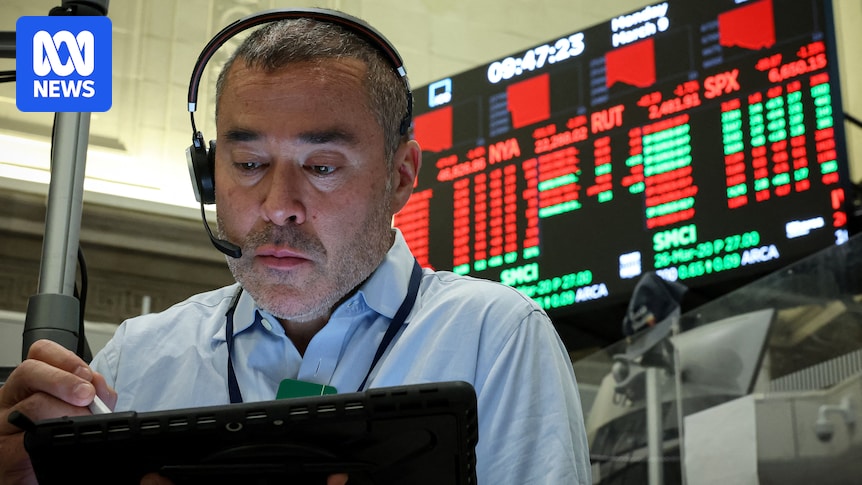
Plus ça change, plus c’est la même chose — a lot happened on the war front, but on the markets, it was more of the same.
As NAB’s head of FX strategy Ray Attrill said in a note this morning, “developments over the weekend, while no more disconcerting than at the end of last week, don’t offer any obvious pretext for a less pessimistic start to the new trading week”.
“Markets finished up at the end of last week with little ground for optimism towards an early cessation of military assaults by either side in the Iran war or for an early re-opening of the Straits of Hormuz,” Mr Attrill said.
Equities continued to tumble on Wall Street and in Europe, oil prices rose back above $US100/barrel — and may rise more after the weekend bombing of Iran’s Kharg Island oil hub — while the US dollar strengthened again as a perceived flight to safety.
S&P 500: -0.6%Dow: -0.3%Nasdaq: -0.6%Eurostoxx600: -0.5%Brent Crude: +2.7%
Anxiety over the war and the fears of higher oil prices fuelling inflation were the key drivers of sentiment across markets, with the global MSCI benchmark down 0.9% on Friday.
“Headlines are coming at the market like water from a fire hose, which is impacting the price of oil, and consequently, financial markets,” Federated Hermes head of fixed income Mitch Reznick told Reuters.
With Iran stepping up attacks across the Middle East as its new Supreme Leader Mojtaba Khamenei vowed to keep the Strait of Hormuz shipping lane closed, investors are bracing for a prolonged conflict and higher oil prices.
The spectre of rising inflation has led markets to rapidly reprice what they expect from central banks this year, with traders now anticipating just 20 basis points of easing from the Federal Reserve compared to 50 bps of cuts priced in last month.
Two-year Treasury yields, which typically move in step with Fed interest rate expectations, hit a six-month high on Thursday.
“US data didn’t go completely unnoticed Friday, despite the preoccupation with the Iran conflict and oil prices,” Mr Attrill said.
US Q4 GDP growth was revised down from 1.4% quarter-on-quarter to an insipid 0.7%q/q, with a slump in exports the key factor in the revision.
There were also downward revisions for consumer spending and business investment.
Elsewhere, the Personal Consumption Expenditures index, the Federal Reserve’s preferred inflation gauge, rose 0.3% in January on a monthly basis, in line with economists’ estimates.
“With markets laser-focused on oil prices and geopolitics, today’s numbers may mostly fly under the radar,” Ellen Zentner, Morgan Stanley Wealth Management’s chief economic Ellen Zentner said.
“Despite signs of economic softening, more sticky inflation data simply strengthens the idea that the Fed will remain on the sidelines.”
The stronger US dollar saw the Aussie dollar slip back under 70 US cents.
Global oil prices bounced around on speculation about an Indian tanker making it through the Strait of Hormuz.
Ultimately, the Strait remained closed, and the oil price rose.
Investment bank Goldman Sachs predicted that Brent oil would average more than $100 a barrel in March and $85 in April, as energy prices remain volatile due to the Iran war, damage to Middle East energy infrastructure and disruptions in the Strait of Hormuz.
Gold continues to lose a bit of its lustre, edging down again on Friday, giving up 2% over the week — the second successive weekly loss.
Copper on the London Metal Exchange dropped 1.8%, its third consecutive daily loss, on global demand worries.
Aluminium fell by more (-2.3%) hit by the strengthening US dollar quelling demand.
Iron ore rallied despite news that China would ease its ban on imports of BHP’s Jimblebar fines product in an attempt to push down prices.
With Reuters