
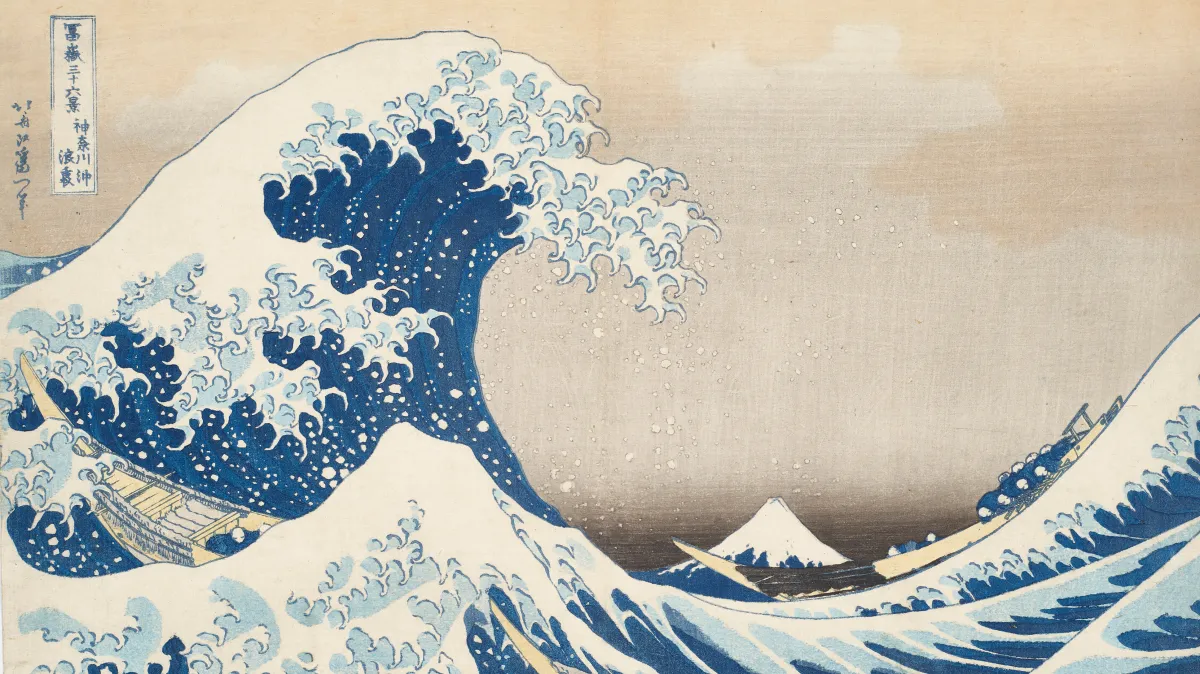
Imagine that you have been transported back in time to the booksellers’ district of Edo, modern-day Tokyo, in the 1830s. Browsing the stalls, your eye is caught by a print that has just hit the market. Three boats battle in a seething sea. A wave of water rises above them seconds from a capsizing crash. You rummage in the pouch tied to your kimono sash and pay the print-dealer 20 mon — about the same as for a bowl of soba noodles.
Last year an impression of Katsushika Hokusai’s Under the Wave off Kanagawa sold for $2.8 million, a record for the artist, at Sotheby’s Hong Kong. That’s a lot of noodles. Although about 8,000 impressions are thought to have been printed from Hokusai’s woodblocks, only 100 or so survive today.
Originals may now sell for millions, but you could drown under a tidal wave of “Great Wave” tat: totes, socks, ties, umbrellas, Thermos cups, even a Build-A-Bear teddy. If I were feeling overwhelmed by deadlines, I could text my editor a desperate Great Wave emoji. It is one of only two paintings — the other is Munch’s Scream — to make it into the official emoji lexicon.
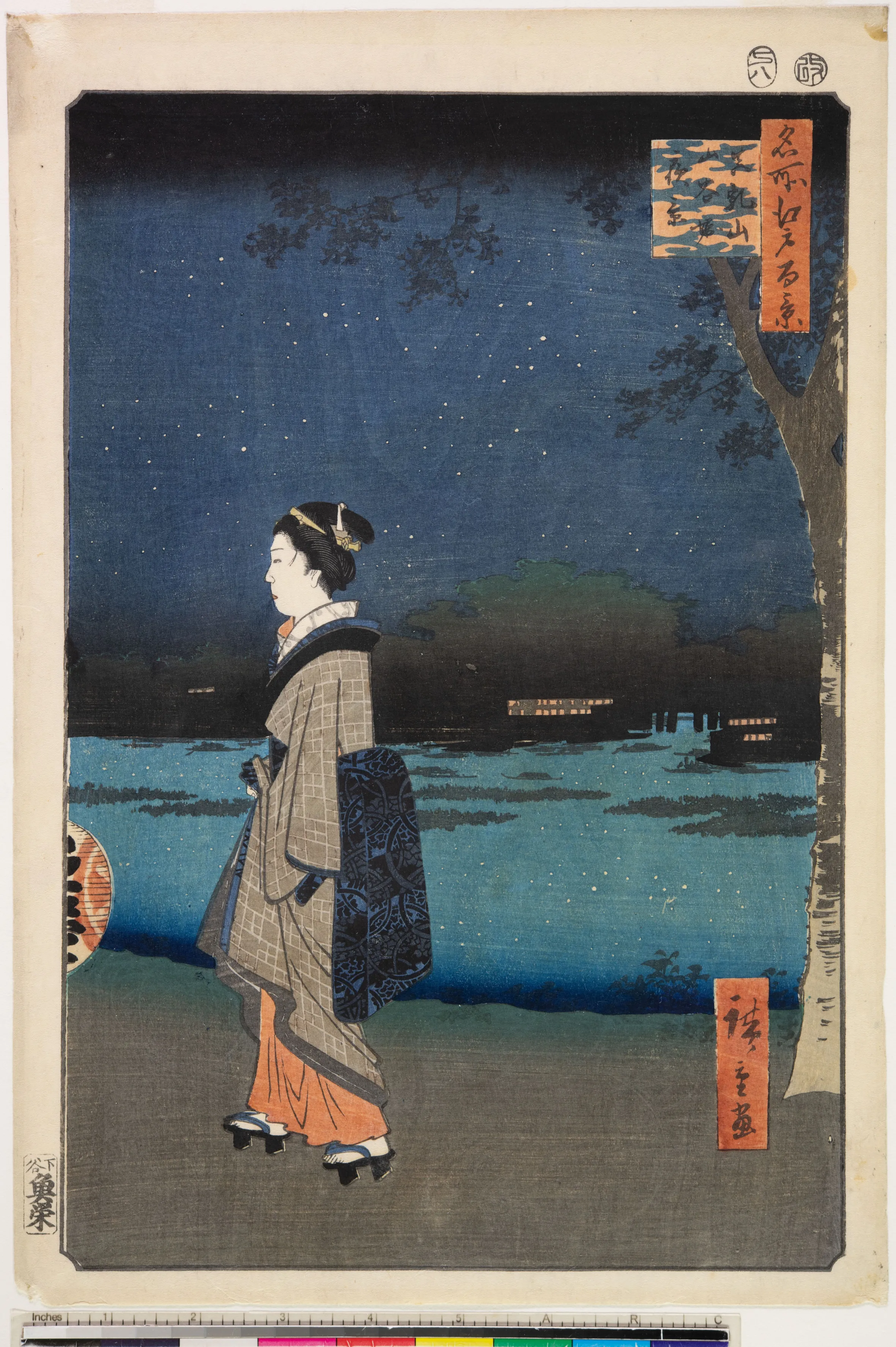 Hiroshige’s Night View of the Matsuchiyama and Sam’ya Canal (Matsuchiyama San’yabori Yakei), No. 34 from One Hundred Famous Views of Edo
We’re so used to seeing the Great Wave, we forget to look. Beneath the Great Wave: Hokusai and Hiroshige at the Whitworth gallery in Manchester introduces us to Hokusai’s most famous print as if we are encountering it for the first time. This perceptive, beautifully presented show is arranged across two rooms.
One room invites close comparison of the land and seascapes of Hokusai (1760-1849) and Hiroshige (1797-1858). The other, like one of Hokusai’s fishermen bent over roiling waters, casts its net wider to take in the city and characters evoked in “ukiyo-e” or “floating world” prints: images of sensual cosmopolitanism and hedonistic pleasure-seeking as here-today, gone-tomorrow as cherry blossom.
This is the world of geishas and actors, lanterns and moonlight, cross-dressing, role-playing and assorted concealments. In one print by Katsukawa Shunsho, a male actor tip-taps about in his costume, as mannered as any courtesan. In another, by Utagawa Kunisada, a band of women have taken over a printer’s workshop.
One incises the lines into a block, another cuts away the excess wood, a third prepares the paper for printing, a fourth rests between puffs on a pipe. It’s an elegant, romantic recreation of the reality of a busy studio with wood shavings on the floor and ink staining every surface.
It’s not a competition, but as with Turner and Constable at Tate Britain, you can’t help but compare. Hokusai surely wins on humour, only then you spot the poor palanquin bearers in a Hiroshige print staggering under the weight of a patron.
Hiroshige was the greater poet, softer, subtler, more attuned to nature and light, you think, until Hokusai makes you pull back your feet from the spray of a mountain cascade. I’ll have the lot — and a side order of soba noodles.
★★★★☆
Whitworth, Manchester, to Nov 15, whitworth.manchester.ac.uk