
Introduction This paper argues that Hezbollah’s decision to join the renewed 2026 war with Israel…
This paper argues that Hezbollah’s decision to join the renewed 2026 war with Israel is neither a simple act of “axis discipline” nor just an automatic extension of its traditional resistance role, but the product of a narrowing strategic corridor shaped by three forces: Iran’s confrontation with Israel and the United States, Hezbollah’s own evolving organizational identity, and a transformed Lebanese political context. This paper shows that Hezbollah entered this round from a weaker, more contested position than in past conflicts, and that the war is likely to accelerate a shift from “Iran’s northern army” to a more battered, localized insurgent actor.
This analysis proceeds in four steps. First, it dissects the mix of compulsion, miscalculation, and last‑stand logic that pushed Hezbollah from calibrated support fire into open war. Second, it compares Hezbollah’s current military and political posture to that of two years ago, highlighting how sustained Israeli pressure and internal Lebanese changes have eroded its “terrorist army” model. Third, it situates the conflict within Beirut’s emerging effort to reclaim a state monopoly on decisions of war and peace, including the Salam government’s unprecedented ban on Hezbollah’s military activities. Finally, it revisits and updates the scenarios previously outlined [BL1] for Hezbollah’s evolution by 2030, and concludes with concrete policy recommendations for Israel, Lebanon’s partners, and international actors seeking to weaken Hezbollah’s war‑making capacity without collapsing the Lebanese state.
Hezbollah’s decision to move from calibrated support fire into open war with Israel in 2026 did not flow automatically from its slogan of “resistance,” but from a convergence of pressures that narrowed its room for maneuver to the point where escalation became almost unavoidable. At the core stand three intertwined drivers: Iran’s strategic needs after the killing of Ali Khamenei, Hezbollah’s internal identity crisis between “Lebanon’s shield” and a strictly Shiite protector, and a deep misreading of how Israel and the United States would respond after the trauma of 7 October 2023. In a previous paper on Hezbollah’s future model toward 2030, it was argued that from Tehran’s perspective, Hezbollah has long been the forward defense line against Israel – a non‑nuclear substitute for a still‑uncertain Iranian deterrent and a core pillar of the “axis of resistance.”
That analysis framed a basic strategic question: as long as Iran lacks an operational military nuclear capability, it needs Hezbollah as a frontal defense in Lebanon; once it acquires that capability, its need to invest in Hezbollah’s military power may diminish. The 2026 Iran War compressed this long‑term logic into a crisis moment. Jerusalem and Washington’s strikes [BL2] on Iran and regime assets, culminating in Khamenei’s assassination, elevated the survival of the Islamic Republic itself to the center of the strategic game. Hezbollah’s leadership had spent months quietly rearming – drawing on a monthly budget estimated at around 50 million dollars, replenishing rockets and drones through Iranian funding and local production – precisely because it assessed a new confrontation with Israel as “inevitable” and potentially existential. Yet Hezbollah did initially try to stay below the threshold of full‑scale war. After Hamas’s 7 October attack, it chose a pattern of controlled harassment from 8 October 2023: anti‑tank fire, drones, and rockets calibrated to show solidarity with Gaza without triggering massive Israeli ground operations in Lebanon. The earlier 2030 paper highlighted how Hezbollah’s lessons from the Swords of Iron War included a recognition that tactical surprise is powerful but insufficient without the ability to sustain a long campaign. That paper also raised a core puzzle: if inter‑organizational cooperation is a doctrinal “lesson,” why did Hezbollah and Hamas not act together on 7 October itself? The answer emerging from both that previous work and current events is that Hezbollah sought to hedge – to preserve the credibility of the “resistance axis” while avoiding an all‑out war that could devastate Lebanon and risk the movement’s material base.
This hedging strategy misjudged the transformed Israeli calculus after 7 October. In an earlier analysis of Hezbollah’s wartime learning, it was shown how the movement had drawn extensive lessons about Israel’s ability to adapt rapidly, to absorb shocks, and to fight long wars while mobilizing public resilience, and how it gradually abandoned the simplistic “spider web” myth. In the 2023–24 northern front and the renewed 2026 war, Israel demonstrated not only technological and operational adaptability but also a political determination to “finish the job” against Hezbollah, with its leadership openly speaking of full disarmament as a war aim. Hezbollah’s calibrated fire thus triggered a much more expansive Israeli response than it had anticipated, especially once its own attacks were framed as part of a broader Iranian war. If the first driver is Iranian, the second is deeply Lebanese. Over three decades, Hezbollah has evolved from a clandestine militia into a semi‑institutionalized actor embedded in parliament, government, and key state sectors, particularly the Shiite communities of the South and the Bekaa. An organizational‑identity study previously authored on Hezbollah’s institutionalization described how its leadership cultivated a dual identity: “Lebanon’s shield” against Israel and a sectarian protector of Shiites in a fragile consociational system. The devastating economic collapse from 2019, the 2020 Beirut port explosion, and the 2019–20 protest movement eroded Hezbollah’s image as a clean, effective outsider and associated it instead with the corrupt political class, forcing it to work harder to justify its weapons and independent decision‑making. In this context, sitting out the Iran war while Israeli forces struck Iranian assets and Lebanon itself would have risked a narrative collapse: a “resistance” that did not resist, and a “shield” that failed to protect. The fact that tens of thousands of Shiites remained displaced after the 2024 conflict, dependent in part on Hezbollah‑channeled Iranian aid, further bound the movement to its constituency and to the axis that funds it. The third driver is psychological and organizational. The previous 2030‑model paper analyzed Nasrallah’s purported “letter of succession” to his successor, emphasizing his insistence that surprise is a powerful weapon but also that the next leader must invest in civil resilience, technological modernization, and strategic flexibility. The current leadership, operating without Nasrallah’s unique charisma, faced a moment that looked like a test of that legacy. Reports suggest that elements within Hezbollah were surprised by the speed and scope of the decision to escalate in March 2026, yet the group had re‑deployed elite Radwan forces southwards and rebuilt stockpiles precisely for a “fight to the last breath.” In this sense, Hezbollah did not stumble into war; it chose escalation under conditions that its own prior strategic choices had made extremely hard to refuse.
Two years ago, Hezbollah marketed itself as a hybrid between a state army and a guerrilla movement: a disciplined “terrorist army” with regional reach, precision weapons, cross‑border raid capabilities, and politico‑religious legitimacy reaching well beyond Lebanon. The previous assessment of “Hezbollah Model 2030” described this self‑image as the culmination of a long transition from clandestine terrorist group to “terrorist army,” and noted that the organization itself had begun to question whether battlefield realities truly justified this label. The war cycles since October 2023 and especially the current 2026 campaign have significantly eroded this model, pushing the organization closer to a battered insurgency than to an unbeaten “resistance army,” even if its core force remains substantial. Militarily, the organization has absorbed heavy blows. Israeli operations since late 2023 have systematically targeted Hezbollah’s long‑range strike infrastructure, command‑and‑control nodes, and senior cadre. The earlier 2030 paper detailed how Hezbollah invested in precision missiles, advanced UAVs, encrypted communications, and real‑time battle management systems as tools to overcome Israel’s technological edge. It also underlined the significance of the Israeli attacks on pagers and radios during the Swords of Iron War, which constituted a major blow to morale and C2 resilience. The renewed war has intensified this dynamic: Israeli strikes have hit Radwan training bases and weapons depots, while the group has reportedly lost around 5,000 fighters in earlier rounds, a serious attrition even if it still fields tens of thousands of combatants. Current external assessments thus converge with the paper’s previous argument: Hezbollah is “greatly diminished” but “still dangerous” – its ability to project power across the region is curtailed, but its capacity to harass Israel and destabilize Lebanon persists. The technological race has cut both ways. Hezbollah has successfully replenished part of its rocket and drone arsenal through domestic production and continued Iranian support, positioning new rockets and logistical material in the South before the latest escalation. At the same time, the very emphasis on sophisticated, networked capabilities has made it more vulnerable to Israeli cyber, SIGINT, and precision strike campaigns aimed at degrading its communications and leadership. An earlier analysis of Nasrallah’s guidance argued that technology must serve flexibility and resilience, not create new single points of failure; the current war shows how hard that is to implement under sustained Israeli pressure and shrinking safe havens in Syria. Politically, the contrast with two years ago is just as stark. The organizational‑evolution study traces Hezbollah’s long path of “restrained institutionalization”: entering elections from 1992, gradually increasing its parliamentary share, joining governments, and positioning itself as both a resistance movement and a key player in state institutions. The 2009 “political document” reframed the organization as a Lebanese actor that accepts the Taif Agreement and the pluralist system, while reserving an exceptional status for its weapons. This duality – state participant and armed non‑state actor – has now come under unprecedented challenge. The Nawaf Salam government, formed in early 2025, deliberately dropped the explicit “resistance” clause from its policy statement, re-emphasizing the state’s sole authority over war and peace and “no weapons but those of the legitimate forces.” While Hezbollah and its allies still secured ministerial posts, the symbolic shift signaled an emerging “post‑Hezbollah” language in official discourse, even as the movement retains veto power over certain decisions. The war has also eroded deterrence in complex ways. On one hand, Hezbollah has demonstrated that it can still hit northern and even central Israel with rockets, drones, and missiles, and that it remains willing to escalate in defense of Iran and in response to Israeli incursions into Lebanese territory. On the other hand, Israel has shown a willingness to accept significant escalation and even seize territory in southern Lebanon to push Hezbollah north of the Litani and to enforce a de facto buffer zone. Earlier work on Hezbollah’s learning from Swords of Iron concluded that the organization had come to see Israel as a state with high resilience and adaptive capacity, rather than as a brittle “spider web”. The current conflict reinforces that lesson: Hezbollah’s deterrent value as an existential threat to Israel has diminished, while its role as a persistent but containable insurgent foe has grown. Finally, the organization’s internal identity tensions have sharpened. The 2030 paper highlighted a growing strain between “Lebanon’s shield” and “Shiite shield,” and questioned whether, without Nasrallah and with increased U.S. and French involvement, the movement could maintain the same strategic flexibility.
Wartime recruitment difficulties, continued displacement of Shiite communities, and potential competition from alternative Shiite and cross‑sectarian actors are all signs that Hezbollah has moved from an uncontested hegemon of its community towards a more fragmented, contested position.
The renewed war is not occurring in the same Lebanon that produced Hezbollah’s rise in the 1980s and consolidation in the 1990s–2000s. It is taking place in a state in deep multi‑dimensional crisis – economic, political, social, and institutional – but also in a political system that, for the first time in decades, has formally challenged Hezbollah’s doctrinal status as “the resistance.” Politically, the formation of the Salam government in early 2025 marked an inflection point. For the first time in roughly twenty‑five years, the ministerial statement omitted the classic “army, people, resistance” formula that successive cabinets had used to justify Hezbollah’s independent arsenal and operational autonomy. Instead, it stressed the unity of state authority and the exclusive legitimacy of official armed forces in matters of defense and sovereignty. Hezbollah’s bloc nevertheless granted the government confidence, reading clauses on “Lebanon’s right to self‑defense” as a residual legal basis for resistance, but the symbolic downgrade was unmistakable. The previous institutional‑analysis paper treated such moves as part of a broader “Lebanonization” of the Hezbollah question – a shift from an untouchable axis of national consensus to a problem to be managed through state institutions and external guarantees – and the current war is accelerating that trend. At the societal level, public anger has grown. The 2019–20 protest movement, cutting across sectarian lines, explicitly targeted the entire political class, including Hezbollah, for corruption, clientelism, and mismanagement. The catastrophic economic collapse, with soaring poverty and currency devaluation, weakened the movement’s ability to present itself as an efficient alternative and tied it more visibly to the failing system it helped sustain. The current war has added a new layer of resentment. Hundreds of thousands have been displaced in the South and the Bekaa; infrastructure and homes are again being destroyed, and many Lebanese perceive Hezbollah’s decision to enter the Iran war as “dragging” an already broken country into another disaster to serve an external agenda. While Hezbollah’s core Shiite base still depends heavily on its welfare networks and sees it as a protector, the broader cross‑sectarian tolerance for its weapons is eroding. External actors are exploiting and shaping these trends. Western and Gulf states have conditioned serious reconstruction aid and IMF‑linked assistance on structural reforms and, implicitly, on curbing Hezbollah’s freedom of action. Israel’s stated objective of full disarmament is unlikely to be achieved militarily in the short term, but it sets a high benchmark for any post‑war arrangement, whether through UN frameworks, expanded UNIFIL mandates, or direct security understandings involving European and Arab states.
The previously mentioned 2030 scenarios outlined several possible future shocks – renewed civil war, a strong anti‑Hezbollah political movement, an ISIS‑like spill‑over from Syria, or deeper U.S./Russian involvement – all of which would transform Hezbollah’s operating environment; the present trajectory suggests a mix of gradual external constraint and internal contestation rather than a single dramatic rupture. The paradox is that Hezbollah is fighting the 2026 war at the very moment when Lebanon is, at least rhetorically, trying to imagine a post‑Hezbollah security order. This does not mean the organization will disappear. It means that the political and normative foundations of its exceptional status, the cornerstone of its “restrained institutionalization,” are being chipped away even as it expends blood and resources to defend that status against Israel and to support Iran.
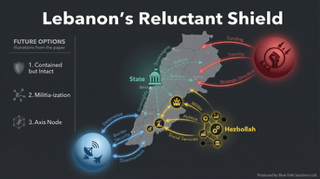
Looking towards 2030, the current war is best understood not as an end but as a catalyst. Building directly on the scenarios developed in the “Hezbollah Model 2030” paper and updating them with today’s dynamics, three broad trajectories stand out: a contained but intact Hezbollah subordinated to a stronger state, a fragmented militia‑ization within a failing Lebanon, or a reconfigured axis node whose local hegemony shrinks even as its value to Tehran remains high. In the first scenario, international pressure and domestic exhaustion produce a stronger Lebanese state that gradually asserts more control over security decision‑making, while co‑opting Hezbollah into a more explicit “party with arms” model. The Salam government’s doctrine of state monopoly over force, combined with conditional reconstruction aid and security guarantees along the border, could push Hezbollah to accept formal limitations on its deployment and an incremental integration of parts of its military wing into state structures, especially if Iran recalibrates its regional posture after the war. Hezbollah would remain armed and influential but would act more like Iraq’s major Shiite factions: powerful yet operating within a more defined institutional framework. In the second scenario, Lebanon’s multi‑dimensional crisis deepens, reforms stall, and external support fragments. Here, the 2030 paper’s warnings about a “disintegrating state” and the risk of renewed civil war become central. Under such conditions, Hezbollah’s remaining arsenal and networks could devolve into more parochial structures: territorial militias, economic protection rackets, and factional security forces aligned with local leaders rather than a central command. Analysts already caution that the heavy losses, recruitment challenges, and need to rely on local production might push the movement towards more decentralized, less disciplined forms of armed presence. This outcome would confirm an argument made previously: that Hezbollah’s organizational flexibility could, under intense external and internal pressure, flip from being a strength to being a pathway into fragmentation and criminalization.
In the third scenario, Hezbollah becomes more important to Tehran than to Beirut. The earlier 2030 analysis explicitly raised the problem of “Hezbollah without Assad” and questioned how the movement would function if Syrian support weakened and Iranian priorities shifted. The 2026 Iran War has shown both the risks and the limits of Hezbollah’s direct involvement: it escalated in response to Khamenei’s killing, making clear its role as a core axis asset, yet Lebanon’s government formally banned non‑state military activity and sought to distance itself from the war’s rationale. Future Iranian strategy may aim to preserve Hezbollah as a long‑range harassment tool and deterrent against Israel, even if that means tolerating a reduction in its domestic dominance and a more contested legal status in Lebanon. Hezbollah 2030, under this logic, could be simultaneously a weaker Lebanese party and a still‑central Iranian proxy. Across all scenarios, the themes in Nasrallah’s “letter of succession” are strikingly relevant: the need to learn from the limits of surprise, to invest in civilian resilience, to integrate technology wisely, and to preserve unity inside Lebanon as much as within the Shiite community. Whether his successors can translate these lessons into organizational adaptation, under conditions of sustained Israeli pressure, shifting Iranian calculations, and a more assertive Lebanese state, will determine not only Hezbollah’s future, but Lebanon’s and Israel’s security environment well beyond the current war.
For Israel
1. Exploit, don’t collapse, Lebanese state capacity
Israel should calibrate its military pressure to keep degrading Hezbollah’s long‑range and C2 capabilities while avoiding large‑scale strikes on core state institutions, which would undercut the Salam government’s emerging effort to assert a monopoly over war and peace. Targeting LAF or central government infrastructure would weaken the very actor that is now formally banning Hezbollah’s military activities and implementing a phased disarmament plan north of the Litani.
2. Anchor any ceasefire in Lebanese and international mechanisms
Any eventual ceasefire should be tied to concrete benchmarks for LAF deployment, phased Hezbollah redeployment, and border monitoring, backed by an expanded UNIFIL mandate and European participation, rather than relying solely on informal understandings with Hezbollah. This would reinforce the shift documented in earlier work, from acceptance of Hezbollah’s “exceptional” role toward a state‑centered security architecture.
3. Prepare for a weaker but more fragmented Hezbollah
Israeli planning should assume a future in which Hezbollah is less capable of large‑scale conventional rocket warfare but more prone to cross‑border raids, terror plots abroad, and activation of proxy micro‑groups along the frontier. This requires reinforcing civilian defense, counter‑terrorism, and intelligence coordination, rather than assuming that degrading Hezbollah’s current arsenal ends the threat.
For Lebanon and its partners
4. Back the state’s monopoly on force with real resources
International actors should translate their rhetorical support for Salam’s ban on Hezbollah’s military activities into accelerated budgetary and training support for the LAF and internal security forces, conditioned on transparent implementation of the disarmament plan south of the Awali. As argued in the institutionalization study, only a state that delivers basic security and services can credibly challenge Hezbollah’s “protector” narrative.
5. Sequence economic relief with security benchmarks
Western and Gulf financial support and IMF programs should be phased against verifiable steps: extension of LAF control, removal of heavy weapons from designated zones, and legal measures limiting non‑state armed activity. This sequencing can reinforce the domestic shift away from the “army, people, resistance” formula analyzed in earlier work.
6. Invest in Shiite-sector resilience and alternatives
Donors should channel part of their assistance directly into municipalities, NGOs, and service‑delivery structures in Shiite‑majority areas, reducing exclusive dependence on Hezbollah’s welfare networks. Over time, this can open political space for alternative Shiite leaderships and make it easier for local communities to accept constraints on Hezbollah’s military role.
For the United States and Europe
7. Integrate Iran and Hezbollah tracks without making Lebanon a bargaining chip
While US‑Israeli pressure on Iran will inevitably shape Hezbollah’s calculus, negotiations and coercive measures should avoid treating Lebanon as expendable collateral. As the 2030 paper showed, a scenario in which Hezbollah becomes primarily an Iranian asset with diminished local legitimacy is particularly dangerous for Lebanese stability and for Western interests in the Eastern Mediterranean.
8. Sustain long‑term attention beyond the immediate war
Weakening Hezbollah’s armed capacity without strengthening Lebanese institutions would simply invite another armed non‑state actor to fill the vacuum. Western policy should therefore treat the current disarmament push as the beginning of a decade‑long state‑building and governance effort, not as a short‑term crisis management exercise.