
Tree canopy needs to be close to homes, workplaces and public spaces to be effective as a countermeasure to extreme heat; homes surrounded by unshaded concrete and asphalt are vulnerable, even if they happen to be in suburbs or municipalities with high average levels of canopy. A Wisconsin-based study by Ziter et al. (2019) found that canopy cover exceeding 40%, within 60 m of housing, was needed to provide significant cooling effects2. Studies in Germany have shown similar results. When canopy exceeds 30–40%, shading and evapotranspiration effects begin to significantly lower both surface and air temperature in the immediate surroundings at levels that ensure adequate physiological cooling of humans3.
While cities vary in their overall canopy cover, with some achieving totals around 30–40%, recent studies in Europe, South-East Asia, Australia and the USA have highlighted that much of this canopy is not close enough to homes to offer effective cooling. A large majority of urban residents live and work in buildings that fall far short of even 30%4,5,6,7,8. This shortfall of canopy coverage often occurs in low-income neighbourhoods subject to chronic disinvestment, an environmental injustice which further compounds the risks posed by heatwaves9. This is a striking finding when considering the sharp heat fluxes of unshaded surfaces in urban settings; while these vary across climates (e.g. air and soil dryness)10, the basic thermal gain associated with such large areas of unshaded asphalt and concrete, aggravated by the lack of cooling from transpiration when leaf cover is low, amounts to a significant heat risk to human health. Urgent as it is, rollout of canopy must occur thoughtfully, avoiding potential pitfalls such as night-time ‘heat trapping’ in narrow, poorly ventilated street canyons11.
An important challenge is that the gaps between street trees in urban areas are often too large to overcome these heat fluxes. In a study of five global cities (Ottawa, Stockholm, Paris, Buenos Aires, and Washington DC), Smart et al. (2020) found planting density to be in the range of 1.0 to 10.6 trees per 100 m of street segment length12—a very low planting density in design terms. Ten trees per 100 m of street (noting that this figure includes both sides of the street) represents a spacing of 20 m between trees on each side of the street. Figure 1 shows a 100 m street segment; in the top example (Fig. 1a), we see roughly 10 trees per 100 m, which is the high end of commonly observed densities. Below, in Fig. 1b, we show how using simple, common approaches (such as median planting, tree placement between parking areas, and footpath planting at 6 m spacing) can achieve 48 trees per 100 m all while retaining gaps of at least 6 m between trees on footpaths, and without loss of parking or lane viability.
Fig. 1: Demonstration of Typical vs. Achievable planting density.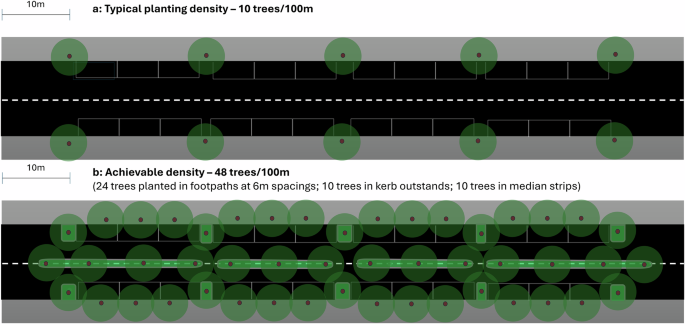
The streetscape designs below the plot demonstrate a 100 m street segment showing the high end of commonly-observed planting density (a), and achievable planting density (b). A density of 48 trees/100 m is achieved using common approaches such as median planting, tree planting between parking areas (outstands), and footpath planting with relatively close (6 m) spacing.
The differences between these built outcomes are considerable in terms of heat adaptation. Compared to shaded asphalt, temperatures of unshaded asphalt can exceed 40 degrees (Celsius). Dense canopy is especially effective as a heat response, offering much stronger thermal comfort outcomes than sparser canopy. A study in Germany found that dense canopy in urban environments can reduce temperatures experienced by humans by 11 °C, compared to only 4 °C with sparse canopy coverage13.
Canopy sparseness partly reflects the modest budgets assigned to municipal forestry departments, which effectively preclude more ambitious streetscape works (e.g. those requiring more excavation or changes to drainage). However, the large gaps between trees are also the hallmark of a more subtle, bureaucratic barrier to tree canopy expansion. Trees continue to be afforded low priority in streetscape design decisions. It is common that buried utilities, driveways, sightlines and signage are all treated as reasons to exclude trees, often through the application of very large ‘no plant zones’ around these common urban features14. This is driven by a culture of risk exclusion (often by actors with siloed interests and accountabilities) rather than one of comprehensive risk management in the public interest. Addressing conflicts between tree planting and utilities requires greater use of physical solutions such as root barriers and utility conduits, as well as changes in regulatory standards that minimise conflict and prioritize win-win design solutions. More broadly, a re-framing of these utility-related risks is necessary, to recognise tree exclusion as an inherently unacceptable ‘solution’ given the growing evidence that underscores the role of urban trees in the welfare of urban residents9,15,16.