
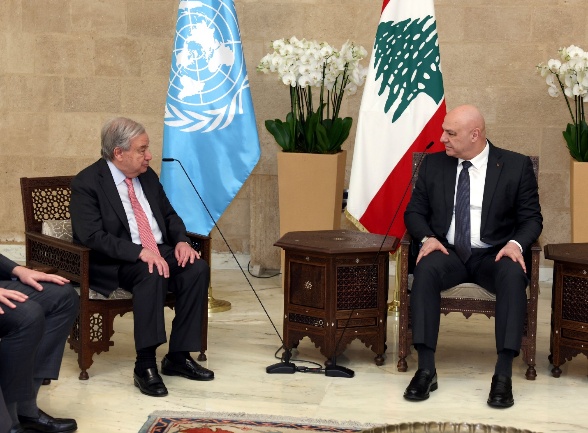
 Combat equipment seized during activity in south Lebanon (IDF spokesperson, March 14, 2026)
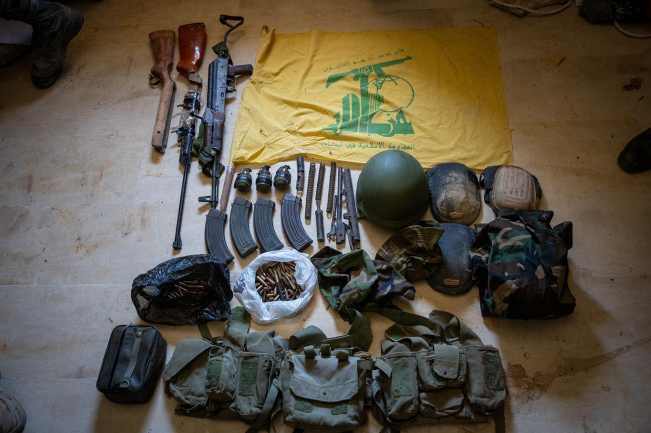
 Na’im Qassem in a speech (website of the Hezbollah secretary general, March 13, 2026)
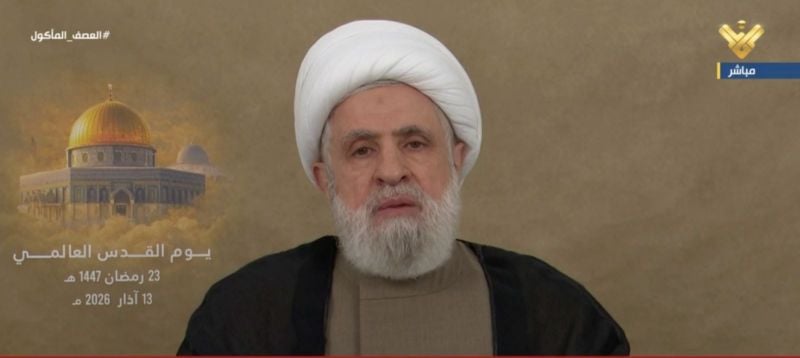
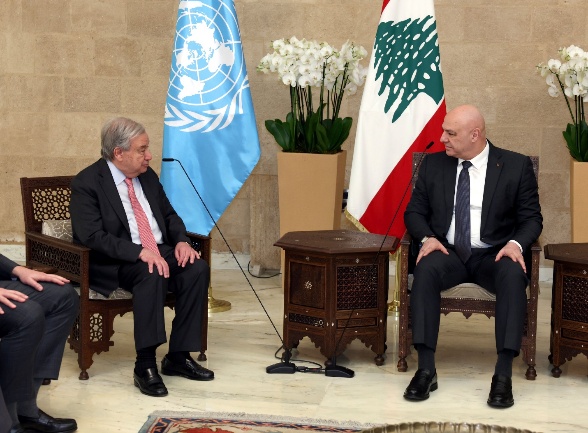 Aoun and Guterres meet (X account of the Lebanese presidency, March 13, 2026)
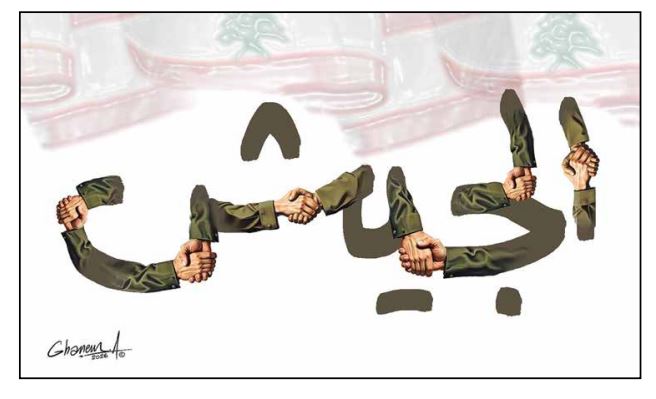 The cartoon reads “Lebanon,” composed of hands shaking one another in military uniforms, symbolizing unity and cooperation among the citizens of the state around the military institution (al-Jumhuriya, March 14, 2026)Overview[1]
IDF forces continued attacking Hezbollah targets in Lebanon from the air and eliminated terrorist commanders and operatives, including the commander of the Nasr Unit, as well as operatives linked to Iran and Palestinian terrorist organizations operating in Lebanon. The forces continued ground activity in south Lebanon to locate and destroy weapons and terrorist infrastructure and assets. Evacuation notices were issued in south Lebanon and in neighborhoods in the Dahiyeh al-Janoubia in Beirut.
Hezbollah claimed responsibility for more than 180 attacks on civilian, military and security targets in Israel and on IDF forces in south Lebanon using rockets, missiles and unmanned aerial vehicles, some of the attacks simultaneous with missile and UAV launches from Iran. Hezbollah did not report home many of its operatives were killed, but the IDF spokesperson stated that more than 350 had been eliminated since the beginning of the hostilities on March 2, 2026.
Hezbollah secretary general Na’im Qassem claimed the conflict was “defensive” in response to Israeli “aggression” and part of the campaign by Israel and the United States against Iran. Qassem and other Hezbollah figures said they were prepared for a long conflict and would fight until they had achieved their objectives.
The president of Lebanon, Joseph Aoun, is promoting an initiative to open direct negotiations with Israel to end the fighting and regulate the security situation on the border. The Shi’ite speaker of the Lebanese Parliament, Nabih Berri, said he supported the initiative but progress depended on a ceasefire and the return of the displaced to their homes.
The Lebanese government continued to place responsibility for the new crisis on Hezbollah and noted the obligation of the state’s monopoly over weapons. The minister of information prohibited the National News Agency from referring to Hezbollah as “jihad fighters” or “resistance.”
The president of Lebanon and the speaker of parliament said the supported the army commander, Rodolph Haykal, after opponents of Hezbollah were reportedly taking action to remove him.
Lebanese authorities stated that at least 850 people had been killed since the beginning of the Israeli attacks and that nearly one million people had been displaced.
UNIFIL reported that “non-state armed organizations” almost shot UN forces in south Lebanon in three separate incidents. There were no casualties.
The Fighting in Lebanon
The IDF
This past week the IDF attacked Hezbollah terrorist targets throughout Lebanon from the air and on the ground (IDF spokesperson, March 9-16, 2026):
Attacks on Hezbollah infrastructure and elimination of commanders and operatives: The IDF carried out hundreds of aerial attacks on Hezbollah targets in various areas in Lebanon, especially in south Lebanon, the Beqa’a Valley and the Dahiyeh al-Janoubia in Beirut. The forces attacked military headquarters, most of them located within concentrations of the civilian population, buildings of the al-Qard al-Hassan Association (Hezbollah’s financial arm), weapons warehouses, rocket and missile launchers and strategic sites. Many attacks were directed against Radwan Force headquarters and operatives. Bridges over the Litani River were attacked to prevent Hezbollah terrorists from moving to south Lebanon. Hezbollah commanders were also eliminated, including the commander of the Nasr Unit in south Lebanon and commanders in the Badr Unit, field commanders, commanders in the Radwan Force and terrorist operatives who shot at IDF forces and Israeli territory. According to the IDF, since the beginning of the hostilities more than 350 operatives were eliminated.
Ground activity: IDF ground forces continued the establishment of a forward defensive zone in south Lebanon to distance Hezbollah from the border and reduce the organization’s ability to fire rockets and UAVs at northern Israel. According to reports, on March 16, 2026 the activity was expanded to enlarge the defensive zone. Hezbollah terrorists identified in the area were eliminated and stockpiles of rockets and weapons, launchers, headquarters, observation posts and additional terrorist infrastructure were located and destroyed.
Combat equipment seized during activity in south Lebanon (IDF spokesperson, March 14, 2026)
Evacuation notices: To reduce harm to the local population, the IDF spokesperson in Arabic issued evacuation notices to residents in Hezbollah strongholds throughout the country. Previous evacuation instructions for Lebanese living in south Lebanon and in the Dahiyeh al-Janoubia were repeated, and Lebanese living between the Litani River and the al-Zahrani River were also required to move northward. Evacuation notices were issued for neighborhoods in the Dahiyeh al-Janoubia, as were warnings before attacks targeting buildings in various areas in Lebanon.
Other eliminations: The IDF continued to attack Iranians assisting Hezbollah, including the elimination of a commander from the Iranian Revolutionary Guards who operated in Hezbollah’s missile unit and the commander of the Imam Hussein Division and his deputy.[3] A Palestinian terrorist operative who for Iranian intelligence and an operative in the Hamas branch in Lebanon were eliminated.
Hezbollah Activity[4]
This past week Hezbollah continued attacking targets in Israel and IDF forces in south Lebanon (Hezbollah combat information Telegram channel, March 9-15, 2026):
From March 9 (12:00 noon) until March 16, 2026 (12:00 noon), Hezbollah claimed responsibility for 189 attacks on military, security and civilian targets in Israel and on IDF forces in south Lebanon using UAVs, “precise” missiles, rockets, anti-tank missiles, artillery shells and anti-aircraft fire, along with exchanges of fire with IDF forces in south Lebanon. Hezbollah claimed responsibility for attacking targets in central Israel, such as the Tel HaShomer and Glilot bases, although not all cases received official Israeli corroboration. On March 9 the satellite station in the Elah Valley was attacked.
On March 11, 2026 Hezbollah announced that the war against Israel had been given the name “The Eaten Chaff.”[5] A source in the Hezbollah leadership stated that the announcement reflected the continued readiness of the “resistance” for confrontation despite the Israeli attacks. The source added that Hezbollah’s concept for the confrontation was one of prolonged struggle and the organization was prepared to confront any attempted Israeli ground advance (X account of al-Jazeera, March 14, 2026).
According to a statement issued by the Iranian Revolutionary Guards on the evening of March 11, 2026, the 40th wave of attacks of Operation True Promise 4[6] was “a joint, coordinated operation between the Revolutionary Guards and the Lebanese resistance,” which included “intense attacks” of Hezbollah UAVs and rockets and Iranian missiles, thereby “imposing a new situation on the enemy” (al-Manar, March 11, 2026). The director general of the Lebanese foreign ministry, ambassador Abd al-Sattar Issa, summoned Tawfiq Samadi Khoshko, responsible for relations at the Iranian embassy in Lebanon, and raised Lebanese reservations regarding statements by the Iranian Revolutionary Guards about joint operations with Hezbollah (al-Jumhuriya, March 13, 2026).
Hezbollah did not issue the names of its senior figures and operatives who were killed in IDF attacks, but social media accounts, including unofficial accounts affiliated with Hezbollah, uploaded pictures of more than 200 operatives who were killed in Israeli attacks during the past week. An obituary was published for the death of Ramadan Hassan Salama, who commanded the Nasr Unit (X account of QalaatM and Telegram channels South Lebanon, Watching the Enemy and Hezbollah in the Field, March 9-16, 2026).
According to reports, Hezbollah concentrated operatives along the border with Syria, from the area of al-Nabi Chit to al-Hermel in the Beqa’a Valley, in preparation for a possible Syrian action (Nidaa’ al-Watan, March 11, 2026). Lebanese Shi’ite political figures told the president of the country, Joseph Aoun, that they were concerned about possible developments on the Lebanese-Syrian border. They warned of reports that the president of Syria, Ahmed al-Sharaa, might consider opening a front against Hezbollah along the border between the two countries (Lebanon Debate, March 14, 2026).
Hezbollah
In a speech for World Jerusalem Day, Hezbollah secretary general Na’im Qassem said the organization’s leadership had held three separate discussions regarding a response to the “aggression,” but had decided that the timing was inappropriate and that another opportunity should be given to diplomacy. However, the understanding that the Israeli attacks would not stop, the killing of Iran’s leader Khamenei and the fighting against Iran led them to decide on a “defensive confrontation.” He added that “the Israeli-American aggression is the reason for what is happening, and the resistance is a response,” while accusing the Lebanese government of failing to defend the state’s sovereignty. Qassem declared that the Hezbollah was prepared for a prolonged campaign and said they would not stop because it was an “existential battle” (al-‘Ahed, March 13, 2026).
Na’im Qassem in a speech (website of the Hezbollah secretary general, March 13, 2026)
A source in Hezbollah said they had entered the current hostilities “with everything they had,” calling it a decisive “struggle” which would end either with the end of Hezbollah or with a “new equation” and a full Israeli withdrawal from Lebanon and the cessation of attacks. He said the decision to enter the hostilities had been made months earlier, but was implemented only after a significant regional development, the war between the United States and Israel and Iran, which created more “favorable strategic conditions” (al-Jumhuriya, March 14, 2026).
Qassem sent a letter to congratulate Mojtaba Ali Khamenei following his selection as the new leader of Iran after the elimination of his father, Ali Khamenei, at the beginning of the Israeli-American attack. Qassem said he saw his leadership as a continuation of the path of Imam Ruhollah Khomeini and Khamenei, adding that Hezbollah drew inspiration from the Islamic Revolution in Iran and noting the organization’s commitment to continuing the path of the “resistance.” In the name of the organization’s leadership and its fighters, he pledged his loyalty to the alliance with Iran’s leadership and prayed for Khamenei’s success in leading Iran and the “oppressed peoples” (website of the Hezbollah secretary general, March 11, 2026).
Hezbollah expressed its commitment to continuing the fighting and its perception of the campaign as part of a broader regional struggle of the “resistance axis”[7] which was not expected to end soon. It noted its support for Iran and for the “resistance” forces in the region and said Hezbollah would not withdraw from its positions or stop its military activity as long as the Israeli attacks in Lebanon continued:
The deputy chairman of Hezbollah’s political council, Mahmoud Qamati, claimed Iran had not asked the organization or the “resistance” forces in the region to assist it in the confrontation with Israel and said that Iran was defending itself. He said that for months Hezbollah had been patient with the Israeli attacks but decided to respond when the opportunity arose, as it had in the Israel-Iran war. Qamati said the organization would continue “resistance” activity and would not stop until the Israeli attacks stopped. He said Hezbollah had changed its security patterns and reduced the use of digital communications to prevent Israeli intelligence penetration (Arabic Rudaw, March 12, 2026).
In a message for World Jerusalem Day, the Hezbollah faction in the Lebanese Parliament stated that the ongoing regional confrontation and the war against Iran reflected the significance and objectives of World Jerusalem Day as presented by the founder of the Islamic Revolution, Khomeini. The faction reiterated its support for Iran, its leadership and its solidarity with the Palestinian people and the “resistance”[8] forces (al-‘Ahed website, March 12, 2026).
Hussein Jashi, a member of the Hezbollah faction in the Lebanese Parliament, said the war against Israel was “a struggle of ups and downs,” adding that Hezbollah would not change its position or path until it had achieved its objectives. He accused Israel of trying to compensate for its failure on the battlefield by attacking civilians (Lebanon Debate, March 12, 2026).
According to reports, Hezbollah ordered business owners and residents in several neighborhoods in Beirut to turn off private security cameras and disconnect them from the internet, apparently to reduce enemy surveillance and intelligence capabilities. Security sources in Lebanon warned that such actions could significantly harm law enforcement capabilities, since security cameras were central to solving crimes, especially during the period of high population density caused by waves of internal displacement (al-Sharq al-Awsat, March 15, 2026).
The Lebanese Government
Diplomatic Efforts to End the Fighting
In an attempt for a political solution to end the fighting and prevent further escalation, the president of Lebanon, Joseph Aoun, presented a framework for a full ceasefire, an Israeli withdrawal, strengthening and deploying the Lebanese army in the border areas and afterward opening direct talks between Lebanon and Israel under international supervision. Reportedly, Lebanon also began examining the appointment of a negotiating delegation which would participate in talks if political agreement were reached (al-Sharq al-Awsat, March 13, 2026:
The prime minister of Lebanon, Nawaf Salam, noted that Beirut, south Lebanon and the Beqa’a Valley were under attack and said Lebanon had not sought the war but was working to end it. He said Lebanon could not again become an arena for other people’s wars, adding that the president had launched a diplomatic initiative to advance negotiations to end the fighting (X account of the Lebanese prime minister, March 12, 2026).
The speaker of parliament, Nabih Berri, said he supported the president’s efforts. However, he said the composition of the negotiating delegation, and especially the possibility of including a Shi’ite representative in it, depended on achieving a ceasefire (al-Diyar, March 14, 2026). On another occasion he said that a positive position on his part regarding the initiative and progress on the matter were linked to the fulfillment of the conditions of the ceasefire and the return of the displaced to their homes. He noted that he remained committed to the implementation mechanism of the ceasefire agreement as the basic framework for ending the fighting and supervising the situation on the border (al-Sharq al-Awsat, March 15, 2026).
An official source in Lebanon said Beirut continued preparations for a negotiating delegation which would examine the possibility of holding talks with Israel. According to the source, several European countries welcomed the Lebanese initiative, while Lebanon was waiting for the position of the United States. The source added that Lebanon conditioned negotiations on a ceasefire, and stated its commitment to UN Security Council Resolution 1701. Reportedly, the possibility of holding the talks in Cyprus or a European capital was being considered and the Lebanese delegation was expected to be composed at the level of ambassadors (al-Jazeera, March 14, 2026) as well as political, diplomatic, military and technical figures representing various Lebanese communities; however, it was difficult to find a Shi’ite representative for the delegation (al-Akhbar, March 13, 2026).
The president of France, Emmanuel Macron, issued a message in French, Hebrew and Arabic stating that he had spoken with the leaders of Lebanon and said they were prepared for direct talks with Israel. He said that all Lebanese communities should be represented in the talks and offered to host them in France. He urged Israel not to launch a large-scale attack and to respond to the initiative to bring about a ceasefire and find a solution which was sustainable and would allow the authorities in Lebanon to fulfill their commitments to the sovereignty of the state. He also called on Hezbollah to stop its dangerous escalation (X account of Emmanuel Macron, March 14, 2026).
Hezbollah parliament member Hassan Ezz al-Din attacked those in Lebanon who, he claimed, “offer the enemy concession after concession for free,” even though the “enemy” rejected the principle of negotiations because it wanted “to strip Lebanon of all its strength.” He added that would not happen “because of the presence of the resistance” (al-Nashra, March 15, 2026).
The secretary general of the United Nations, Antonio Guterres, visited Lebanon and met with president Aoun, prime minister Salam, speaker of parliament Berri and army commander Rodolph Haykal. Aoun said Israeli “aggression” had to be stopped and a ceasefire achieved which would enable the advancement of political steps according to his initiative. He called for continued support from the international community for Lebanon and warned that continued fighting could affect regional stability. Guterres said he stood with the Lebanese and called for a ceasefire between Israel and Hezbollah while stating the need for solution that would allow Lebanon to be a sovereign state holding the exclusive right to enforce security (X account of the Lebanese presidency, March 13, 2026).
Aoun and Guterres meet (X account of the Lebanese presidency, March 13, 2026)
Lebanon’s president Aoun also spoke with the president of Egypt, Abdel Fattah al-Sisi. Al-Sisi said his country supported the Lebanese government, the people and the army. He said Egypt would send humanitarian aid to Lebanon to help efforts to assist the displaced (X account of the Lebanese presidency, March 10, 2026).
Criticism of Hezbollah
The president of Lebanon, Joseph Aoun, held a virtual meeting with the EU leadership where he described the humanitarian and security situation in Lebanon caused by Israel’s attacks. He also criticized the activity of armed actors outside the framework of the state, a hint at Hezbollah, and warned that rocket fire from Lebanon could drag the country into a broad war and place it before a difficult strategic dilemma (X account of the Lebanese presidency, March 9, 2026).
Following the escalation in the fighting, according to reports, criticism of Hezbollah was growing in Lebanon. According to a government source, the Israeli threats and the intensification of the fighting increased pressure on the state, exacerbated the humanitarian crisis and strengthened the assessment that Hezbollah’s independent militaryactivity was dragging Lebanon into confrontations which did not serve its interests. That assessment received international support, as did the need to strengthen the authority of the state and its exclusive control over weapons in the country (al-Jumhuriya, March 14, 2026).
Interviewed by CNN, the Lebanese minister of justice, Adel Nassar, said decisions regarding war and peace had to be exclusively in the hands of the Lebanese state, and the existence of an extra-state military force harmed its sovereignty and weakened its ability to operate in the diplomatic arena. He said Hezbollah’s activity and its decision to fire rockets at Israel were taken unilaterally and dragged Lebanon into a regional confrontation which did not serve its interests. He added that the government was committed to the principle of the state’s monopoly over weapons and preserving the stability of the multi-sectarian state, and it was against Lebanese interest to be drawn into regional conflicts (Lebanon Debate, March 15, 2026).
According to reports, the office of the Lebanese minister of information, Paul Morcos, confirmed instructions had been given to employees of Lebanon’s National News Agency and to other official media outlets to avoid using terms such as “resistance” or “jihad fighters” in reports about Hezbollah (al-Akhbar, March 13, 2026, al-Madan, March 16, 2026).
According to reports, the government’s representative to the military court, judge Claude Ghanem, filed indictments against four Hezbollah operatives who were arrested at a Lebanese army checkpoint with weapons, and during interrogation admitted that they belonged to the organization and intended to reach the front in south Lebanon. According to the report, 21 Grad rockets, several hand grenades and other military equipment was discovered in their possession. Two of the detainees are accused of transferring unregistered weapons and the two others of violating the neutrality measures established by the government (al-Madan, March 16, 2026).
The Lebanese Army
The commander of the Lebanese army, General Rodolph Haykal, toured the headquarters of the Seventh Infantry Brigade in Marjayoun in south Lebanon, where he was briefed on the operational situation in the sector south of the Litani River and met with officers and soldiers. He praised the soldiers’ steadfastness and sacrifice in the face of the Israeli attacks, and said the army guaranteed Lebanon’s unity. He added that the military would continue to fulfill its duty and apply Lebanese state sovereignty over all its territory in accordance with the decisions of the political leadership. He also called on the soldiers to remain vigilant and not to heed rumors that harmed the army (X account of the Lebanese army, March 11, 2026).
The Lebanese army announced that the IDF had dropped leaflets over Beirut which included a QR code and links to social media leading to contact with Unit 504, the unit responsible for HUMINT in the IDF. The Lebanese army warned against scanning the code or clicking on the links, stating that doing so could expose users to security risks and allow intrusion into mobile phones and access to personal data (X account of the Lebanese army, March 13, 2026).
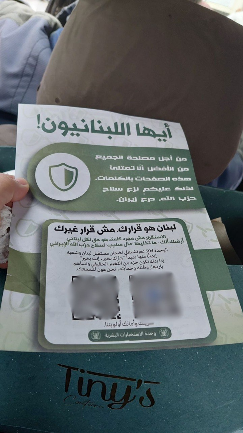
The leaflet (Telegram channel of Bint Jbeil, March 13, 2026)
Hezbollah-affiliated daily newspaper al-Akhbar reported that contacts were taking place in Lebanon regarding demands to dismiss the commander of the Lebanese army, Haykal, in light of external pressures and a campaign led by parties opposed to Hezbollah. According to the report, the president of Lebanon, Joseph Aoun, removed the issue from the agenda and warned against dragging the army into an internal confrontation, while officers in the army expressed reservations about having it confront Hezbollah. A draft statement was published in the name of the “national officers,” warning against actions which would damage the army’s cohesion. However, the army command denied any connection to the publication and said the army was committed only to the institutions of the state. It was later reported that the speaker of parliament, Nabih Berri, sent a message to Haykal in which he opposed his dismissal and to introducing the army into internal political disputes (al-Akhbar, March 12-13, 2026).
The cartoon reads “Lebanon,” composed of hands shaking one another in military uniforms, symbolizing unity and cooperation among the citizens of the state around the military institution (al-Jumhuriya, March 14, 2026)
Hezbollah’s Opponents
Opponents of Hezbollah in Lebanon continued to place responsibility for the new escalation on the organization and accused it of acting outside the framework of the state, dragging Lebanon into regional confrontations and attacking the state’s sovereignty and internal stability:
The chairman of the Phalange Party, Sami al-Gemayel, accused Hezbollah of turning Lebanon into an Iranian military base and following directives from the Revolutionary Guards. He said Hezbollah bore responsibility for the security situation, the destruction and the scale of casualties and displaced persons in Lebanon. He argued that the only way to end the crisis was for Hezbollah to hand its weapons over to the state or for organization to be dismantled (X account of Sami al-Gemayel, March 13, 2026).
Member of the Lebanese Parliament from the National Dialogue Party, Fouad Makhzoumi, accused the government of not taking genuine measures to disarm Hezbollah by claiming fear of civil war. He said the government also did not advance economic measures to deal with the activity of parallel financial institutions, including Hezbollah’s al-Qard al-Hassan Association (X account of Fouad Makhzoumi, March 13, 2026).
Member of the Lebanese Parliament from the Christian Lebanese Forces Party, Ghada Ayoub, called for intensifying measures against Hezbollah and classifying it as a terrorist organization, banning its activity, dismantling its institutions and eliminating its sources of financing. Ayoub said March 14 symbolized the struggle to establish a sovereign state in Lebanon, similar to the struggle that led to the end of the Syrian presence in the country.[10] She said Hezbollah had had opportunities to return to the framework of the state and stop its independent military activity but chose to continue operating outside state authority and to maintain ties with the Iranian Revolutionary Guards (MTV Lebanon, March 14, 2026).
The Civilian Situation in Lebanon
The Lebanese Ministry of Health reported that at least 850 people had been killed since the beginning of the campaign on March 2, 2026, including 107 children and 66 women, and at least 2,105 people had been wounded (al-Nashra, March 15, 2026).
The Disaster Risk Management unit in the office of the Lebanese prime minister reported that the total number of displaced persons who registered independently had reached 831,882, of whom 132,419 were staying in 619 shelters opened throughout the country (al-Markazia, March 14, 2026). The president of the Lebanese Red Cross, Dr. Antoine al-Zoghbi, noted that 900,000 Lebanese had left their areas and many were still on the roads (Telegram channel of Houna Lebanon, March 16, 2026).
The minister for social affairs in the Lebanese government, Hanin al-Sayed, said a European Union aid plane had arrived in Lebanon and its contents were expected to be distributed in reception centers, and additional aid shipments from Jordan, France and other countries were expected to arrive later (X account of the Lebanese presidency, March 11, 2026).
A meeting was held at the office of the Lebanese prime minister in Beirut to launch the Urgent Humanitarian Appeal for Lebanon 2026, whose objective was to raise $308 million to deal with the country’s humanitarian crisis. Prime minister Nawaf Salam said that more than 900,000 people had been displaced from their homes by the fighting, and infrastructure and basic services were under heavy strain. The UN secretary general, Antonio Guterres, called for increased international assistance (website of the Lebanese prime minister and al-Diyar, March 13, 2026).
Political and sectarian tensions in Lebanon were also reflected in public discourse regarding the issue of the displaced. During a meeting held at the office of the governor of Beirut, the chairman of the Beirut municipal council, Ibrahim Zeidan, was criticized when he raised the possibility of “sending the displaced by sea,” a statement interpreted as referring to displaced Shi’ites from south Lebanon and from areas considered Hezbollah’s support base. It was also reported that Fouad Makhzoumi, a member of the Lebanese Parliament, proposed adopting broader monitoring measures of displaced persons staying in apartments in Beirut, including checking the identity of those living in private homes. However, the governor of the city rejected the proposal on the grounds that it had no legal basis or practical feasibility (al-Akhbar, March 14, 2026).
Lebanese real estate experts warned of a worsening housing crisis and claimed that some property owners had raised rents by 500%, exploiting the emergency, the chaos in the market and the absence of effective oversight. They also warned that the continued sharp rise in rental prices could become a social bomb threatening the country’s internal stability, since the cost of living harmed not only the displaced but also civilians coping with growing economic pressures (al-Diyar, March 13, 2026).
With the wave of displacement caused by the new hostilities, according to a report by the International Organization for Migration (IOM), since the previous hostilities which began on September 23, 2024, about 242,000 Lebanese citizens have left the country and not returned, a figure representing about 4.4% of Lebanon’s estimated population of 5.5 million. According to the report, during that period about 3.376 million people left Lebanon while about 3.134 million returned, a negative migration balance (al-Akhbar, March 14, 2026).
UNIFIL
UNIFIL announced that forces of the Italian battalion had assisted in evacuating civilians from the town of Alma al-Shaab in southwest Lebanon at the request of the local municipality. Peacekeeping forces, in coordination with the Lebanese army and the IDF, escorted the civilians in an operation which lasted about two and a half hours and whose objective was to move them to a safe place. Reportedly, since the latest escalation UNIFIL has assisted in evacuating dozens of additional civilians, including children, elderly people and persons with disabilities, from several villages in south Lebanon and supported humanitarian operations carried out by the Lebanese Red Cross (al-Diyar, March 10, 2026).
UNIFIL reported three shooting incidents by “non-state armed organizations” at its forces near the bases in Yater, Deir Kifa and Quleileh; there were no casualties. According to the statement, in the incident in Yater the shooting was only five meters from UN observers, while in the two other cases the shooting occurred at distances of 100 and 200 meters. The UN personnel returned fire and then resumed their planned activity. UNIFIL said harm to UN forces was unacceptable and the presence of weapons outside the control of the Lebanese state in the UNIFIL area of operations contradicted UN Security Council Resolution 1701 (Telegram channel of UNIFIL, March 15, 2026).
[1] Click https://www.terrorism-info.org.il/en to subscribe and receive the ITIC’s daily updates as well as its other publications.
[2] Hezbollah has two operational units with sectoral responsibility between the Litani River and the border with Israel (the Blue Line): the Nasr Unit is responsible for the eastern sector from Bint Jbeil to Mount Dov in the east, the Aziz Unit is responsible for the western sector from Bint Jbeil to the Mediterranean coast. Both are subordinate to Hezbollah’s southern front command, which is responsible for the area from the Sidon line to the border with Israel. In addition, the Badr Unit is responsible for the area between the Litani River and the Sidon line and is also subordinate to the southern front command.
[3] The Imam Hussein Division, which was established by the Iranian Qods Force and Hezbollah, is composed of thousands of operatives from various countries in the Middle East. It was involved in the civil war in Syria and later also operated alongside Hezbollah in the fighting in south Lebanon and in carrying out terrorist attacks from Lebanon, Syria and Iraq against Israeli territory. The previous commander of the division was eliminated as part of Operation Northern Arrows in October 2024.
[4] See the March 2026 ITIC report, Hezbollah’s Use of Force During the Current Fighting Against Israel
[5] “The Eaten Chaff” is a term from the Quran (Surah 105 al-Fil, verse 5). It refers to Allah, who harshly struck the enemies who fought the residents of Mecca in the year of the birth of the prophet Muhammad and figuratively crushed them.
[6] The name the Iranians gave to their response to the American-Israeli attack.
[7] Iran, Hezbollah, the Palestinian terrorist organizations, the Houthis in Yemen and the Shi’ite militias in Iraq.
[8] The Palestinian terrorist organizations.
[9] Hezbollah and the other terrorist organizations operating in Lebanon.
[10] On March 14, 2005, a month after the assassination of former prime minister Rafiq al-Hariri, a massive demonstration was held in Beirut to protest the Syrian presence in Lebanon, the event leading to the Syrian withdrawal, which was completed about a month later.
Related Articles