
When a black hole and a neutron star spiral toward collision, theory predicts that their orbit should become almost perfectly circular before the final impact.
Gravitational waves steadily drain energy from the system, tightening the orbit and smoothing out any stretched shape along the way.

By the time the objects finally merge, astronomers usually expect to see a clean circular path. But one recent event broke that pattern.
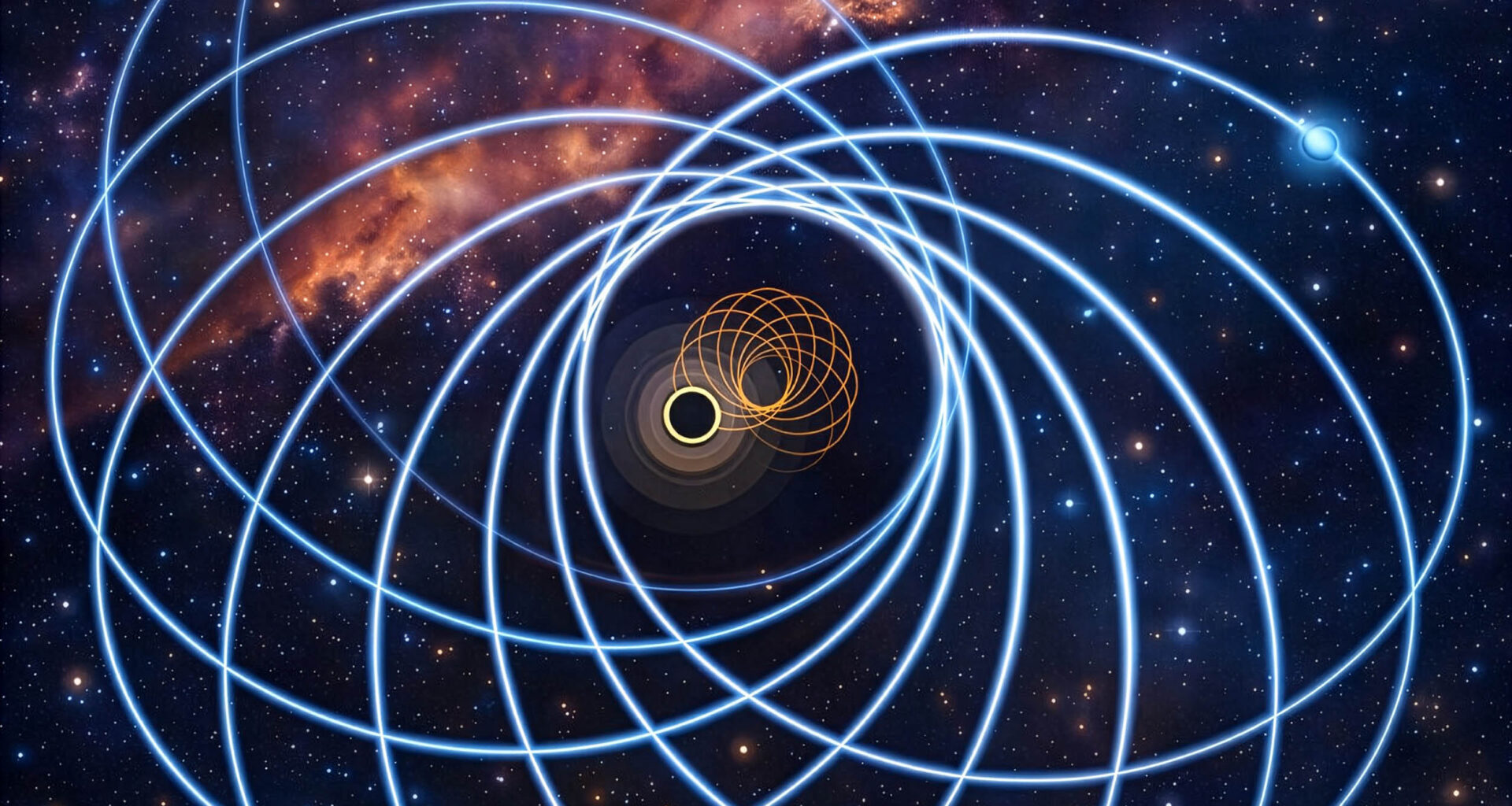
In the gravitational-wave signal GW200105, scientists at the University of Birmingham detected a neutron star and black hole spiraling together on a clearly oval orbit just before the merger.
The unusual geometry is now giving astronomers new clues about how some of these extreme pairs form.
Circles expected from GW200105
Most neutron star–black hole pairs were expected to lose any orbital stretch long before their final collision.
Gravitational waves steadily drain energy from these systems, tightening their paths and rounding their orbits over time.
Physicists describe the remaining stretch of an orbit as orbital eccentricity, the amount an orbit departs from a perfect circle.
For GW200105, the researchers estimated the eccentricity at about 0.145, strongly ruling out a and confirming that the system followed a distinctly oval path all the way to merger.
That measurement also reshaped scientists’ understanding of the objects themselves. Earlier analyses placed the black hole at roughly 8.9 solar masses and the neutron star near 1.9 solar masses.
Once the oval orbit was included in the models, those values shifted. The black hole’s mass rose to about 11.5 solar masses, while the neutron star’s estimate dropped to around 1.5 solar masses.
Because the orbit was not circular, earlier interpretations had slightly misjudged the balance between the two objects. By the end of the merger, the combined system formed a black hole roughly 13 times the mass of the Sun.
A crowded cosmic birthplace
The unusual orbit also points toward a more turbulent origin. In dense star clusters or triple-star systems, gravitational interactions can continually jostle a pair of compact objects.
Those outside influences can feed energy into the orbit and prevent it from settling into a circle.
Such environments fit the new observations better than a quiet binary history. If two stars evolve together in isolation, gravitational radiation usually shrinks and smooths their orbit long before the final merger.
Left alone for long enough, orbiting bodies steadily lose energy through gravitational waves, which tighten the orbit and round out its shape.
Seeing a noticeably oval orbit this late in the process therefore becomes difficult to explain with an isolated formation scenario.
“This discovery gives us vital new clues about how these extreme objects come together,” said study co-author Dr. Patricia Schmidt, an associate professor at the Institute for Gravitational Wave Astronomy.
Instead, the evidence suggests that at least some neutron star–black hole mergers may originate in crowded stellar environments where complex gravitational encounters shape their paths.
Spins did not shape orbit
The researchers also tested another possible explanation for the unusual signal. Sometimes spinning black holes or neutron stars can create a slow wobble in their orbit, known as precession.
That wobble can slightly distort the gravitational-wave signal and make an orbit appear more stretched than it really is. But in this case, the team found no strong evidence that spinning motion was responsible.
Instead, the data pointed to a simpler explanation: the orbit itself was genuinely oval. That makes it more likely the pair formed in a chaotic environment where outside gravitational forces shaped their path.
With spins playing only a small role, the case for a dynamically disturbed origin became stronger.
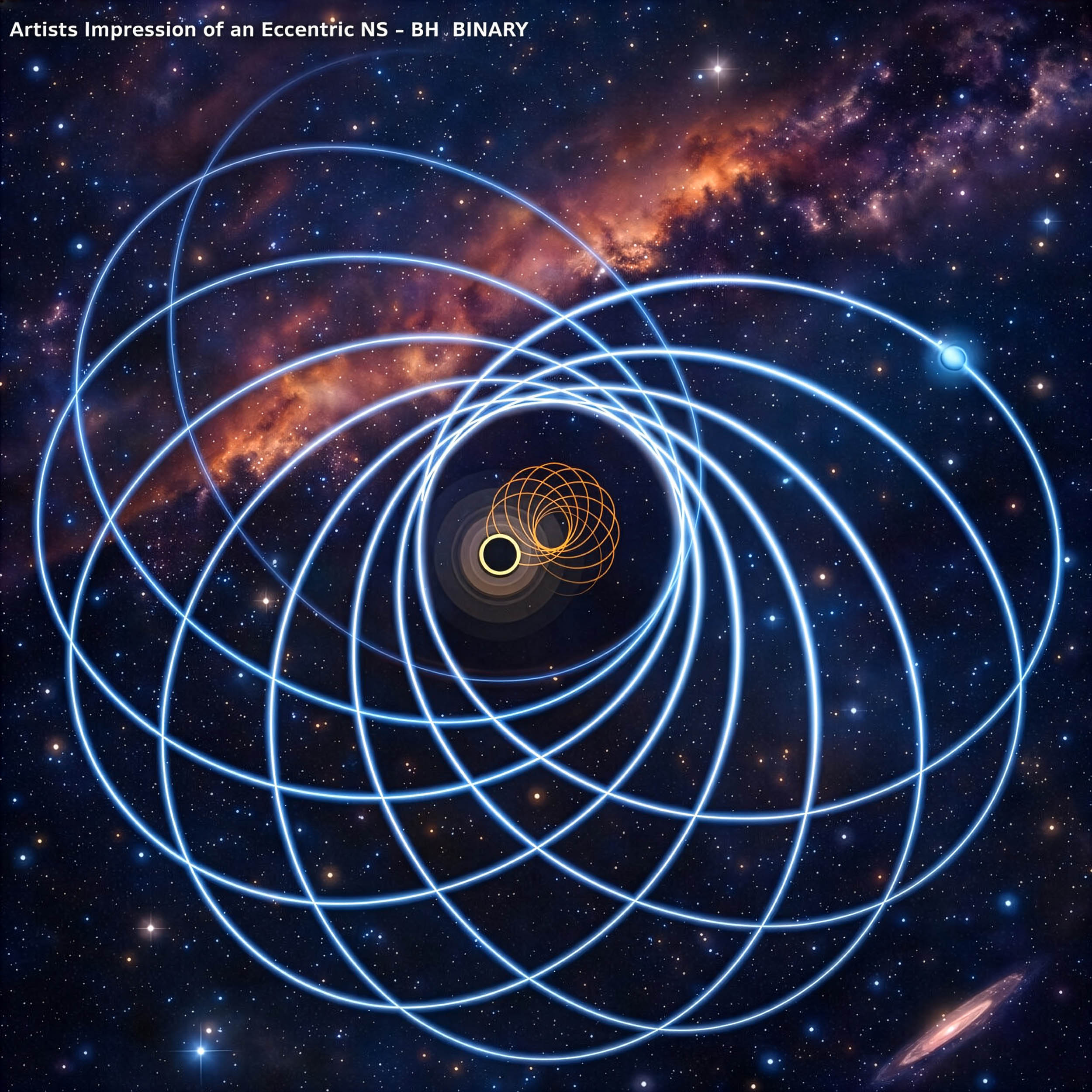 Artist’s impression of an eccentric neutron star–black hole binary. The neutron star’s path is shown in blue and the black hole’s motion in orange as the two objects orbit each other. The eccentricity shown here is exaggerated compared to the real system, GW200105, to make the effect on the orbital motion clearer. Credit: Geraint Pratten, Royal Society University Research Fellow, University of Birmingham. Click image to enlarge.Models uncovered hidden signals
To understand the signal, researchers compared the detected gravitational waves with thousands of simulated patterns that included both oval orbits and spinning effects.
Older analysis tools often assumed the orbit was nearly circular. That shortcut made calculations easier but also meant unusual systems could be overlooked.
When scientists removed that assumption and allowed for elliptical motion, GW200105 no longer looked like an ordinary merger.
Instead, the improved models revealed details that had been hidden in the signal all along.
These more advanced techniques are now helping astronomers measure masses more accurately and better understand how these extreme systems form.
Searching for more like GW200105
New generations of gravitational-wave observatories should soon reveal many more unusual mergers like this one.
Improved detectors on Earth will increase the number of events astronomers can study. Meanwhile, the European Space Agency’s planned Laser Interferometer Space Antenna (LISA) will listen for gravitational waves from space.
Because LISA is designed to detect lower-frequency waves, it could spot black hole-neutron star systems much earlier in their lives, long before the final collision.
Observing these over longer periods could show whether oval orbits like the one seen in GW200105 are rare or fairly common.
It may also help astronomers identify the kinds of cosmic environments that shape these extreme pairs over millions of years.
Mergers may form differently
GW200105 was the only event in the analysis that showed a clearly noncircular orbit, which made the finding especially focused.
Other neutron star–black hole mergers studied with the same method still appeared consistent with nearly circular orbits, at least with today’s available data.
That contrast hints that these cosmic collisions may form through more than one pathway. Instead of a single, uniform origin, neutron star–black hole mergers may represent a more diverse population shaped by different environments and histories.
Astronomers say this single detection does not settle every question about how these systems form. But it does push researchers to think more broadly about the possible routes that bring these extreme objects together.
Future gravitational-wave detections will now help test how often crowded stellar environments, hidden companion stars, or other unusual cosmic histories leave detectable marks in the ripples of spacetime.
The study is published in the journal The Astrophysical Journal Letters.
—–
Like what you read? Subscribe to our newsletter for engaging articles, exclusive content, and the latest updates.
Check us out on EarthSnap, a free app brought to you by Eric Ralls and Earth.com.
—–