
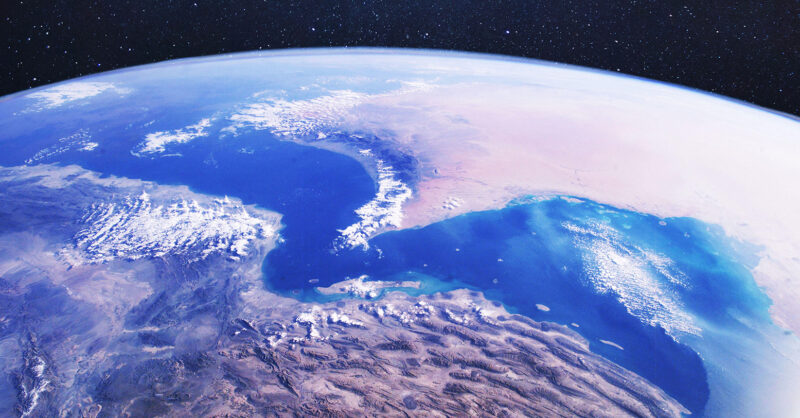
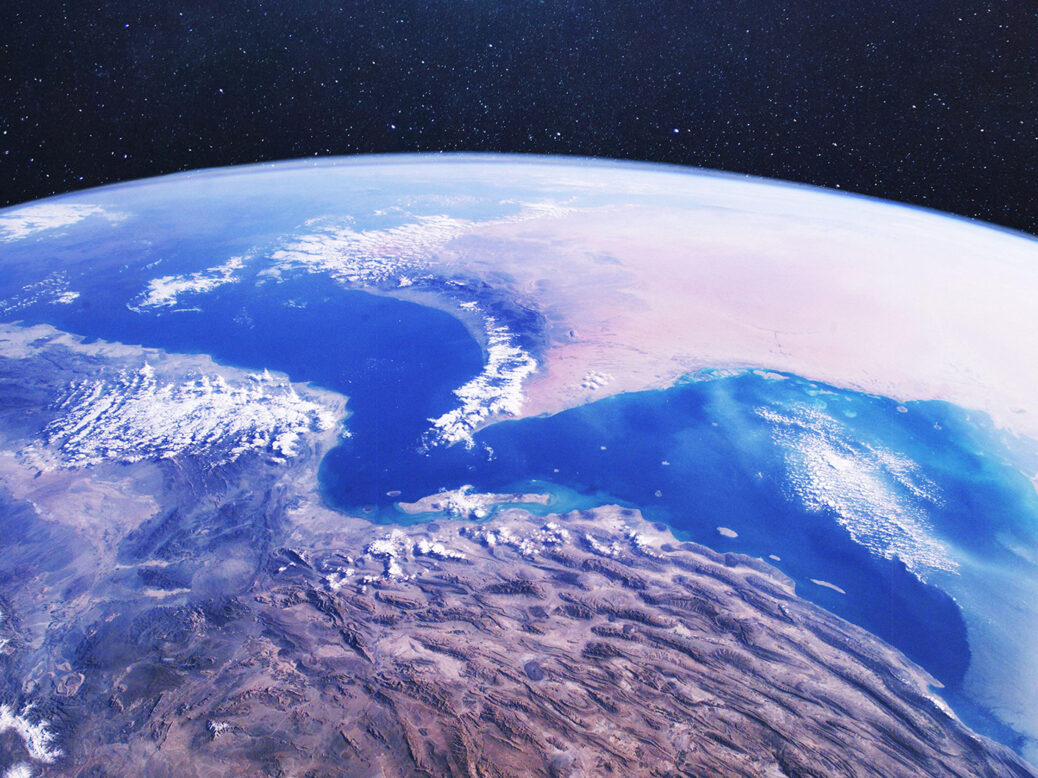
A satellite view of the Strait of Hormuz and Iran taken from space. Photo by Ales Utouka/Alamy
For nearly three weeks, the world has struggled with the fallout of the US-Israel war on Iran. While Tehran has retaliated against its nearest neighbours in the region with missiles and drones, it has also weaponised its control of the Strait of Hormuz in order to inflict pain further afield. By blocking the vital passage, through which a fifth of global trade in crude oil and other fossil fuels travels, Iran has unleashed an economic crisis around the world. Rory Johnston, an oil market researcher and creator of the Commodity Context newsletter, talks to the New Statesman about how this crisis rivals Covid, the potential for food shortages and the prospect of a global depression.
Megan Gibson: The effective closure of the Strait of Hormuz has driven oil prices up globally and there’s no end to the war in sight. You have previously said that this crisis could send oil prices to as much as $200 a barrel. What does the world start to look like when that happens?
Rory Johnston: I don’t normally consider myself an alarmist. I usually talk about how resilient and flexible the global oil market is. We’ve seen that in pretty dramatic fashion over the past half decade with the oil market being able to adapt – to Russia’s invasion of Ukraine and the very broad sanctions against Russia, particularly from the European Union, and more recently the Houthis closing off the Red Sea. All of these things historically we would have considered massive risk scenarios, and the oil market was able to pretty dynamically adapt to them in real time.
This situation is different because it’s such a large loss of supply all at once. It bends the system to the point of breaking. I want to stress that this scenario I’m going to talk through here assumes that the Strait of Hormuz, the major oil conduit from the Middle East Gulf, remains closed or predominantly throttled, as it currently is. And in that scenario, 15 to 20 million barrels a day – let’s just say roughly 20 per cent of global supply – goes through the Strait every day. If demand stayed the same and we just basically started drawing down inventories at 15 to 20 million barrels a day, that would very quickly drain global inventories and become a very unsustainable situation. So if we can’t get supply back up to where it was, we need to destroy demand. And the way we do that is by ratcheting prices higher and higher and higher until we lose [buyers] somewhere along the way. That’s how the market is going to solve this.

Subscribe to the New Statesman today and save 75%
But the volume we’re talking about – 20 million barrels a day – what does that mean? In 2020, in the depths of Covid in March and April, the peak of global demand loss, when you and I were locked inside and there wasn’t a plane in the sky, Heathrow airport was completely empty, that was a 20 per cent loss of demand. So what we’re talking about is trying to stimulate or prompt the same degree of demand losses we saw during Covid but without a pandemic and through only price mechanisms.
You and I, sitting in advanced wealthy economies, will experience this as an acute, debilitating price shock of the pump. We will see our disposable income ratcheted down. It’ll effectively be like a massive, sudden tax increase for us and that will have all of the normal recessionary influences and pressures we would expect with an oil price spike. That loss of disposable income means less aggregate demand, which means less spending in the economy, which means a recession.
But that’s for us in wealthy economies where we can still attract those residual remaining [oil] supplies in the world. For poorer areas in the world they’re not going to be able to incentivise that [supply] to their shores. So we will see awful price spikes; much of the global south will see outright shortages, which for many areas of the world, particularly at this time of the year, could mean outright deadly circumstances. So this is truly a life or death crisis. You’re gonna hear lots of complaining politically about high prices, but remember that those of us that can complain about high prices are actually in the enviable situation here.
And it’s not just oil and gas we should be thinking about. In Asia, we’ve seen over the weekend fertiliser plants in Pakistan that rely on a lot of LNG are closing down operations. What are the knock on effects of this?
In addition to oil, you have a third of global fertiliser supplies, you have massive amounts of natural gas, liquefied natural gas, and others as well as natural gas liquids, things like propane and butane – all of these also come from the Middle East. So it won’t just be an energy crisis, it will be an entire fossil fuel supply chain crisis. People are going to all of a sudden, shockingly, realise the degree to which fossil fuels are in everything – including fertilisers. This will start as a political and a geopolitical crisis [but] it will shift into an energy crisis very rapidly. And then, again, if this continues, there will be a rolling food crisis, there will be all manner of crises that we can’t even begin to estimate.
This is a scenario that we used to [give to new analysts] as the thought experiment: imagine if Hormuz was closed, walk me through what you think would happen? It was the doomsday scenario. We never actually thought it would happen.
This crisis is happening very quickly. In some ways it’s shocking that we’re already more than two weeks in. We’re in our third week of the war already but in terms of moving the global structure of the economy, that’s a very, very short amount of time. So just over two weeks ago, we still had tankers laden with crude leaving the Gulf, heading largely to Asia. Those tankers take three, four, five weeks to get to where they’re going. So we aren’t going to feel the full ramifications of that physical shortage until that effective air pocket that’s opened up in global trade hits land. Once that hits land, that’s when we’re going to start really aggressively drawing those stockpiles and when the fireworks really begin.
But jet fuel prices in Asia are already over $200 a barrel. And the reason for that is that refineries’ worst nightmare is being forced to shut down because of a lack of crude. A refinery is basically like a big chemistry set: it needs to stay hot, it needs to stay flowing. Once things slow down, once you stop, things start to literally solidify in pipes and it’s very onerous to get things started back up again. So getting a refinery from dead stop back up to full running could take weeks. They would rather operate at partial capacity for as long as they can. But let’s say these plants typically run, say, 90 per cent of their capacity; and now they’ve already begun throttling back on that to maybe, say, 65 per cent. So they’ve cut a quarter of their capacity in order to extend their runway of how long they continue operating with the current stocks they have on hand and the stuff that’s still – before that air pocket hits.
Because of that, crude is taking a little while to actually begin to really tighten the market. The refined products market, particularly in Asia, is already ahead of crude because those refineries have already cut back supply immediately in their local environments.
Donald Trump is pressuring a handful of nations, including the UK, to send ships to the Strait of Hormuz to help on an escort mission. Is this something that we should be considering? Is this likely to help?
I think a lot depends on how willing the Trump administration is to continue this war as it currently exists. I think if the war continues, then we’re going to need to get this Strait reopened. It’s really that simple.
I think, unfortunately, it’s too important a system for the global economy to remain closed. So I think the most likely path to get it reopened is that the Trump administration and Israel pull back on their attacks in Iran, and Iran says, okay we’ll re-allow some or the majority of [traffic] to continue.
I think that’s the most likely way to end, but I honestly didn’t think we’d get this far. So I’ve been wrong on that so far. The Trump administration is clearly more committed and more willing to expend this political capital than I expected them to be. If this does continue, and we just had Secretary Bessent saying that he doesn’t know when it’s going to end, it could be weeks. So if it continues, we’re going to need to put as much military equipment and personnel in that theatre as possible to try and secure the strait now.
But it seems very unlikely that that can be done through naval escorts and airstrikes alone. The waterway at its narrowest point is about 22 miles across, which sounds really wide, but because these ships are so big, there’s really only a two mile navigable waterway that those ships can go back and forth across. That’s a really, really tight target window. And if you are sitting there with a giant naval vessel in addition to your tankers, that makes for a lot of very tempting targets for drones, for other munitions, et cetera. It’s gonna be very, very difficult to defend those in a real, meaningful way.
I think most people that have looked at this have said: if you wanted to do that, you would need a massive boots-on-the-ground, expeditionary invasion for the entire coastal region of Iran. Have you seen a topographical map of Iran? It’s all mountains. It’s a nightmare scenario, but I think if this continues, that is the way [the fight] has to go. Which again, feels unthinkable right now that we’re going that route, but it will take a very, very long time and many lives and much treasure lost in order to maintain that security.
Another move that we saw the US attempt this weekend were strikes on Kharg Island, where Iran’s largest oil export depot sits. So far Trump’s said he’s only ordered strikes on military targets, and he hasn’t targeted any oil infrastructure. What would happen if the US were to destroy Iran’s capacity to export its own oil?
What’s interesting through this crisis thus far is that while the vast majority of shipping traffic through the Strait has been throttled, Iran has maintained its exports pretty well, almost on a normal schedule this entire time. And we’ve seen a lot of Maga voices on the right increasingly have gotten [the idea] in their heads that if you take Kharg Island, if you capture this terminal, then Iran is dead. That could not be further from the truth. Iran has other means of exporting its oil. It has old assets that can continue exporting these to other regions, other areas.
But why hasn’t Trump hit [Kharg]? I think the answer’s twofold. Secretary Bessent, the treasury secretary, said “we don’t want to further contribute to tightening the oil market unnecessarily, even if the revenue is going to our enemy”. The other reason though, I think, is that Iran has basically said that so far we’ve been going easy on some of the infrastructure in the region. And they basically said, if you take up Kharg Island, we’re going to view every other oil loading terminal port in the Gulf as fair game. And so far, largely they haven’t been hitting those. There are very, very large tempting targets where you see massive volumes of Saudi and Iraqi and Kuwaiti oil shipped that could be targeted.
The Strait, you could reset it theoretically and things just go back to relative normal – with a big lag, but we could get back to normal. But attacks on actual physical infrastructure? It’s a much bigger ordeal to repair a massive oil terminal than it is to send your tanker that’s been waiting through the Strait.
The thing is, it’s really bad right now. It could get worse. And I think if it gets worse, then it’s gonna take a much longer time to unwind.
Say the war lasts another three weeks and the Strait is blocked that entire time. At what point do we hit a global recession?
It’ll take some time for this to all trickle through to a full blown global recession.
To be clear, if the Strait does remain closed, let’s say indefinitely, we’re not talking recession – we are talking depression. But I think in terms of, let’s say, three weeks – by that stage you’re probably looking at prices tipping up into $130, $140, $150 [a barrel] on Brent. That trickles through to all the [refined] products as well. I think that is when people will start to fill the pinch and people will begin to change behaviour.
But I think that it’ll probably take a couple more months to actually enter a full blown recession. And then thereafter things get worse the longer this goes on. But let’s say the war ended today, and let’s say the Strait reopened today to 100 per cent of its prior flow – even then, I think we’re talking two to three months to renormalise the global system. All of these tankers are basically piled up on top of each other, on either side of the Strait. You need to get tankers back entering the Strait after they’ve all been diverted elsewhere trying to find other things to do. The tankers in the Strait are all going to rush for the same unloading terminal, they’re all going to be piled up. It is going to be this replay of the supply-chain bottlenecks that we experienced during Covid. The system, the whole global supply chain, is meant to just continue flowing. Anytime you seize it up and stop it, it takes a lot to get it going anywhere like we were before.
Beyond stopping the war today, what else can the US or other Western countries do to lessen the economic pain?
So there are levers. I think most of them are insufficient to the crisis we currently face, but there are levers. The International Energy Agency, formed in response to the energy crisis in the 1970s, was almost purpose built for this crisis. They’ve coordinated their largest release [of stockpiled oil] in history, which is 400 million barrels. So it’s a massive amount of oil, but it’s still only a fraction of the oil we’ve currently lost in Hormuz. And again, even if this [release] started today, this crisis in Hormuz has had a two week-plus head start. It has no hope of catching up. But I do think that it’s important that we do it because it’s the main thing that we can do physically as Western, oil importing nations.
You’ve also seen proposals for things like export bans or export controls in the United States. This can have a short-term benefit because this would provide an artificial loosening of this market. It would screw over all of the normal markets that would normally receive those exports, which would be Latin America, Europe, et cetera. But for US consumers, it would be a brief reprieve.
I think easier, low-hanging fruit [would be] temporary suspension of gasoline taxes. That’s very easy for a politician to do but you shave ten cents off a litre or whatever, and then it’s done. What next? So yeah, I don’t think there’s a lot we can do. And I think that unfortunately for all of us, the traffic in the Strait needs to resume otherwise things will get worse.
[Further reading: The Kharg Island ultimatum]
Content from our partners