
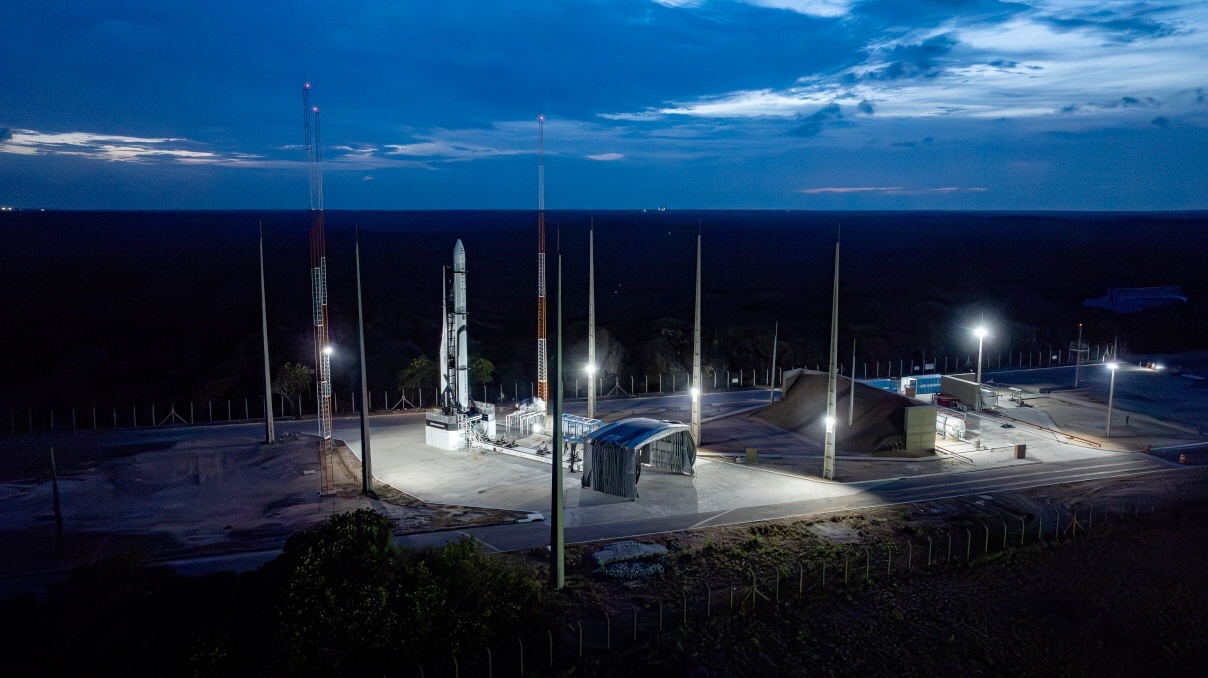
WASHINGTON — South Korean startup Innospace says its inaugural launch failed in December when exhaust leaked from a combustion chamber and caused the rocket to break up.
Innospace announced March 17 that it had completed its investigation into the launch of its first Hanbit-Nano rocket Dec. 22 from the Alcântara Space Center in Brazil. The rocket appeared to lift off normally but fell back to Earth and exploded about 80 seconds after liftoff. There were no injuries or damage to launch facilities.
The company said it found that, 33 seconds after liftoff, exhaust leaked from the rocket’s first-stage combustion chamber, “resulting in a rupture of the combustion chamber and the subsequent separation of the launch vehicle into multiple parts.”
Investigators traced the leak to plastic deformation of sealing components when part of the combustion chamber for the hybrid engine was reassembled at the launch site before the launch. In response, Innospace plans to improve quality management and assembly processes, as well as make “certain design improvements” to the rocket that it did not specify.
The investigation was carried out jointly with Brazil’s Aeronautical Accidents Investigation and Prevention Center, known as CENIPA.
“Both Innospace and CENIPA have reached a consistent conclusion regarding the analysis results, and there are no differences between the two organizations regarding the follow-up measures,” Soojong Kim, chief executive of Innospace, said in the statement. “Based on these findings, we will implement the necessary technical improvements and conduct thorough verification to further enhance the safety and success rate of future launches.”
Immediately after the failure, Kim said the company would attempt the vehicle’s next launch in the first half of 2026. In the announcement, the company said that launch has slipped to the third quarter.
“The exact schedule for the follow-up launch will be finalized after the completion of technical corrective measures and the receipt of launch authorization from KASA,” the Korean space agency, the company said. “Innospace plans to conduct the follow-up launch in Brazil within the third quarter of this year using an already secured launch slot.”
While the investigation was ongoing, Innospace was working to secure additional spaceports for Hanbit-Nano and future vehicles. The company announced in January an agreement with the Atlantic Spaceport Consortium to launch from a planned spaceport in the Azores.
On March 4, Innospace said it signed a letter of intent with Canadian spaceport operator Maritime Launch Services to examine potential use of Spaceport Nova Scotia, a facility under development near Canso, Nova Scotia.
Related