
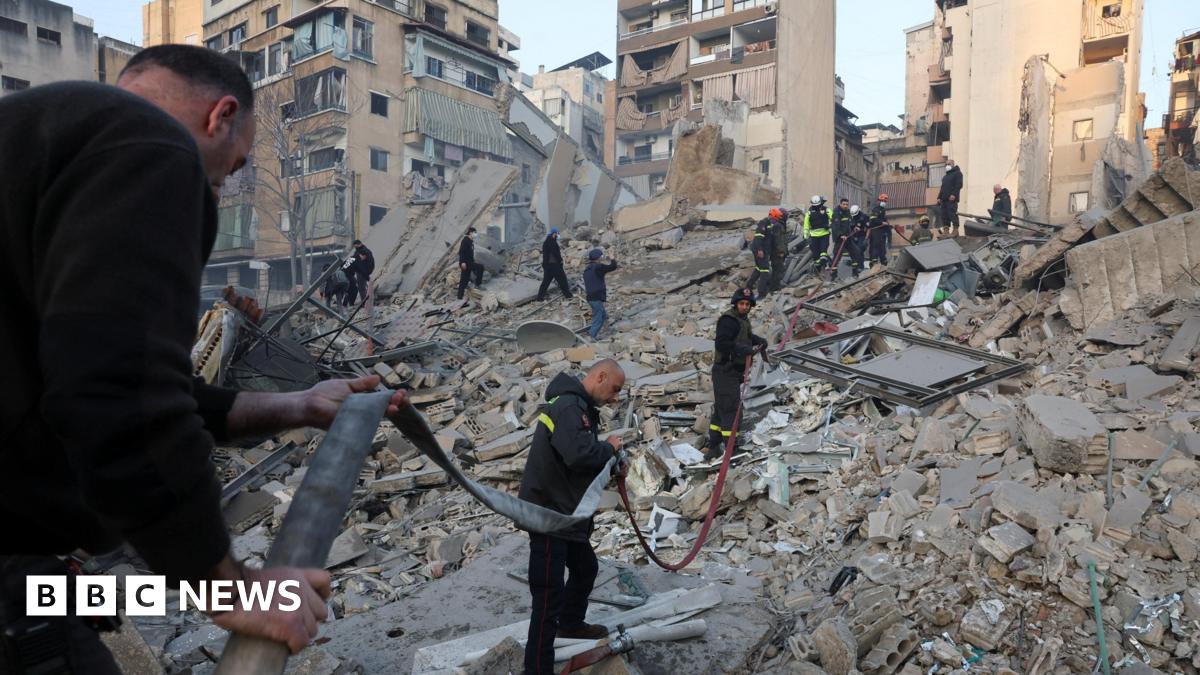
Use of bunker busters a sign Iran keeping weapons deep undergroundpublished at 08:23 GMT
08:23 GMT
Chris Partridge
Weapons analyst
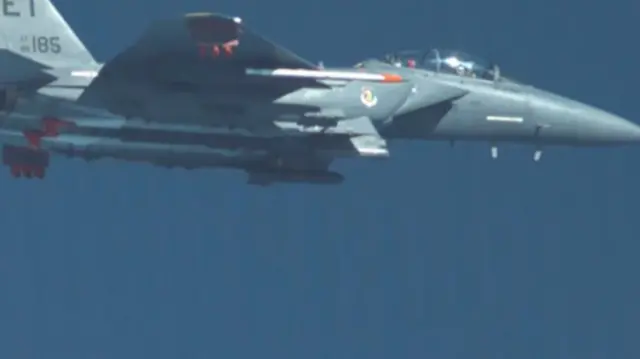 Image source, USAFImage caption,
The GBU-72 bunker buster can be carried by the F-15E Strike Eagles
News that the US is using 5,000lb (2270kg) bunker busters is further evidence that Iran keeps many of its weapons buried deep underground.
US Central Command (Centcom) did not specify which penetrators it used against what it called hardened Iranian missile sites along Iran’s coastline near the Strait of Hormuz.
But there are two known variants that fit the criteria: the GBU (Guided Bomb Unit)-28 laser-guided bomb and the newer GBU-72 Advanced 5K Penetrator. The latter is the one more likely to have been deployed.
First tested in 2021, the bomb is a large Joint Direct Attack Munition (JDAM) free-fall precision munition guided to target by satellites and Inertial Navigation System.
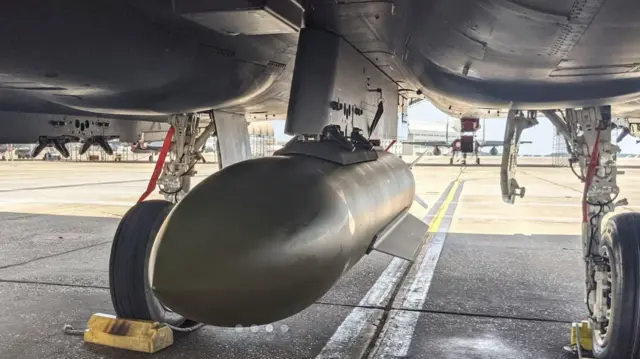 Image source, USAF
At the time of testing, the US Air Force (USAF) said the GBU-72 was “developed to overcome hardened deeply buried target challenges and designed for both fighter and bomber aircraft”.
“The weapon design and its projected effectiveness were developed using advanced modeling and simulation techniques and processes before the first warhead was forged,” it added.
Despite its large size, the GBU-72 can be carried by F-15E Strike Eagles, giving military planners greater flexibility in deployment by not relying on B1-Bs, for example, that operate out of RAF Fairford in England.
Both the US and Israel have pounded Iran’s missile and drone infrastructure, but Tehran’s weapons still pose a significant threat.
Yesterday, the Islamic Revolutionary Guard Corps said it had targeted Tel Aviv in Israel with Khorramshahr 4 and Qadr missiles – both of which carry multiple warheads – in a statement read on state TV. Footage on social media strongly suggests cluster munitions are being used by Iran.