
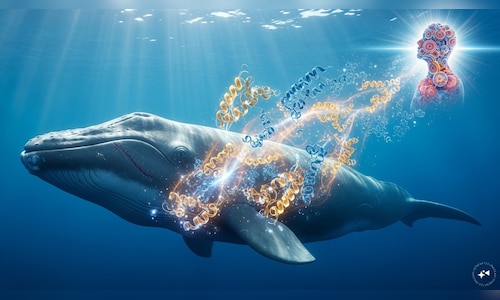
A protein discovered in exceptional abundance in bowhead whales can significantly improve DNA repair in human cells, according to a new study. This finding raises the possibility that human lifespans may eventually equal those of the longest-living species in the ocean.
Bowhead whales are the longest-living creatures on Earth, with a confirmed lifespan of over 200 years. Scientists have been amazed for decades by these enormous Arctic animals’ ability to prevent cancer despite billions of cell divisions over two centuries. Researchers at the University of Rochester now believe that a unique ‘whale protein’ may provide hints for longer, healthier human lifespans.
The groundbreaking study was published in the journal Nature.
Cold-inducible RNA-binding protein, or CIRBP for short, is the protein at the heart of the finding. Compared to humans, bowhead whales produce about 100 times more CIRBP. This protein aids in the repair of double-strand DNA breaks, a major genetic damage linked to ageing, cancer, and other human diseases.
Under the direction of biologists Vera Gorbunova and Andrei Seluanov, the results of the Rochester team introduced the whale version of CIRBP into fruit flies and human cells.
The percentage of double-strand DNA breaks that were successfully fixed nearly doubled in human cells. Additionally, the repair was cleaner because cells made fewer deletion errors at break sites, a type of damage that can lead to mutations, causing cancer.
The findings take on additional significance in what scientists refer to as Peto’s paradox—the long-known but poorly understood fact that larger, longer-lived animals do not get cancer at the higher rates their size and age would predict.
The Rochester team discovered that, unlike elephants, bowhead whales do not combat cancer by aggressively eliminating damaged cells.
Instead, compared to cells from humans, mice, or cows, whale cells repair the most severe kind of DNA damage more effectively and precisely and acquire fewer mutations in the first place.
CIRBP functions at the molecular level by attaching itself to damaged DNA ends and protecting them from enzymes that would otherwise break down the exposed strands, making precise repair much more challenging.
Additionally, it facilitates the activation of the molecular machinery that repairs broken ends.
This improved cellular maintenance system, according to scientists, is a major factor in whales’ long lifespans and overall good health.
According to laboratory research, the body’s natural healing processes may be strengthened by adding or imitating identical proteins in human cells.
Furthermore, the research states that CIRBP levels increase when cells are exposed to cold. The researchers verified that CIRBP protein levels and DNA repair efficiency both increased when human cells were cooled to 33 degrees Celsius.
This raises the potential that taking a cold shower or swimming in cold water could provide a slight boost, but the team is also looking into pharmaceutical alternatives.
Fruit fly trials yielded some of the study’s most remarkable findings. Flies that expressed either the human or bowhead whale variant of CIRBP outlived controls by a significant margin and were more resilient to ionising radiation exposure. Mouse trials with elevated CIRBP are now underway.
However, scientists advise against exaggerating the results. While improving DNA repair might theoretically slow ageing and related diseases, it would be extremely difficult to translate this into humans, according to Professor Gabriel Balmus of the UK Dementia Research Institute at Cambridge.
It is quite likely that the whale’s exceptional longevity is the result of several biological processes other than CIRBP.