
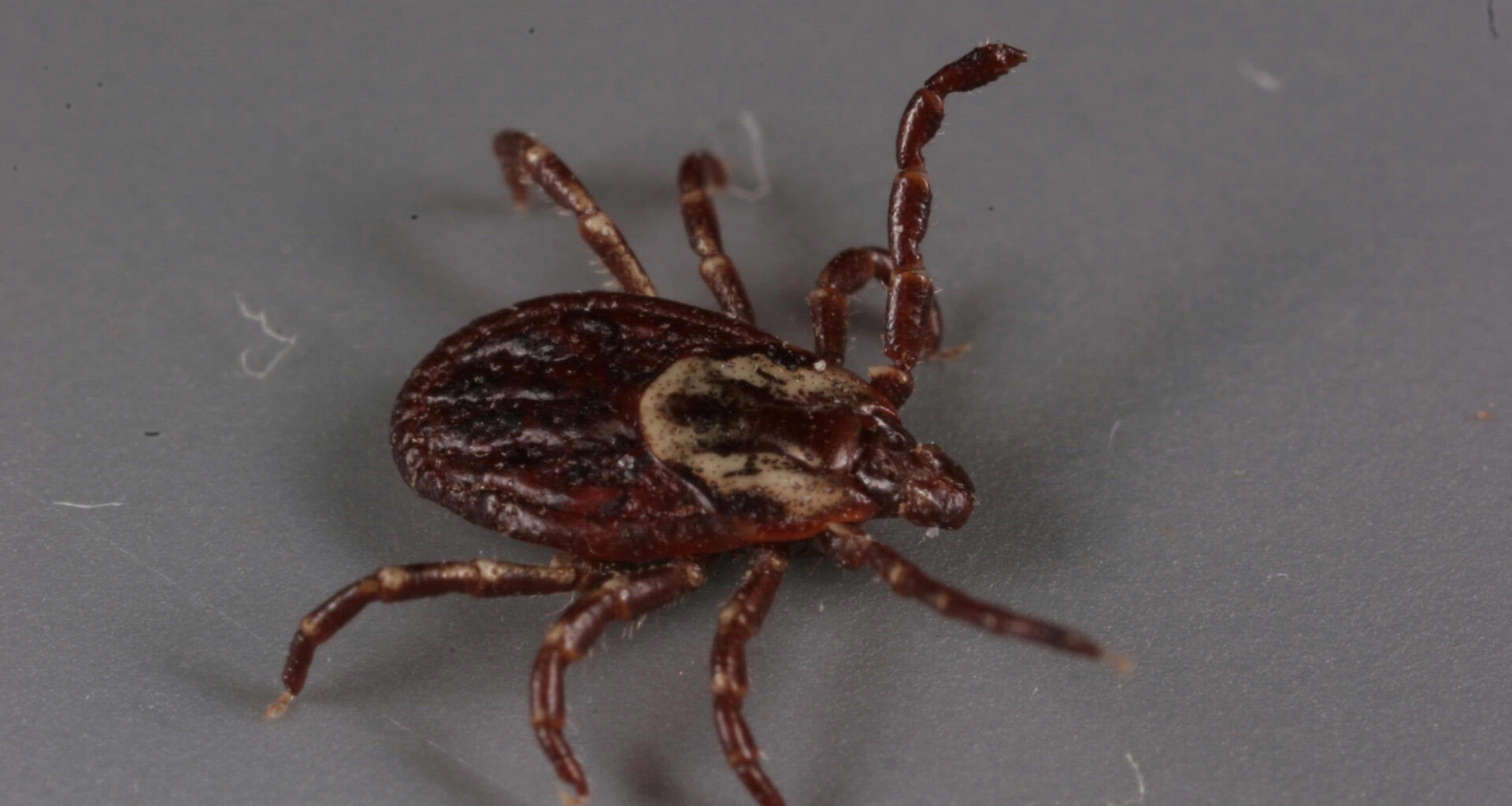
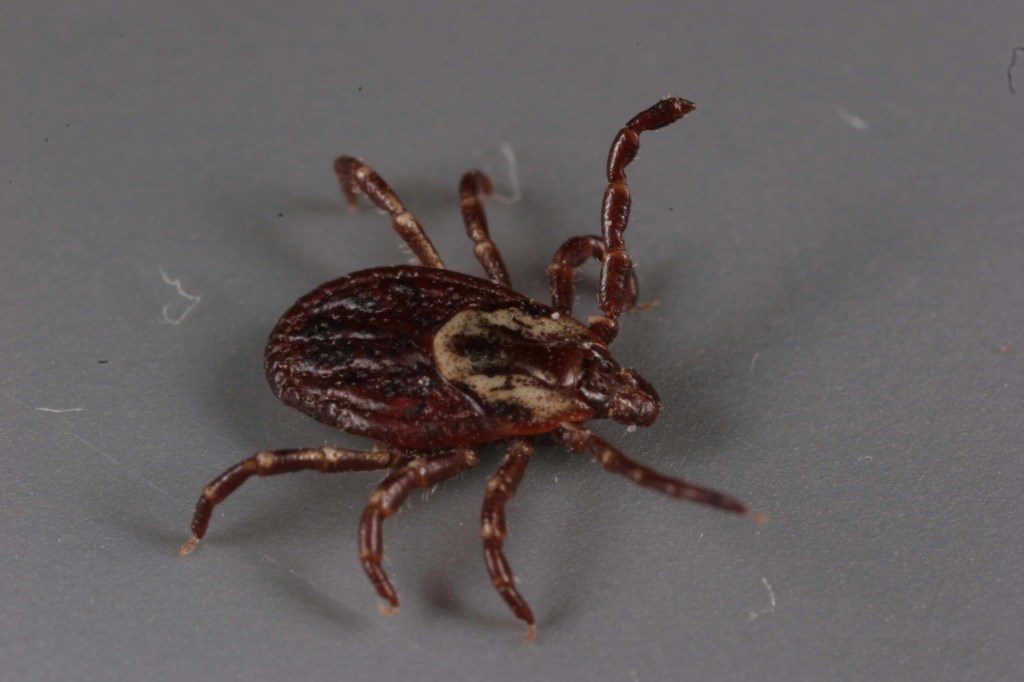
 A new study shows that a spray repellent made from lemon eucalyptus oil strongly repels blacklegged ticks (Ixodes scapularis)and American dog ticks (Dermacentor variabilis, show here) when applied to common clothing fabrics, performing as well as DEET and remaining effective for several days. (Photo by Gary Alpert, Harvard University, Bugwood.org)
By John P. Roche, Ph.D.
Ticks, including the blacklegged tick (Ixodes scapularis)and the American dog tick (Dermacentor variabilis), are vectors of several serious human diseases, including Lyme disease and Rocky Mountain spotted fever. Repellent compounds, including chemicals applied to clothing fabrics, can help reduce the spread of these pathogens. In the U.S., permethrin, a chemical derived from chrysanthemums, is a popular fabric application. But whereas permethrin can kill ticks on contact, it is not strongly repellent. And in Canada, though permethrin is available on clothing that is factory treated with the compound, it is not available as a liquid or spray for consumers to apply to clothing.
Therefore, in a study published in February in the Journal of Medical Entomology, researchers at the University of Acadia in Nova Scotia, Canada, tested the efficacy of an alternative compound to apply to fabrics to protect people from ticks: an extract from lemon eucalyptus essential oil. The study was led by postdoctoral researcher Luis Anholeto, Ph.D., with colleagues Creighton Jarvis, Jaclyn Delahunt, and Nicoletta Faraone, Ph.D.
Lemon eucalyptus essential oil comes from lemon-scented gum trees, Corymbia citriodora, and its active ingredient is the molecule para-menthane-3,8-diol, also known as PMD, oil of lemon eucalyptus, or Citriodiol. Whereas many studies have explored the uses of essential oils in pest control, few previous studies have tested if lemon eucalyptus oil extract can repel ticks. One such study, found that, when applied as a daily repellent, para-menthane-3,8-diol significantly reduced attachment of castor bean ticks (Ixodes ricinus) on humans. Another study found that castor bean ticks were significantly repelled by PMD relative to controls.
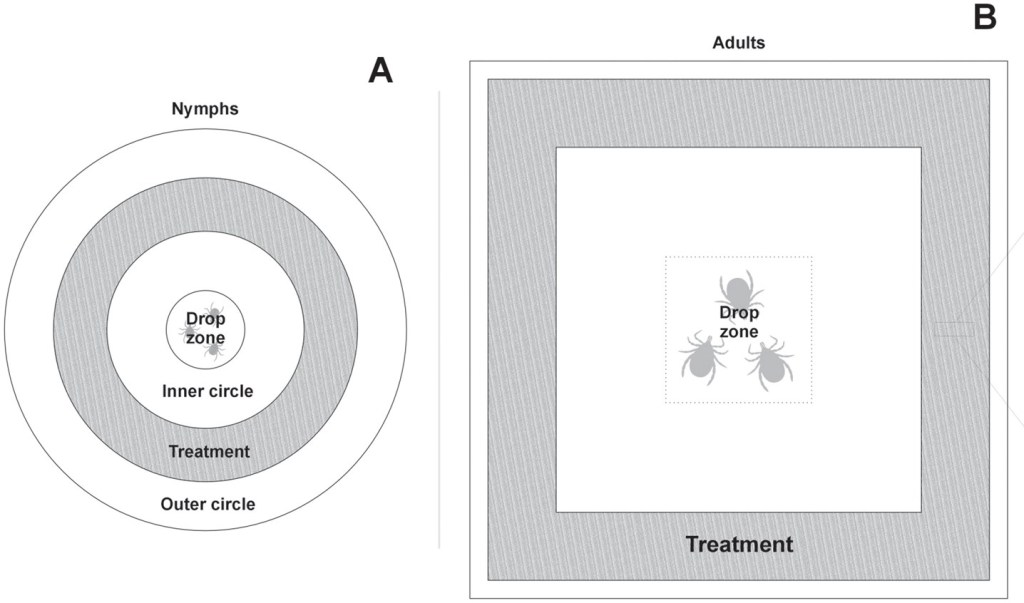 A new study shows that a spray repellent made from lemon eucalyptus oil strongly repels blacklegged ticks and American dog ticks when applied to common clothing fabrics, performing as well as DEET and remaining effective for several days. As part of the study, researchers conducted lab tests in which ticks were placed in the center of a test arena or a piece of fabric that was treated with repellent in either a circle (A) or square (B) surrounding the ticks, and the observed whether the ticks crossed the treated zone within six hours. (Figure originally published in Anholeto et al. 2026, Journal of Medical Entomology)
Faraone and her team sought to build on previous studies to test if lemon eucalyptus oil extract had effects on blacklegged ticksand American dog ticks. For their study, they formulated a lemon eucalyptus oil extract in collaboration with AtlanTick Repellent Products, which was founded in 2017 by Lisa Learning.
The investigators performed a comprehensive suite of lab assays and tests on human subjects to explore the ticks’ responses under realistic conditions. In a six-hour behavioral assay in the lab, they placed five tick nymphs in an arena surrounded by a circle of PMD or a solution without PMD and watched them for six hours. They recorded the location of the nymphs at 30 minutes, 60 minutes, 120 minutes, 240 minutes, and 360 minutes. They found that ticks significantly preferred the control (i.e., they were repelled by PMD ).
In a five-minute behavioral assay, they added five nymphs to the center of an arena surrounded by a circular application of PMD solution. Negative controls had a solution with no repellent and positive controls had a solution with the repellent DEET but no PMD. For each group of nymphs, the investigators waited five minutes, measured the nymphs’ location, and then discarded them. They repeated this process at 30 minutes, 60 minutes, 120 minutes, 240 minutes, and 360 minutes. They found that PMD caused significantly higher repellency than negative controls at all time points, and did not differ significantly from the positive control containing DEET.
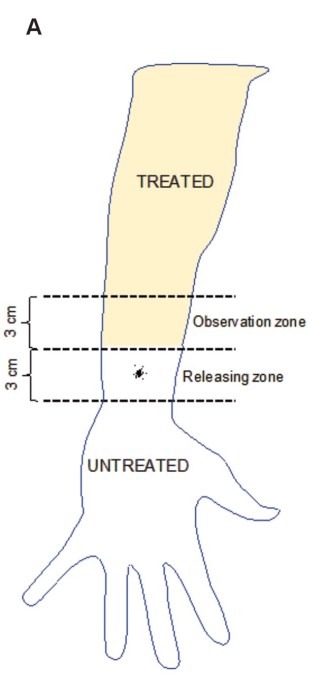 A new study shows that a spray repellent made from lemon eucalyptus oil strongly repels blacklegged ticks and American dog ticks when applied to common clothing fabrics, performing as well as DEET and remaining effective for several days. As part of the study, researchers conducted lab tests in which they placed a piece of repellent-treated fabric on the arm of a human subject and recorded whether ticks crawled over the fabric toward the elbow or not. (Figure originally published in Anholeto et al. 2026, Journal of Medical Entomology)
In an assay using fabric strips, the researchers sprayed strips of fabric with lemon eucalyptus oil extract and formed a square of the fabric strips within an arena. In different trials, fabric strips were cotton, cotton-polyester blend, or polyester. They placed five adult females in the center of the arena surrounded by the fabric strips and watched them for 10 minutes to see if they crossed the fabric. If they did not cross the fabric, they were considered repelled. They measured repellency for both blacklegged ticks and American dog ticks. Their result was that lemon eucalyptus oil extract caused significant repellency for both species on all fabric types.
In their Y-tube behavioral assays, the investigators placed ticks in the opening of a Y-tube choice apparatus. One arm of the Y had a piece of fabric treated with PMD solution, and one arm had untreated fabric. They tested ticks in the Y-tube at days 1, 2, 3, 7, and 14 following application of the extract; they tested both blacklegged ticks and American dog ticks; and they tested cotton, cotton-polyester, and polyester. In blacklegged ticks, females showed a significant preference for untreated fabric for all three fabric types for the first three days. At day seven and beyond, females did not show any significant preferences. For American dog ticks at day two, females showed a significant preference for untreated fabric for all fabric types. At day three, American dog ticks showed significant avoidance of the treated cotton-polyester fabric but not for cotton or polyester treated fabric. At day 14, the blacklegged ticks did not show any significant preference at all.
Because carbon dioxide is a strong attractant for ticks and is a stimulus they use to help them find hosts, the investigators also performed a Y-tube test where one side of the Y contained fabric treated with repellent and also had air containing carbon dioxide. The other side had untreated fabric. Blacklegged ticks were significantly repelled in these tests for the first three days. But by day seven, blacklegged ticks were not significantly repelled. With American dog ticks, repellency decreased faster, and after day three they were not significantly repelled by the eucalyptus oil extract.
In their tick-crawling-on-arm assay, they placed a piece of PMD-treated fabric or non-treated fabric on the arms of human subjects and recorded whether ticks crawled over the fabric toward the elbow or not. They used five adult ticks for each trial. After each trial, ticks were discarded and five new ticks were added for up to 30 minutes. They repeated this procedure for each human subject and each sleeve for 1, 2, 3, 7, and 14 days post-treatment. Their finding supported all their previous findings: fabric treated with lemon eucalyptus oil extract on the arms of human subjects significantly repelled both species of ticks.
This study by Anholeto and colleagues found that lemon eucalyptus oil significantly repelled both blacklegged ticks and American dog ticks, and that it was an effective repellent when applied to cotton fabric, cotton-poly fabric, or polyester fabric.
“Our key finding is that para-menthane-3,8-diol, when delivered in a fabric spray, can provide strong and long-lasting tick repellency, including under conditions that mimic real-world use,” Faraone says. “Para-menthane-3,8-diol performed comparably to DEET in laboratory assays and, when applied to clothing, repelled ticks for several days to a week, depending on tick species and fabric type. This shows that plant-derived repellents can be effective alternatives to synthetic products, especially for fabric-based protection against ticks.”

A new study shows that a spray repellent made from lemon eucalyptus oil strongly repels blacklegged ticks and American dog ticks when applied to common clothing fabrics, performing as well as DEET and remaining effective for several days. Nicoletta Faraone, Ph.D., associate professor in the Chemistry Department at Acadia University, and her group performed a comprehensive suite of lab and human-subject experiments to test if lemon eucalyptus oil extract had repellent effects on the ticks. They found that lemon eucalyptus oil extract provided significant repellency for both species under a range of different conditions. (Photo courtesy of Nicoletta Faraone, Ph.D.)

A new study shows that a spray repellent made from lemon eucalyptus oil strongly repels blacklegged ticks and American dog ticks when applied to common clothing fabrics, performing as well as DEET and remaining effective for several days. Here, Nicoletta Faraone, Ph.D., associate professor in the Chemistry Department at Acadia University visits a company site of AtlanTick® Repellent Products, preparing a lemon eucalyptus oil formulation for her study. (Photo courtesy of Nicoletta Faraone, Ph.D.)
Looking ahead, Faraone believes that future research could include a focus on evaluating efficacy of lemon eucalyptus oil extract in the field and a focus on understanding how different tick species differ in their responses. Also, Faraone says that, “studies linking repellent performance to actual reductions in tick bites and disease risk will be critical for translating laboratory results into public-health impact.”
In conclusion, Faraone says, “This work represents a first-of-its-kind approach. At present, there are no commercially available fabric-spray products based on essential oils that are designed and tested specifically for tick repellency. Most fabric-applied products rely on synthetic insecticides such as permethrin, which function primarily through contact toxicity rather than true repellency. Our study demonstrates that an essential oil–based fabric spray can provide effective, non-contact tick repellency.”
Reduction in tick-borne diseases depends on an expansive array of integrated tactics, including public education, personal protection, habitat and landscape management, wildlife management, pesticides, and repellents. Lemon eucalyptus oil extract is promising as a repellent that can add significantly to this integrated approach.
John P. Roche, Ph.D., is an author, biologist, and scientific writer with a Ph.D. and postdoctoral fellowship in the biological sciences and a dedication to creating compelling narratives for readers. He authors books and writes materials for universities, scientific societies, and publishers. Professional experience includes serving as a scientist and scientific writer at Indiana University, Boston College, and the UMass Chan Medical School; and as editor of science periodicals at Indiana University and Boston College.
Related
Discover more from Entomology Today
Subscribe to get the latest posts sent to your email.