
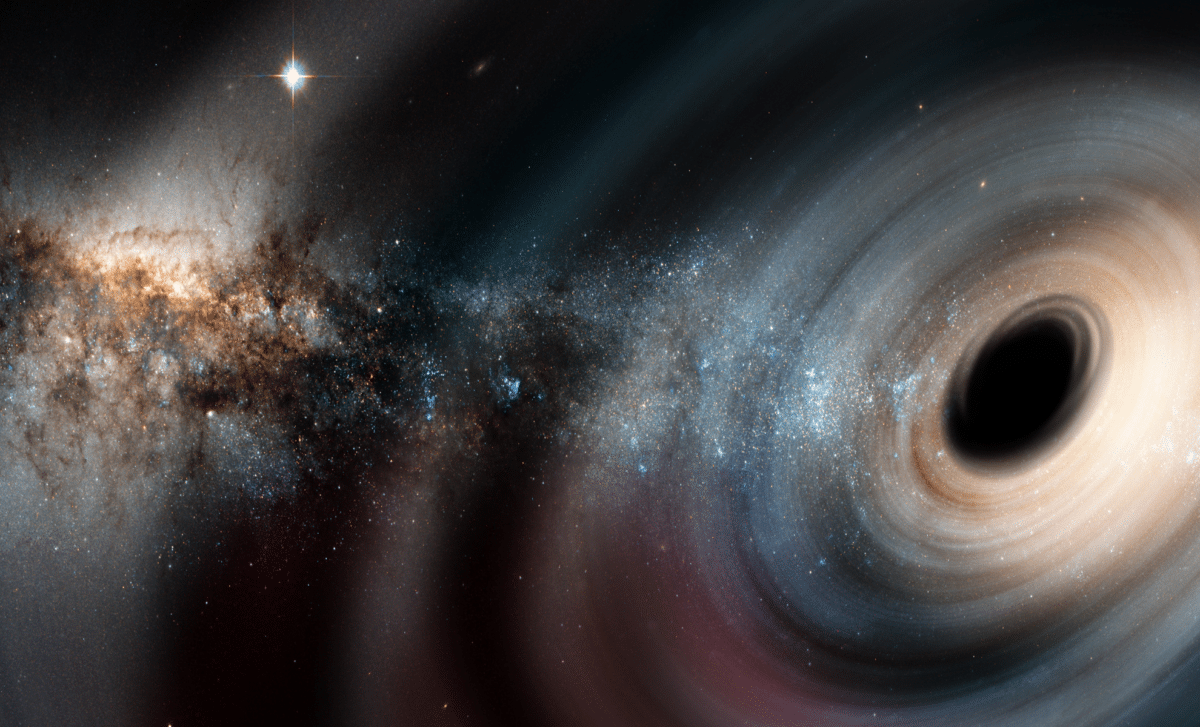
The XRISM spacecraft has captured the dramatic awakening of a supermassive black hole, IRAS 05189-2524, as it fires cosmic bullets into a starburst galaxy. This extraordinary discovery offers an unprecedented view into the violent dynamics at play between black holes and the galaxies that house them. These new results, soon to be published in a special edition of the Astrophysical Journal Letters, could radically reshape our understanding of how black holes influence their cosmic environments.
The Awakening of a Giant
The XRISM spacecraft, launched by the Japan Aerospace Exploration Agency (JAXA), has provided scientists with a front-row seat to one of the most violent phenomena in the universe. At the heart of a starburst galaxy, the supermassive black hole IRAS 05189-2524, which had been dormant for eons, suddenly erupted into action. The spacecraft observed this black hole firing highly energetic matter, referred to as cosmic bullets, at high speeds, shooting vast distances into space.
This outburst marks a significant moment in astrophysical research, as it reveals the complex mechanisms of black hole activity. Until now, such violent eruptions have only been theorized or observed in other galaxies, but XRISM’s detailed imaging has given scientists a rare opportunity to study this event in real-time. The cosmic bullets expelled by the black hole are believed to be composed of hot gas and matter, streaming out from the black hole’s accretion disk, a region of intense gravitational pull where matter spirals in before being consumed.
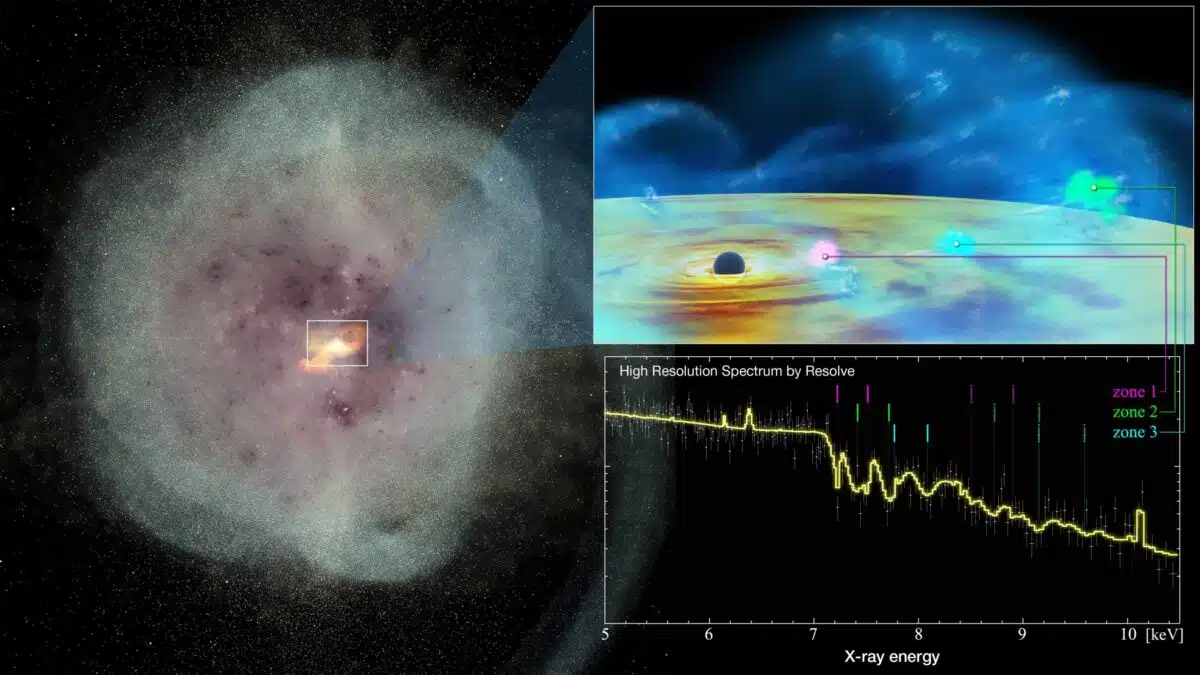 Figure 1: Artist’s concept of a supermassive black hole becoming active at the center of a starburst merging galaxy (left and top right). The bottom right panel shows the X-ray spectrum obtained by Resolve onboard XRISM. The horizontal axis represents the rest-frame energy in kiloelectronvolts (keV). Absorption lines from hydrogen-like and helium-like iron ions within the bullet-like ultra-fast outflows, ejected from the vicinity of the black hole, are observed. These lines are separated by the Doppler effect, corresponding to three distinct velocities, approximately 7.5% (Zone 1), 10% (Zone 2), and 14% (Zone 3) of the speed of light. (Credit: JAXA)
Unveiling the Link Between Black Holes and Galaxies
While the visual spectacle of cosmic bullets is captivating, the real significance of this discovery lies in the potential to understand how black holes influence the evolution of their host galaxies. The intense energy released by these black holes can have a profound effect on the surrounding environment. In starburst galaxies like IRAS 05189-2524, rapid star formation takes place, with new stars being born at an accelerated rate. The cosmic bullets from the black hole could be a crucial factor in regulating this star formation process, either by stimulating or quelling it, depending on their intensity and frequency.
Furthermore, the energy from black holes may contribute to the overall dynamics of galactic gas. When black holes shoot out matter at such high velocities, it can clear paths through dense gas clouds, impacting the conditions for further star formation. Understanding how these interactions unfold could provide insights into the delicate balance that governs galaxy growth.
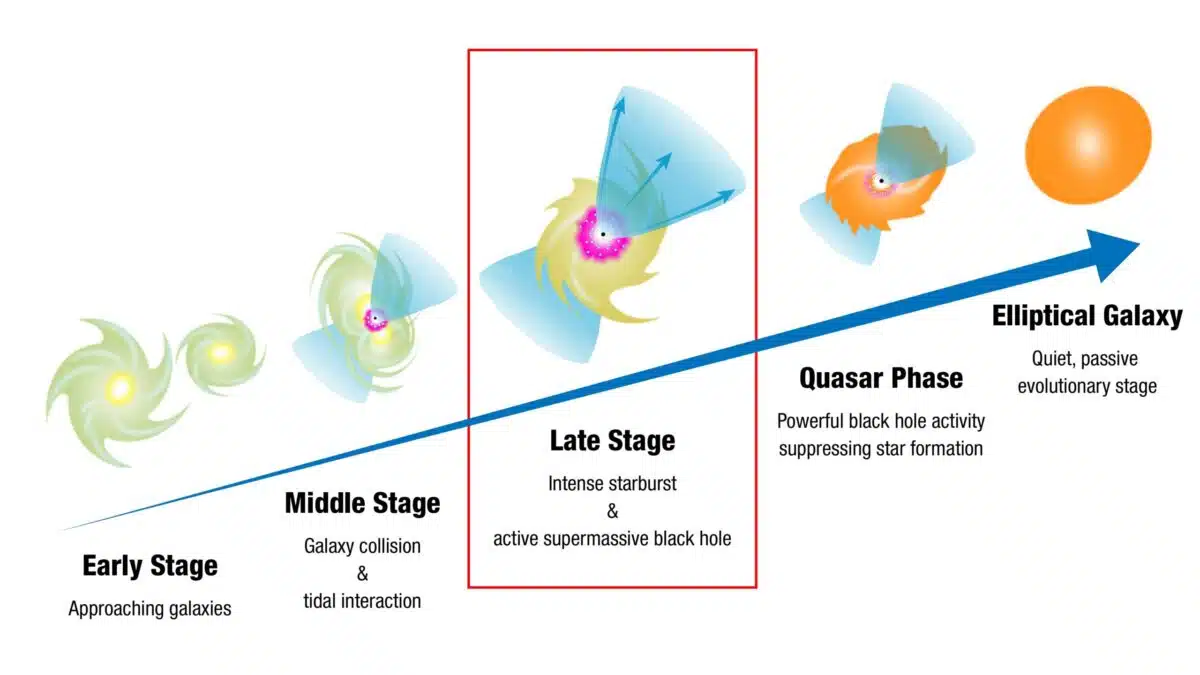 Schematic diagram showing the evolutionary process triggered by galactic mergers. In the late stage of a merger, explosive star formation progresses throughout the galaxy while the central supermassive black hole becomes active as an active galactic nucleus. It is thought that the influence of the active galactic nucleus subsequently suppresses star formation, leading the system through a quasar phase and eventually evolving into a galaxy in its quiet, mature stage. IRAS 05189-2524, the focus of this study, is in the late-merger stage, where explosive star formation and an active galactic nucleus coexist.
(Credit: JAXA)
The Role of XRISM in Astrophysical Research
The XRISM spacecraft is a joint effort between NASA, JAXA, and the European Space Agency (ESA). Equipped with advanced X-ray detectors, XRISM is designed to study high-energy phenomena in the universe, such as black holes, neutron stars, and supernovae. The spacecraft’s high-resolution imaging capabilities allowed it to capture unprecedented data on the cosmic bullets fired by IRAS 05189-2524, marking a pivotal moment in observational astrophysics.
This discovery is not just about studying a single black hole; it provides a glimpse into the behavior of black holes at large. By observing these cosmic events, scientists hope to unravel the fundamental processes that govern the interactions between black holes and their host galaxies. With the publication of these findings in the Astrophysical Journal Letters, the scientific community will have access to a wealth of new data that could guide future research into the formation and growth of galaxies.
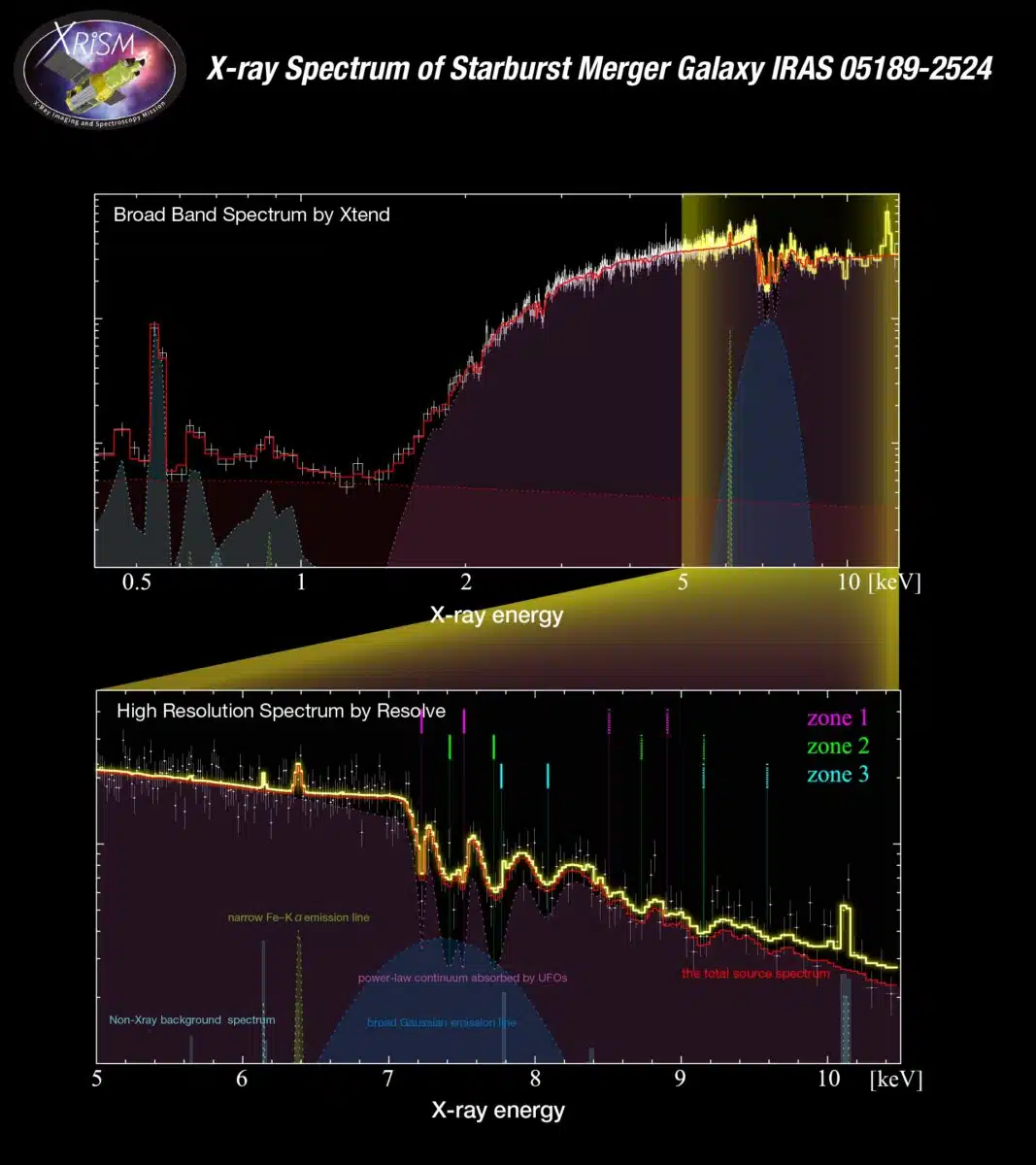 Observation results from XRISM. The top panel shows a wide-band X-ray spectrum obtained by Xtend representing the energy distribution as observed from Earth in kiloelectronvolts (keV). It indicates that emissions below approximately 1.5 keV are dominated by radiation from the entire merging galaxy, while higher energy components originate from the vicinity of the active supermassive black hole at the center. The bottom panel displays the high-precision X-ray spectrum from Resolve converted to the rest-frame energy in keV. Absorption lines from hydrogen-like and helium-like iron ions within the bullet-like ultra-fast outflows ejected from the vicinity of the black hole were detected, clearly separated according to their respective velocities, approximately 7.5% (Zone 1), 10% (Zone 2), and 14% (Zone 3) of the speed of light. Additionally, a broad emission line, thought to originate from the ultra-fast outflows surrounding the black hole, was captured simultaneously.
(Credit: JAXA)
New Insights into Galactic Evolution
The XRISM spacecraft’s observation of IRAS 05189-2524 could provide new insights into the broader question of how galaxies evolve over time. While the majority of galactic evolution theories focus on the processes occurring within the galaxy itself, this discovery emphasizes the importance of the supermassive black hole at the center. The interaction between black holes and their galaxies may be a crucial driver in shaping their development, influencing everything from star formation to the growth of galactic structures.
As scientists continue to analyze the data collected by XRISM, they hope to answer key questions about the role of black holes in cosmic evolution. How do these massive objects influence the galaxies they inhabit? What happens when a black hole “wakes up” after a period of dormancy? The answers to these questions could open up entirely new avenues of research into the life cycles of galaxies and the central role played by black holes.