
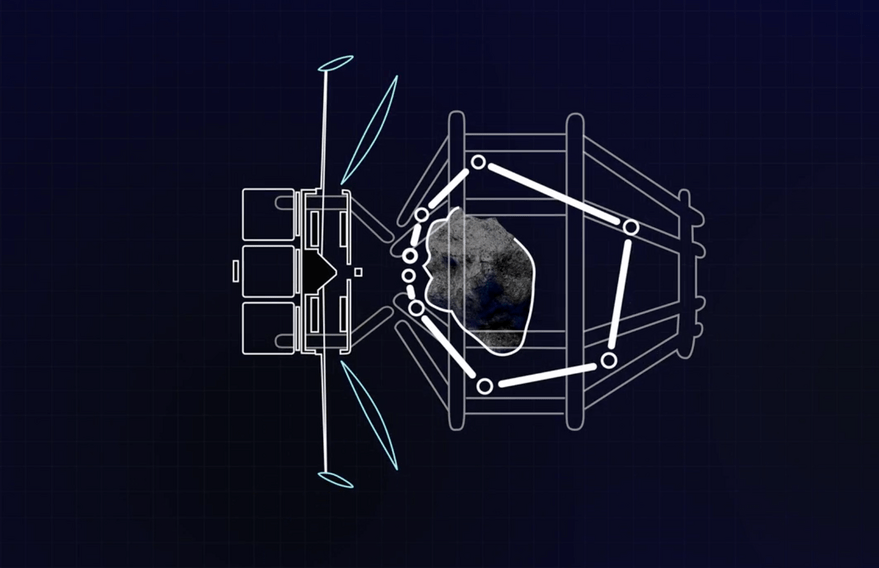
SAN FRANCISCO — TransAstra is performing a study, funded by investors and customers, to explore the technical feasibility of moving a 100-metric-ton asteroid to a stable near-Earth orbit.
“We want to bring an asteroid to the Earth-moon system and turn it into a robotic research outpost for materials processing and manufacturing in space,” Joel Sercel, TransAstra founder and CEO, told SpaceNews.
Working with the University of Central Florida, Purdue University, the California Institute of Technology and NASA Jet Propulsion Laboratory, Los Angeles-based TransAstra will identify suitable asteroids, analyze their trajectories and select spacecraft to perform the mission, called New Moon.
TransAstra’s first asteroid-retrieval mission could launch later this year and rendezvous with an asteroid in 2028 or 2029. Through hundreds of subsequent robotic missions in the 2030s, TransAstra could aggregate a million tons of asteroid material for space industrialization, Sercel said.
Some near-Earth asteroids “contain metals we can use for manufacturing or water that can be converted into rocket propellant,” Robert Jedicke, University of Hawaii research astronomer and TransAstra consultant, said in a statement, adding that all asteroids “contain inert material that can provide radiation shielding for spacecraft and crews.”
Asteroids are the most accessible material in the solar system and the ability to exploit their resources could transform space operations, Daniel Britt, University of Central Florida astronomy and planetary sciences professor and a TransAstra consultant.
“If we can learn to use resources that already exist in space — water for fuel, metals for construction, minerals for anything from radiation shielding to solar panels — it reduces the need to expensively launch everything from Earth’s deep gravity well,” Britt said in a statement. “That’s a major step toward a sustainable space economy.”
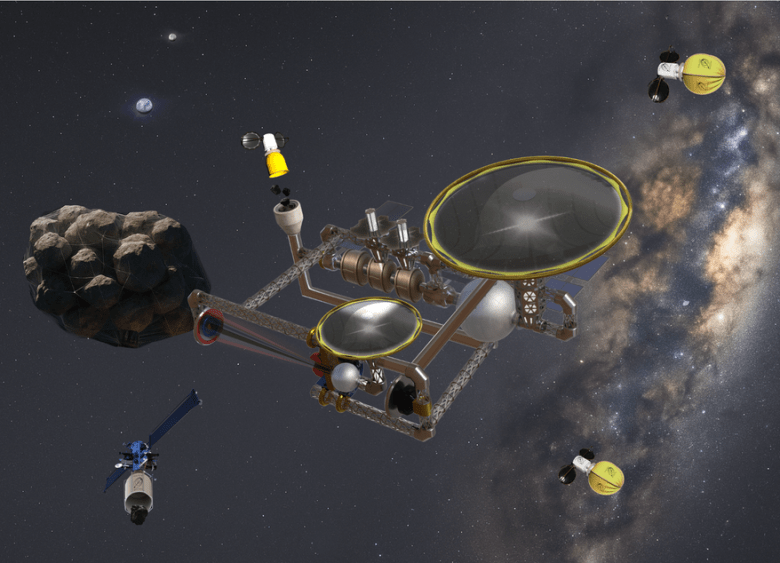 TransAstra plans to bring an asteroid to the Earth-moon system to establish an outpost for robotic research outpost and materials processing. Credit: TransAstra
Detecting Asteroids
TransAstra estimates that roughly 260 asteroids with diameters of 20 meters or less will be discovered in the next several years thanks to the commissioning of the Vera C. Rubin Observatory in Chile and other advances in sky-survey technology. With Space Force funding, TransAstra also has deployed Sutter telescopes in Spain, Australia, Arizona and California for tracking satellites and asteroids.
For more than a decade, TransAstra has developed technologies for asteroid mining, while performing work under contracts with the U.S. Air Force, U.S. Space Force, NASA and other government agencies.
Asteroid mining companies have drawn the attention of the Space Force because the technologies they are developing have dual-use applications beyond geosynchronous orbit. TransAstra employees and partners “holds 23 patents covering the four key technological areas required for asteroid mining: detection, capture, movement and processing of space resources,” the company said in a news release.
Capture Bag
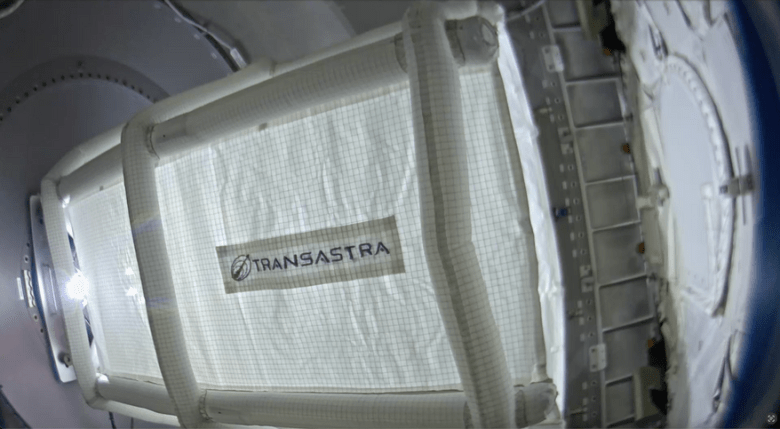
Last year, TransAstra won a $2.5 million NASA’s Commercial Research and Products Program contract and matching private investment to produce and flight qualify an inflatable 10-meter asteroid Capture Bag. A one-meter version of the TransAstra Capture Bag was inflated in the International Space Station Bishop Airlock in October.
“We demonstrated that we can deploy and retrieve the bag multiple times in a microgravity vacuum environment,” Sercel said. “This was a critical de-risking milestone — the first time our core inflatable capture technology has operated in space — laying the foundation for operational orbital debris remediation and asteroid capture.”
TransAstra plans to test the 10-meter Capture Bag in the NASA Jet Propulsion Laboratory Spacecraft Assembly Facility High Bay.
Related