
Iranian authorities have issued stark warnings ahead of Chaharshanbeh Suri as officials point to what they describe as wartime conditions and the risk of unrest.
Police commander Ahmadreza Radan said this year’s celebrations come under “different circumstances,” adding that the country is effectively in a state of war and that emergency and medical services are on high alert.
He warned that adversaries could exploit the night’s gatherings, saying there is a possibility that “agents” could blend into crowds celebrating the festival and trigger incidents or casualties to inflame the situation.
In a separate notice, the Intelligence Ministry urged citizens to remain vigilant, claiming that “a small number of Israeli soldiers” may attempt sabotage during the festivities and calling on people to report suspicious activity.
The messaging has been reinforced by a broader security buildup. Reports indicate increased coordination among police, intelligence, and judicial bodies, alongside threats of decisive action against what officials describe as dangerous behavior.
In some areas, people have been encouraged to hold events in mosques and controlled spaces rather than in the streets.
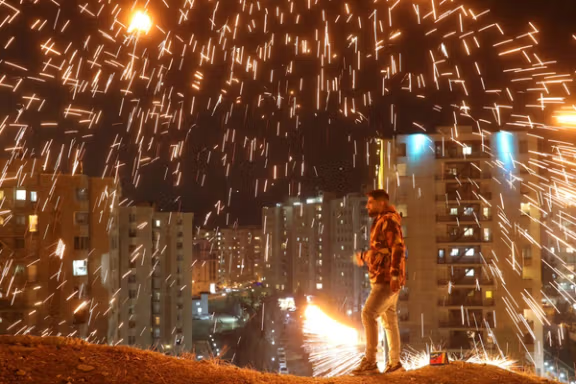 An Iranian man lights a firework during the Wednesday Fire celebration (Chaharshanbeh Suri in Persian) at a park in Tehran, Iran. (2024)
Contest over public space, culture and control
Yet Chaharshanbeh Suri has rarely stayed contained.
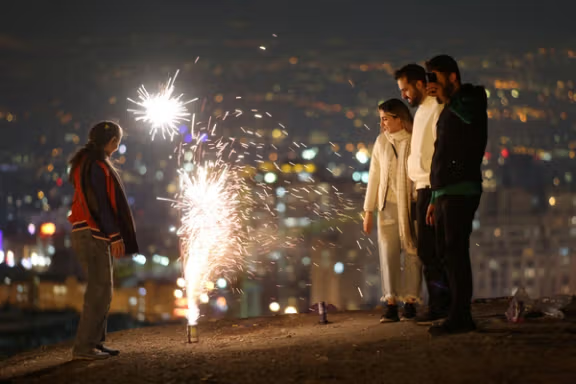
Celebrated on the eve of the last Wednesday before Nowruz, the festival – marked by bonfires, fireworks, and the ritual of jumping over flames – predates Islam and has endured for centuries. In recent years, it has taken on an added meaning, evolving into one of the few nights when large numbers of people gather spontaneously in public spaces.
That scale has made it difficult to control. It has also turned the festival into a recurring flashpoint.
Last year, crowds across multiple cities poured into the streets despite heavy security presence. Clashes broke out in several areas, leaving at least 19 dead and thousands injured. Videos showed bonfires lighting up neighborhoods as music, chanting, and fireworks filled the air.
In earlier years, the night has gone further, with young people using firecrackers and homemade devices to confront security forces, chanting slogans, and in some cases burning photos of late Supreme Leader Ali Khamenei.
The pattern has become familiar: warnings ahead of the night, followed by mass turnout, and then confrontation.
This year, however, the backdrop is markedly different.
Iran is in the midst of an escalating conflict, with the United States and Israel striking targets linked to military and security structures. A strike announced on Tuesday killed the IRGC Basij commander Gholamreza Soleimani, a key figure in crowd control and repression.
Against that backdrop, officials have framed the festival not only as a safety concern but as a potential security threat.
‘A symbol of resilience’
Exiled Prince Reza Pahlavi, in an interview with Iran International earlier this week, said the festival carries a deeper meaning beyond tradition.
“When we celebrate Chaharshanbeh Suri today, it is not only to preserve our culture,” he said. “It is a powerful message to those who have always tried to erase our identity… an opportunity to show that we exist – to ourselves and to the world.”
He also pointed to a broader generational shift, saying: “Today everyone has reached the conclusion that a secular system is needed… a system built on ideology has, from the beginning, imposed discrimination on society.”
At the same time, he framed the preservation of cultural traditions as central to Iran’s resilience, adding that the country has endured “because of the courage of its people and the preservation of Iranian culture.”
His call to mark the night has been echoed among parts of the diaspora, including appeals for gatherings outside Iranian embassies, while inside the country officials have warned that participation could carry consequences.
The tension between these two narratives – celebration and control – is not new.
As analyst Morad Vaisi has noted, the confrontation over festivals like Nowruz and Chaharshanbeh Suri reflects a deeper struggle.
These traditions, he wrote, have endured not because of official backing, but because of people’s resistance to cultural pressure, becoming a symbol of identity and continuity beyond political systems.
Each year that people gather despite restrictions, the act itself sends a message that Iran’s cultural life extends beyond those in power.
That dynamic is expected to be on full display again tonight.
But this year, the familiar sounds of celebration will unfold alongside something heavier: a country under bombardment, a heightened security presence, and warnings that frame even small gatherings as a potential threat.
In past years, Chaharshanbeh Suri has often blurred the line between festivity and confrontation.
As darkness falls, that line may once again be tested – raising expectations of large turnouts, and concern that the night could end, as it has before, with violence and more lives lost.