
Dr. Uzi Rubin tells TML that stopping missiles at high altitude remains the only effective defense once submunitions are released
“After the cluster has opened, it’s too late,” Dr. Uzi Rubin, one of Israel’s leading missile defense experts, told The Media Line.
Rubin’s warning comes as analysts and defense officials examine the use of cluster warheads in missiles launched from Iran during the recent war with Israel. The weapons, which disperse multiple smaller bomblets instead of a single explosive payload, have drawn renewed attention from missile defense specialists.
The core challenge, Rubin said, is simple: A ballistic missile carrying a cluster warhead must be intercepted before the payload opens and releases its submunitions. Once that happens, the missile is no longer a single target, and the chance of stopping its full effect drops sharply.
Rubin, the founding director of Israel’s missile defense program and now a senior fellow at the Jerusalem Institute for Strategy and Security, led Israel’s Missile Defense Organization from 1991 to 1999, overseeing the development and deployment of the Arrow, Israel’s first national missile defense shield. He later served as senior director for proliferation and technology at Israel’s National Security Council, directed major defense programs at Israel Aerospace Industries and the Defense Ministry, and was a visiting scholar at Stanford’s Center for International Security and Arms Control. He received the Israel Defense Prize in 1996 and 2003, as well as the US Missile Defense Agency’s David Israel Prize.
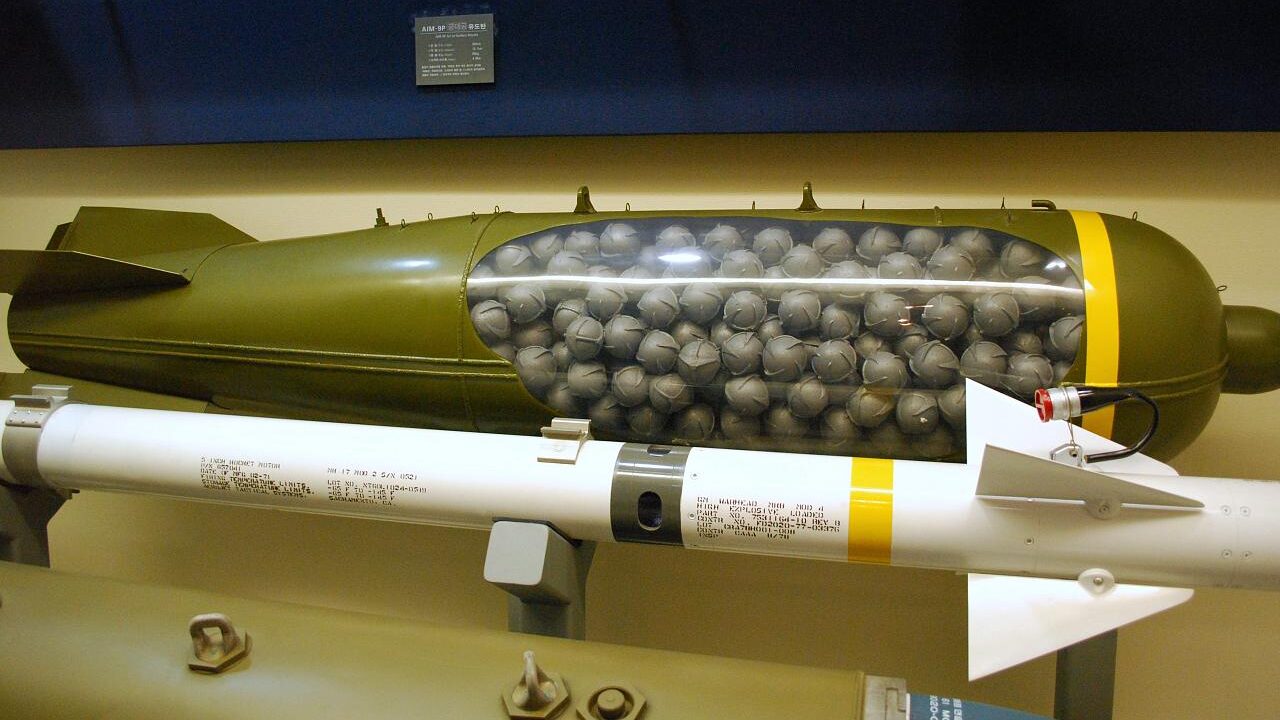
To explain the weapon, Rubin started with the basic concept. “What is a cluster warhead?” Rubin said. “A cluster warhead is a class of bombs, which were more famously used in the Vietnam War and other wars. It’s a bomb which contains, instead of one big barrel of explosive, it contains a lot of small bomblets.”
He then described what happens as the missile nears its target. “So a cluster warhead for a missile is the same thing,” Rubin said. “The tip of the missile, instead of containing a big barrel of explosives, contains a mechanism which holds on to a lot of small bombs. And when the missile approaches the target, it opens its skin, it peels off, and it spins around, and the bomblets are released and released into space and fall on the ground.”
Iran’s missile program includes a range of ballistic systems developed over decades, and according to Rubin, many of them can carry more than one type of warhead. “Every one of their missiles, and they have several types, heavier ones, smaller ones,” he said. “For each one of them, they have a regular warhead or a cluster warhead.” The number of submunitions varies depending on the missile and payload capacity. “Cluster warheads can contain, let’s say, from 20-30 bomblets to 70-80 bomblets; it depends on the type of the missile.”
From a defensive standpoint, timing is everything. Missile defense systems must destroy the incoming missile while the warhead is still intact. Once the cluster mechanism activates and disperses the bomblets, interception becomes far less effective because the payload has already separated.
“Interception usually is done if it’s successful,” Rubin said. “It’s not always successful. It’s above the altitude where it opens there, and it disperses the cluster, when it’s still held in one piece.”
Technical assessments suggest that the altitude at which cluster warheads disperse their payload is relatively low compared with the height reached by ballistic missiles during flight. “In the papers, they say that the opening altitude of clusters is a dispersed altitude of 7 kilometers,” Rubin said. “Seven kilometers is pretty low. Most of the interception is done above that.”
You have to intercept them well away from the target
In Rubin’s view, cluster warheads do not fundamentally alter the defensive equation. The strategy remains the same as with conventional ballistic missiles: Destroy the missile as early as possible in its trajectory, well before it reaches the target area. “So, there is no difference in intercepting cluster warheads than the regular warhead,” he said. “You have to intercept them well away from the target.”
Once a missile descends below a certain altitude, interception becomes much more difficult regardless of the warhead type. “After the cluster has opened, it’s too late,” Rubin said. “But anyway, even if there’s not a cluster, a unitary bombhead, a barrel, below a certain altitude, you cannot intercept it anymore. It’s too late.”
That point also helps explain a common misconception about Israel’s missile defense network. Iron Dome is built to stop short-range rockets, while Arrow is designed to intercept long-range ballistic missiles high above Israeli territory. In other words, the system most associated internationally with Israel’s air defense is not the one meant to handle this kind of threat. “The Iron Dome is too low for that,” Rubin said. “The Iron Dome is not designed against that. It’s designed against a short-range rocket.”
Cluster warheads and conventional warheads, Rubin said, are built for different tactical effects. Cluster munitions are meant to spread damage across a wider area, making them more dangerous to exposed troops and unprotected sites. “It depends for what use,” Rubin said. “A cluster warhead is very dangerous against troops in the open, against installations which are not protected.”
By contrast, traditional warheads concentrate their destructive power in a single impact point. “A unitary warhead is more dangerous to, like you saw what happened last night in that village … that was a unitary warhead,” Rubin said.
A cluster warhead is very dangerous against troops in the open, against installations which are not protected
Each bomblet is relatively small compared with the explosive payload of a ballistic missile, but the cumulative effect can still be deadly. Rubin compared the impact of the submunitions to rockets commonly fired by terrorist groups from Gaza. “No, it’s a small bomb,” he said. “The effect is like a Grad, a rocket that comes from Gaza. It can be fatal.”
Rubin said the cluster warheads used in the conflict are not a new development. Asked whether the versions used in the recent fighting differed from those launched in earlier exchanges between Iran and Israel, he gave a short answer. “Same thing,” he said. “They fired less of them, but it’s the same thing.”
For Rubin, the broader issue is not the novelty of the weapon but the narrow window for stopping it. Missile interception comes down to altitude and seconds. If the missile is destroyed early, the warhead never opens. If it is not, defense gives way to damage control.