
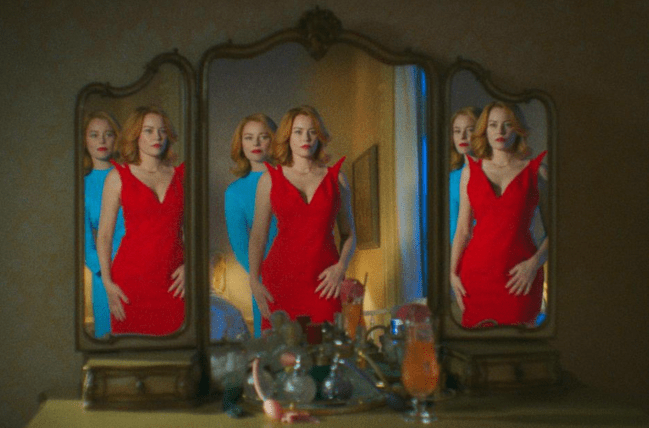
Utilizing techniques adapted from filmmaking and aesthetics that put a surreal spin on Old Hollywood glamour, Alex Prager’s work blends still images and moving ones. It’s surprising that it’s taken her this long to direct a feature, especially considering that the Los Angeles-born photographer has also been making short films since the early 2010s. In this way, “DreamQuil” is more of a culmination than a new chapter: Elizabeth Banks, who also appeared in Prager’s 2013 short “Face in the Crowd,” even wears the same carrot-orange hair and tomato-red lipstick combination as Bryce Dallas Howard in Prager’s early film effort “Despair.”


But the further Prager expands her filmmaking efforts, the more she becomes beholden to the demands of narrative as well as lighting, composition, and color. And as it sometimes goes with visual artists who make the transition to storytelling, the narrative is the weakest element of Prager’s feature debut. “DreamQuil” poses some compelling questions about the implications of outsourcing human relationships to machines, a relevant topic in the age of AI “companions” and startups promising to upload deceased loved ones to the cloud. Prager is not the first filmmaker to address these topics, however, and her insights into them are minimal.
The most frustrating thing about “DreamQuil” is its failure to follow through with conclusions to its hypotheses. Of course, it’s not on Prager and her co-writer (and sister) Vanessa Prager to single-handedly solve one of the biggest existential problems facing humanity in the 21st century. But making an observation is not the same thing as having a point of view, and more thoughtful answers to the film’s many questions — really, all we get are a few shots of protestors carrying signs that read “Think While You’re Still Human” — would have helped “DreamQuil” immensely from a narrative standpoint.
As it is, the story is inconclusive, shifting gears every time it seems like it’s about to have something to say. One thing that remains consistent throughout is our protagonist Carol (Elizabeth Banks) and her dissatisfaction with her life. She’s doing well enough at her job, but has yet to receive the promotion she craves. Her husband Gary (John C. Reilly) is attentive, but uninterested in sex. And she has trouble connecting with her son Quentin (Toby Larsen), who tells her early on that he doesn’t really like spending time with her.
Of course, it doesn’t help that the only way Carol can see her friends is virtually, as the air in what’s presumed to be near-future California is too polluted to go outside without a doll-like plastic mask attached to the lower half of one’s face. The psychological atmosphere is suffocating as well, so much so that a “Metropolitan Suicide Division” comes to clean up the woman who jumps off the balcony of the family’s apartment in the opening scene. Who is she? We’ll find out, albeit too late for it to matter much.
And so, as in our current late-capitalist dystopia, Carol seeks a consumerist solution to her existential issues, enrolling in the heavily advertised women’s wellness program that gives the film its name. Her friend Rebecca (Sofia Boutella) tells her it’s like “digital ayahuasca,” a way to reset her brain chemistry and her attitude in the process. Once Carol commits to the DreamQuil process, a nurse in a baby-pink uniform played by Juliette Lewis injects her with a syringe full of a glittery purple substance, prompting total ego death as Carol re-experiences the day where she almost drowned in the ocean — except this time, Gary doesn’t jump in to save her.
This sense of domestic insecurity carries through the remaining two-thirds of the film, which incorporates doubles, cyborgs, and holographic recreations of the film’s female characters. Again, there’s something here about misogyny and objectification, but Prager never really gains a firm grasp on the theme. Instead, she uses these figures as props in an exercise in retro-futuristic kitsch that plays a bit like “The Stepford Wives” — which is referenced explicitly in the dialogue — shot in the style of a Douglas Sirk ‘50s melodrama.
The dialogue is arch, the music cues are knowing, and the performances are just a little stiff, all the better to pair with the hard plastic shells of the mechanical caregivers who are supposed to make Carol’s life easier, but just end up making her feel worse. These combine with old-fashioned visual effects that evoke Technicolor classics like “The Wizard of Oz;” this reference pops up throughout the film, including the field of poppies that surrounds Carol during a masturbatory “Minx” session in the family’s egg-shaped virtual reality pod.
The blend of era-specific references in “DreamQuil” is very deliberate, incorporating objects and fashions from approximately the 1940s through the ‘80s. Here, Prager is confident and not afraid to make a statement: The compositions are as meticulously composed as one might expect from a fine art photographer, making striking use of refracted images and shallow depths of field. The use of color is exquisite, as Prager pairs buttery yellows, mint greens, vivid blues, and vibrant reds. Every aesthetic element in this film is impeccably judged: At one point, Carol’s lipstick, nails, heels, and pen all match, and the effect is breathtaking.
But while simply admiring the look of “DreamQuil” is enough to sustain interest throughout the film’s abbreviated 89-minute run time, it also means that what sticks in the viewer’s memory after it’s over is a series of images and not ideas. In a way, this is appropriate for a movie about a woman who feels as though she’s been hollowed out inside. But in the end, “DreamQuil” is more interested in admiring its reflection in a robot’s shiny metal face than it is in discovering what it really means to be human.
Grade: B-
“DreamQuil” premiered at SXSW 2026. It is currently seeking U.S. distribution.
Want to stay up to date on IndieWire’s film reviews and critical thoughts? Subscribe here to our newly launched newsletter, In Review by David Ehrlich, in which our Chief Film Critic and Head Reviews Editor rounds up the best new reviews and streaming picks along with some exclusive musings — all only available to subscribers.