
Optimising OstraBot to achieve personal bests
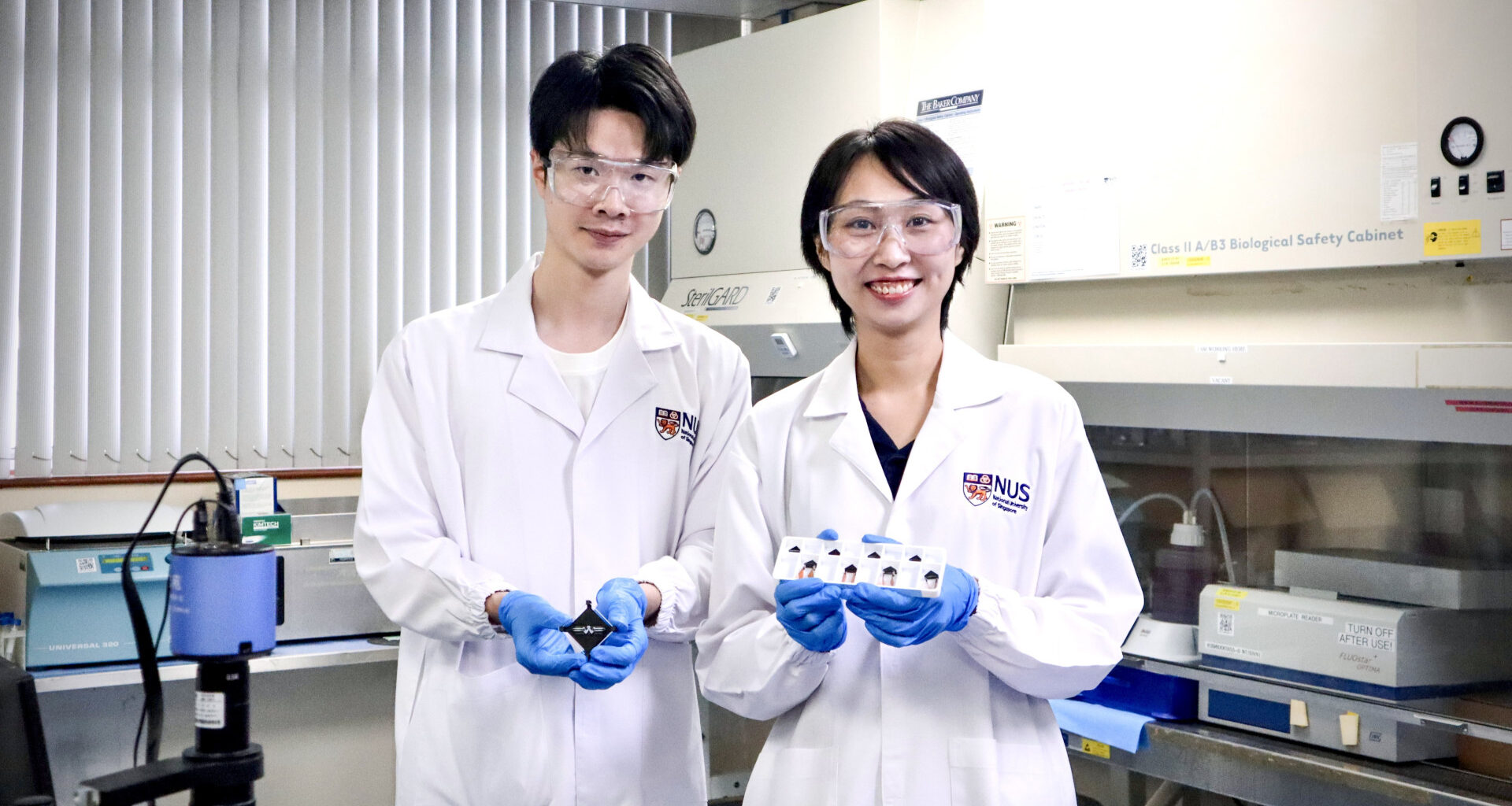
The team developed a physiology-based model tracing the full chain from electrical stimulation through calcium signalling and muscle activation to force output, then used it to guide OstraBot’s design. Inspired by the boxfish, which keeps its body rigid and propels itself entirely by oscillating its tail, OstraBot pairs this model-informed structure with a single trained muscle that drives two flexible tails. At optimal stiffness and 3 Hz stimulation, it swam more than three times faster than an identical robot powered by conventionally cultured muscle.
Beyond speed, the robot demonstrated something equally significant: precise controllability. Its speed could be tuned continuously by adjusting electrical field strength, and a sound-triggered system let it start and stop in response to clapping signals.
“The clap shows that the robot is not just alive – it is controllable. In the past, muscle-powered robots either moved constantly without clear control or were too weak to respond visibly. Our strengthened skeletal muscle allows the robot to react clearly to an external signal, similar to how nerves control muscles in the body,” said Asst Prof Tan. “This demonstrates that biohybrid robots can combine strength with precise regulation, which is essential for real-world applications.”
Robots with a vanishing act
The NUS team is now pursuing systems in which all structural materials are biodegradable – robots that perform their function and then safely break down. Possible applications include environmental monitoring devices deployed in sensitive ecosystems such as wetlands or coral reefs, as well as temporary implantable tools that perform a clinical task before dissolving inside the body, eliminating the need for surgical retrieval.
“Strength is one important milestone, but long-term stability, energy efficiency and lifecycle design are equally important,” said Asst Prof Tan. “Ultimately, we aim to develop biohybrid machines that are not only high-performance but also environmentally responsible by design.”
The team’s next steps include integrating biodegradable structural materials, refining control strategies and improving the durability and efficiency of muscle-powered robotic systems.