
Following the sweeping visual overhaul introduced in One UI 8.5, Samsung’s upcoming One UI 9.0 update appears to be taking a more measured approach. Rather than reinventing the wheel, the South Korean tech giant is focusing on interface refinements, enhanced privacy controls, and deep integration with the core features of Android 17.
Here is everything we know so far about the next evolution of Samsung’s software ecosystem.
One UI 9.0: Subtle Design Tweaks and a “Glassy” Finish
Because One UI 8.5 delivered such significant design changes, One UI 9.0 is expected to refine rather than replace. Early observations reveal thicker display brightness and volume sliders, alongside a visually engaging lock screen media player widget that now features colorful waveform animations.
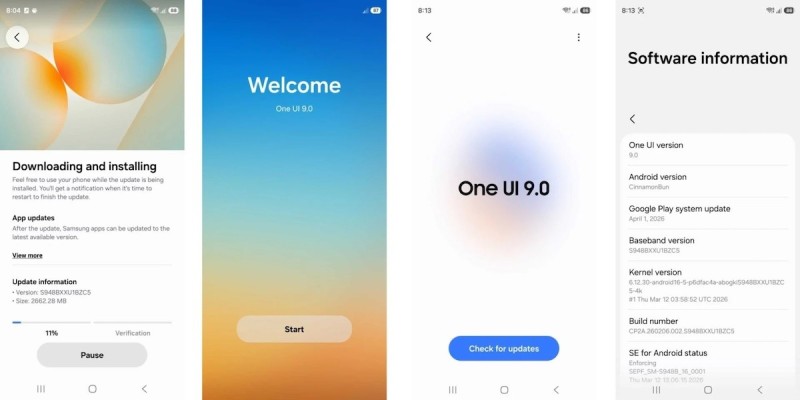
Minor interface adjustments are scattered throughout the system. The lock screen media player now displays a more intuitive “This Phone” prompt instead of the technical “Media Output” when selecting audio devices. Additionally, select media controls have transitioned from rounded rectangular containers to sleek circular buttons. While most native apps retain their One UI 8.5 aesthetic, industry insiders suggest that future beta builds may introduce more “glassy” UI effects across the operating system.
New Features and Android 17 Under the Hood
Beyond the surface, One UI 9.0 is fundamentally built on Android 17, bringing a host of platform-level upgrades to Galaxy devices.
Key enhancements include:
Next-Gen Multitasking: Users will be able to open any application in a floating bubble.
Adaptive App Sizing: Google is cracking down on locked orientations and aspect ratios, forcing developers to optimize their apps seamlessly across phones, foldables, and large tablets.
Heightened Privacy: A new system-level contacts picker restricts apps to accessing only the specific contacts a user approves, replacing the old “all-or-nothing” permission model. Advanced Protection Mode has also been added for tighter device security.
Advanced Connectivity: Android 17 improves support for direct satellite connectivity in areas without cellular reception and refines distance measurement for ultra-wideband (UWB) compatible devices.
System Reorganization: Samsung has notably extracted Parental Controls from the Digital Wellbeing menu, granting it a dedicated, easier-to-find section within the main Settings app.
With Google I/O 2026 on the horizon, more Android 17 features are expected to be announced, many of which Samsung will likely integrate and customize for the Galaxy ecosystem.
Release Timeline: When to Expect the Update
The official rollout for One UI 9.0 is slated for mid-2026. Samsung’s highly anticipated foldables—the Galaxy Z Flip 8 and Galaxy Z Fold 8—are expected to be the first devices to ship with the new software out of the box.
Leading up to the launch, Samsung will likely initiate the One UI 9 Beta Program for select flagship models, including the Galaxy S26 series. Following the initial release, stable updates will cascade down to older flagships, tablets, and eventually mid-range and entry-level devices.
Eligible Devices list for One UI 9.0
Samsung’s robust software support policy ensures that a massive portfolio of devices will receive the update. Recent high-end models are guaranteed up to seven major OS updates, while mid-range devices generally receive up to six.
Below is the expected list of Galaxy devices eligible for One UI 9.0:
Galaxy Series
Eligible Supported Devices
Galaxy S Series
S26, S26+, S26 Ultra, S25, S25+, S25 Ultra, S25 Edge, S24 Ultra, S24+, S24, S24 FE, S23 Ultra, S23+, S23, S23 FE
Galaxy Z Series
Z TriFold, Z Fold 7, Z Fold Special Edition, Z Fold 6, Z Fold 5, Z Flip 7, Z Flip FE, Z Flip 6, Z Flip 5
Galaxy A Series
A57, A56, A55, A54, A37, A36, A35, A34, A26, A25, A24, A17, A16 (LTE+5G), A15 (LTE+5G), A07 (LTE+5G)
Galaxy Tab Series
Tab S11 Ultra, Tab S11, Tab S10+, Tab S10 Ultra, Tab S10 FE, Tab S10 FE+, Tab S9 FE+, Tab S9 FE, Tab S9 Ultra, Tab S9+, Tab S9, Tab Active 5 Pro, Tab Active 5
Galaxy F Series
F56, F55, F54, F36, F34, F16, F15, F06
Galaxy M Series
M56, M55s, M55, M54, M34, M16, M15, M06
Galaxy XCover
XCover 7