
‘One cannot properly describe human life unless one bathes it in the sleep into which it plunges night after night and which sweeps round it as a promontory is encircled by the sea’, wrote Marcel Proust. Sleep – and the edge of sleep – are the great incubators of In Search of Lost Time, Proust’s monumental novel about consciousness and memory. Here, sleep is not merely a regular pause for rest but a constitutive and creative part of the human experience.
This idea forms the starting point of a panoramic exhibition about sleep in art at the Musée Marmottan Monet in Paris, curated by science historian Laura Bossi and by Sylvie Carlier, director of the museum’s collections. Focusing particularly on the 19th and 20th centuries, when ideas relating to sleep underwent profound transformations, the curators examine sleep as an object of fascination for science and medicine as well as a mythic and poetic mystery.
This multi-disciplinary approach has delivered other memorable exhibitions in France, such as Mélancolie: Génie et folie en Occident, held in 2005-06 at the Grand Palais, which examined different representations of melancholy, a sacred malady transformed into a psychiatric disorder. Here the scale is smaller and more intimate, but the rich selection of works – drawings, paintings and sculptures – is judicious and illuminating.
The show begins with examples of the many biblical episodes featuring sleep, often as an eclipse of consciousness that happens at times when inconceivable miracles are being performed. An unfinished 1881-82 vertical painting by George Frederick Watts depicts the creation of Eve rising out of the body of a slumbering Adam. A page from a 1380 illuminated manuscript depicts the Resurrection, with the guards fast asleep at the tomb while Jesus rises out of it, and there are 13th– and 15th-century reliefs of the Dormition of the Virgin, a common theme in medieval and Byzantine art, showing Mary lying on a bier surrounded by mourning apostles, in a strange suspended state between sleep and eternal life. Elsewhere are images of torment and nightmare: William Blake’s expressive rendering of Job’s Evil Dreams (1825), in which Job is lying down, desperately pushing away at a satanic figure bearing his own face, while below him three demons endeavour to drag him down into the flames.
Sleep and Death appear as close relatives. A disturbing 1914 portrait by Ferdinand Hodler of his model and lover Valentine Godé-Darel, whose illness and death he chronicled unflinchingly, captures death at work. An 1885 photograph taken by Nadar of Victor Hugo on his deathbed, displayed next to the great man’s plaster death mask, is profoundly moving. In The Lullaby (1894), a closely cropped domestic scene of mourning, the post-Impressionist Edouard Vuillard depicts his elder sister Marie lying in bed, her face looking smudged. Soon after a miscarriage, Marie had left her husband and moved back to the family home. In the painting, watched over by her dark-clad mother, she has once again become a child.
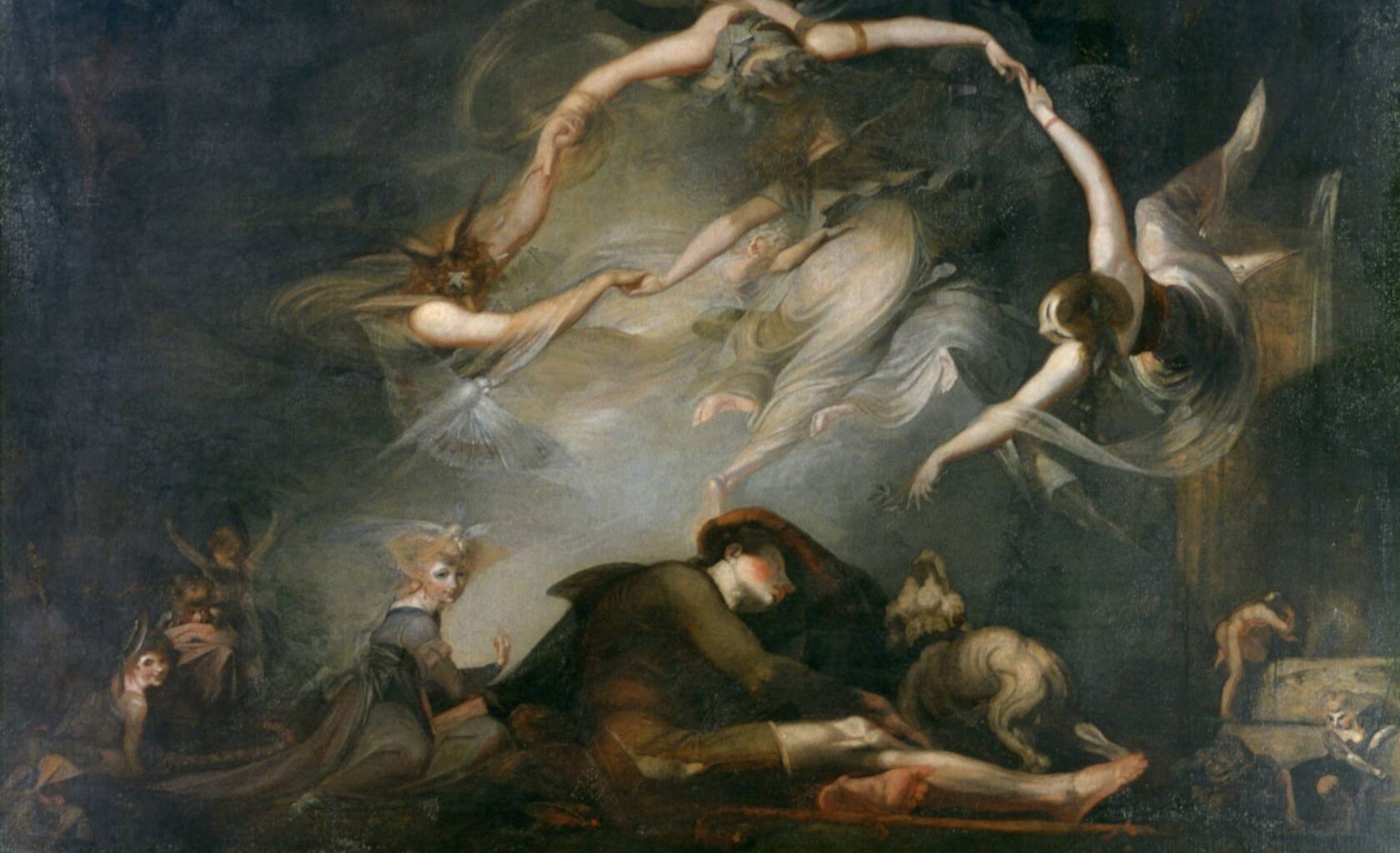
There are many representations of uneasy sleep, from mesmerism, hypnosis and sleepwalking to vivid nightmares: a demonic creature flies out of the window in The Incubus Leaving Two Young Women by Henry Fuseli (1794), while Edvard Munch’s haunted, hollow-eyed self-portrait Le Noctambule (1923-24) is an unforgettable evocation of insomnia. Elusive sleep begets a desire for artificial sleep and narcotics, depicted with decadent abandon in an Orientalist painting of entranced women smoking opium in a low-ceilinged, darkened room by Gaetano Previati (c.1890).
The allure of erotic sleep is illustrated in many guises: recumbent nymphs, Psyche gazing upon a sleeping Cupid, or a sensuous terracotta statue of a half-naked Sleeping Woman by Jean-Baptiste Carpeaux (1876). More unusual examples include a 1933 etching of a Minotaur Caressing the Hand of a Sleeping Girl With His Face by Picasso, some sinuous and elegant 1929 drawings of a sleeping young man by Jean Cocteau, and a dreamlike 1897 painting by Felix Vallotton of a naked woman whose body is cradled in a red chair that rises, like a promontory, out of a red floor.
The fascination of dreams is a pulse throbbing through the whole exhibition, from the oneiric landscape, teeming with fabulous beasts, cherubim, ruins, whirlpools and uncanny effects of light of Giorgio Ghisi’s Allegory of Life (1561) to the cartoonist Jacques Grandville’s hallucinatory 1847 proto-Surrealist seascape, First Dream – Crime and Expiation, featuring fireworks, leaping horsemen, gigantic eyes and carnivorous fish, and Victor Hugo’s charcoal-and-ink image of a haunted castle, Château des Cris-la-Nuit (Castle of Cries-at-Night, 1859), so darkly vaporous that it borders on abstraction. Wonderfully Gothic woodcut illustrations by Gustave Doré of 1860s editions of Dante’s Inferno, Cervantes’ Don Quixote and Milton’s Paradise Lost all have the spectacular quality of waking dreams. Perhaps most memorable of all is the fantastical 1881 series On the Finding of a Glove by German Symbolist artist Max Klinger, in which the artist portrays himself, after picking up a glove lost by a lady at an ice rink, assailed in his sleep by hallucinatory incarnations and adventures of the lost object, the most poignant of which shows Klinger’s arms reaching through broken window panes as the glove is carried away by a pterosaur.
Other inanimate objects endowed with an uncanny presence are beds and bedsheets. Before his masterpiece Liberty Leading the People – which commemorated the July Revolution of 1830 – Eugène Delacroix painted the oeuvre de jeunesse The Unmade Bed (c.1825), an enigmatic watercolour of an empty bed where crumpled sheets fill most of the frame, their disordered folds animated by many different tones of white. Equally unoccupied and inviting speculation is The Bedroom of a Romantic Art Collector (2002), Charles Matton’s boxed diorama of a miniature bedroom filled with paintings and complete with unmade bed, which is both intimate and otherworldly.
This kaleidoscopic exhibition illustrates both meanings of its title: sleep can on the one hand be imagined as a territory, an interior realm of experience that is for the main part obscure and only illuminated intermittently and in parts; and on the other as a force of attraction, a power to be reckoned with. While the French verb ‘s’endormir’ appears to suggest a decision taken by the subject to ‘enter’ willingly ‘into’ sleep, it conveys the same overwhelming experience as the English ‘falling asleep’. There is something magical about this: many of the ordinary sleepers featured in the show, from Claude Monet’s portrait of his infant son, Jean Monet Sleeping (1868), to a 1905 photograph by Emmanuel Bibesco of his brother Antoine and the artist Pierre Bonnard both asleep on a train, appear to us spellbound by the enchanted sleep of fairy tales, like Sleeping Beauty in Gustave Doré’s 1820 illustration, who lies in bed as teeming vegetation threatens to grow over her entire bedroom.
Although we like to imagine it in this way, sleep is in fact an active state, during which we continue to think. L’Empire du sommeil brings to the fore a fundamental cultural shift – accompanying the development of psychoanalysis – from the Greco-Roman idea of dreams as prophetic glimpses of the future to a modern view that they are complicated responses to past experiences. Meanwhile, in our industrial civilisation filled with artificial light, the noises of the city and the radiance of screens, sleep increasingly eludes us and has become an object of desire that we anxiously pursue.