
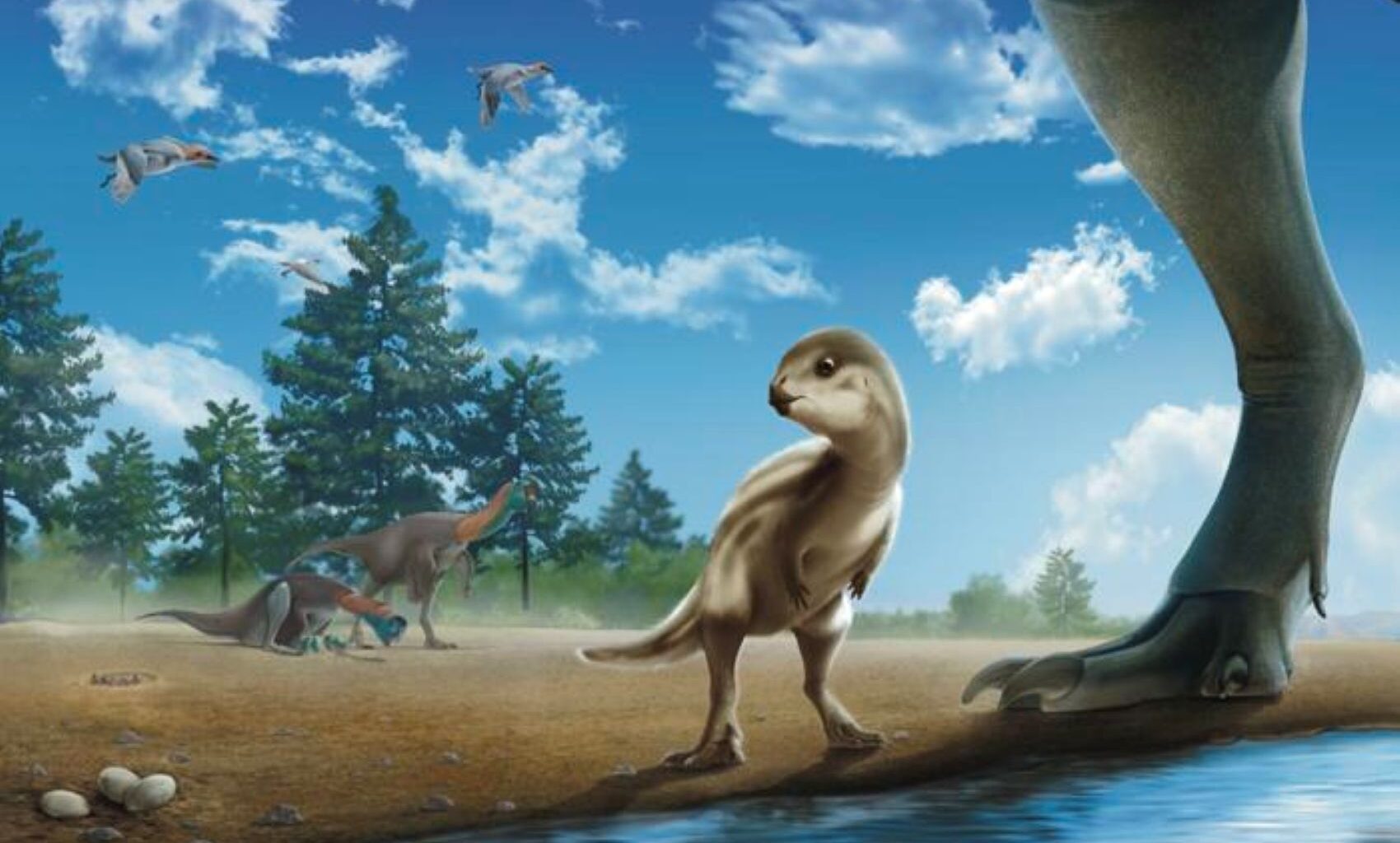
A tiny dinosaur no bigger than a turkey has captured scientists’ attention, and hearts. Researchers from the University of Texas at Austin and the Korean Dinosaur Research Center have discovered an early‑branching neornithischian dinosaur in South Korea and named it Doolysaurus after a famous Korean cartoon character. Its scientific name is Doolysaurus huhmini.
Scientists chose the name because the fossil belonged to a juvenile dinosaur, estimated to be about two years old. Its small size and likely fuzzy appearance made it look surprisingly cute, perhaps even lamb-like.
The name Huhmini honors Korean paleontologist Min Huh, who has spent 30 years studying dinosaurs in Korea, founded the country’s dinosaur center, and worked with UNESCO to protect fossil sites.
The fossil, found on Korea’s Aphae Island, is the first new dinosaur species identified in the country in 15 years. Even more remarkably, it includes rare skull fragments hidden inside rock, revealed using advanced imaging technology.
The study sheds new light on dinosaur diversity in East Asia during the age of dinosaurs.
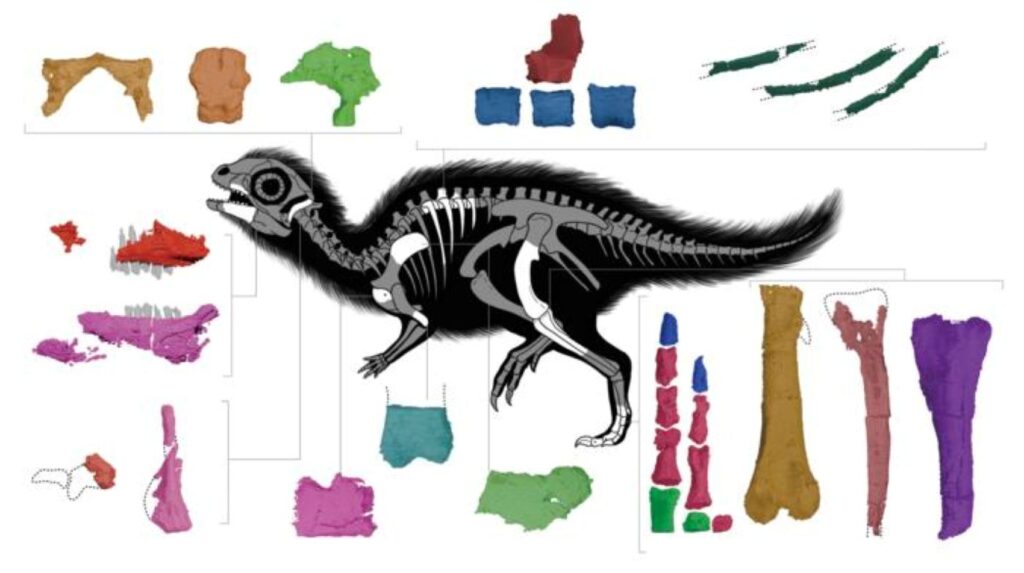 The skeletal anatomy of a juvenile Doolysaurus huhmini. The graphic highlights the fossil bones that were found with the dinosaur
Credit
Janet Cañamar, adapted from Jung et al 2026.
Jongyun Jung, a visiting postdoctoral researcher at UT’s Jackson School of Geosciences, who led the research, said, “When we first found the specimen, we saw some leg bones preserved and some vertebrae. We didn’t expect skull parts and so many more bones. There was a fair amount of excitement when we saw what was hidden inside the block.”
The dinosaur lived between 113 and 94 million years ago during the mid-Cretaceous period. It belonged to a group called thescelosaurids, small, plant-eating or omnivorous dinosaurs that walked on two legs.
Scientists knew it was a juvenile because they saw growth markers in a thin slice of its femur bone. Adult Doolysaurus may have grown to twice the size of the juvenile, and it might have been covered in a fuzzy coat of filaments.
The fossil also contained gastroliths, small stones swallowed to aid digestion. This suggests the dinosaur likely ate a mixed diet of plants, insects, and small animals. The gastroliths prompted scientists to look more closely and examine the fossil. Because these stones are small and light, their staying in place suggested that other parts of the fossil might still be preserved nearby.
Study co-author Julia Clarke, a professor at the Jackson School, said, “A little cluster of stomach stones, with two leg bones sticking out, indicates that the animal was not fully pulled apart before it hit the fossil record. So, I encouraged [Jung and co-authors Minguk Kim and Hyemin Jo] to visit Texas and the UTCT, to try scanning the fossil.”
The fossil is trapped in very hard rock, and it can take an expert nearly 10 years to carefully dig it out by hand. At first, scientists could only see leg bones and vertebrae. But a micro-CT scan at the University of Texas revealed much more hidden inside the rock, including parts of the skull.
This is especially significant because it marks the first Korean dinosaur fossil with preserved skull material in over a decade. It likely would have taken years to discover these fragile bones without CT scanning.
South Korea has numerous dinosaur footprints, eggs, and nests, but actual bones are a rarity. This find adds to insight into what prehistoric life might have been like in the region.
It also demonstrates how advanced imaging tools can uncover fossils that would otherwise remain hidden, opening new avenues in paleo research.
Scientists think there are likely more fossils buried in the islands of Korea. CT scanning suggests lots of discoveries may lie just under the surface. Future studies could yield new dinosaur species, eggs, or more complete skeletons, offering clearer glimpses of ancient East Asia.
Journal Reference:
Jung J, Kim M, Jo H, Clarke JA (2026) A new dinosaur species from Korea and its implications for early-diverging neornithischian diversity. Fossil Record 29(1): 87-113. DOI: 10.3897/fr.29.178152