
A recent study links ground and space-based observations to track structures moving through the solar corona.
It was an amazing sight witnessed during the April 2024 total solar eclipse. For a few precious moments, it seemed like a celestial dimmer switch was thrown, as the Moon eclipsed the Sun. It was one of the very few times you could actually see prominences and the pearly white corona of the Sun in person, without the aid of special equipment.
Now, a recent study out of the University of Hawai’i Institute for Astronomy has linked high resolution images taken during totality with observations from missions orbiting the Sun, in an effort to chronicle the evolution of space weather. In a first, the team has demonstrated that turbulent structures forming deep in the solar corona can survive far from the Sun, as they impact space weather events stretching out across the inner solar system.
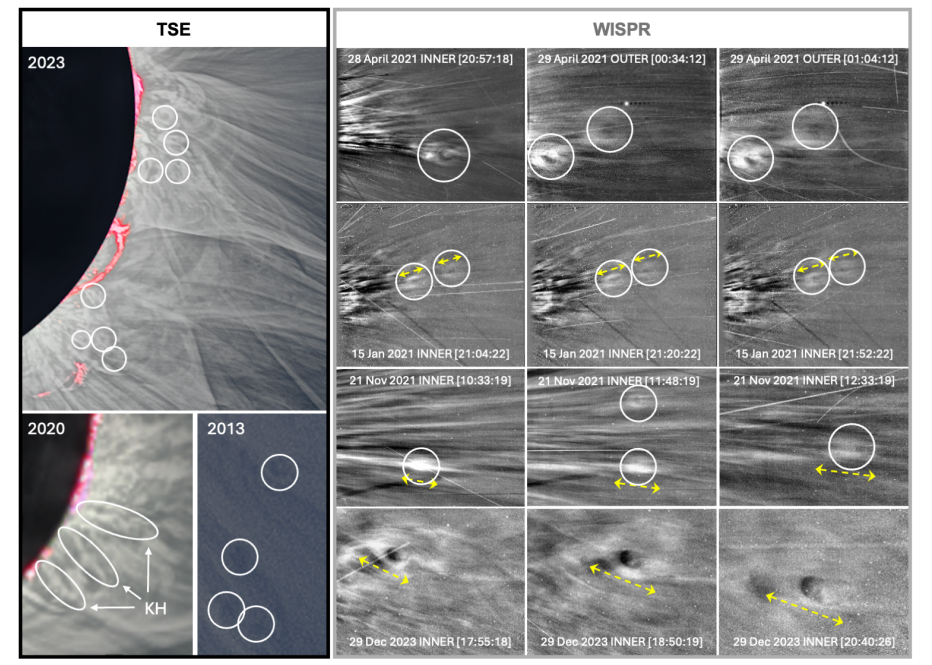 The evolution of vortex rings during the 2020 and 2023 eclipses (left) versus WISPR images showing evolution in the corona. Credit: The Astrophysical Journal/Tracking the Evolution of Plasma Instabilities from the PCTR/Creative Commons Attribution 4.0 license/DOI 10.3847.
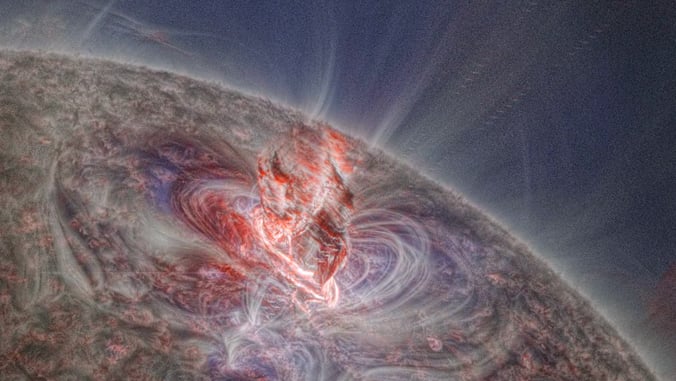
Solar prominences are seen during totality and in the hydrogen-alpha spectrum in the solar chromosphere. Less well understood is what’s known as the solar coronal heating mystery, and why the corona is spikes at 2 million degrees Fahrenheit, hotter than the ‘balmy’ photosphere at 10,000 degrees Fahrenheit below.
Prominences tend to be radically cooler than the plasma they’re embedded within, to the tune of millions of degrees. This steep contrast creates an instability that can trigger turbulence.
Studying the corona presents a dilemma, however. Although its about twice as bright as a Full Moon and bright enough to cast a shadow during an eclipse, it can only be seen during totality. Prominences were first described in the Laurentian Codex written centuries after describing the May 1st, 1185 total solar eclipse, although eclipse watchers have probably noted their presence since antiquity.
The study connects deep coronal observations to activity seen farther from the Sun, in an effort to chronicle how energy is transferred. Specifically, the study looked at the elusive prominence-corona transitioning region (PCTR) and in a first, reported on vortex rings seen emerging in PCTR. These aren’t dissipating as expected, but instead tend to survive far from the Sun on their journey outward.
“The science was triggered by the fact that plasma instabilities in general and turbulence in particular are likely to contribute to coronal heating and solar wind acceleration,” lead researcher on the Study Shadia Habbal at the Institute for Astronomy told Universe Today. “There were no observations of turbulence in the inner corona at the locus of the origination of the solar wind. Our work is based on total solar eclipse observations in white light.”
“We had found in 2014 that there was a preponderance of plasma instabilities in different ‘incarnations’ originating from the immediate vicinity of prominences which are the coolest and most dynamic structures in the corona,” says Habal. “When PSP/WISPR reported on what they called magnetic bubbles forming in-situ, I decided to show how what they observed were nothing other than the expansion of vortex rings, Kelvin-Helmholtz instabilities and Coronal Mass Ejections (CMEs).”
The study relied on several decades worth of high definition images of the Sun’s corona seen during totality. These used processing techniques pioneered by late astrophotographer M. Druckmüller. Dynamic captures of the solar corona farther out relied on NASA’s Parker Solar Probe WISPR (Wide-field Imager for the Parker Solar PRobe) instrument, offering an oblique view from its vantage point in heliocentric orbit of events as they stream past.
“We have been acquiring total solar eclipse observations since 1995,” says Habbal. “Our observations are all taken from the ground. At times when we were clouded out, we complemented our series of observations in white light only with images obtained by amateurs.”
These show the roiling vortex rings writhing and forming, like clouds in the atmosphere of Earth. Understanding the origin of space weather has implications for predicting solar activity and is crucial to knowing how it will impact modern society and technology both on and off Earth.
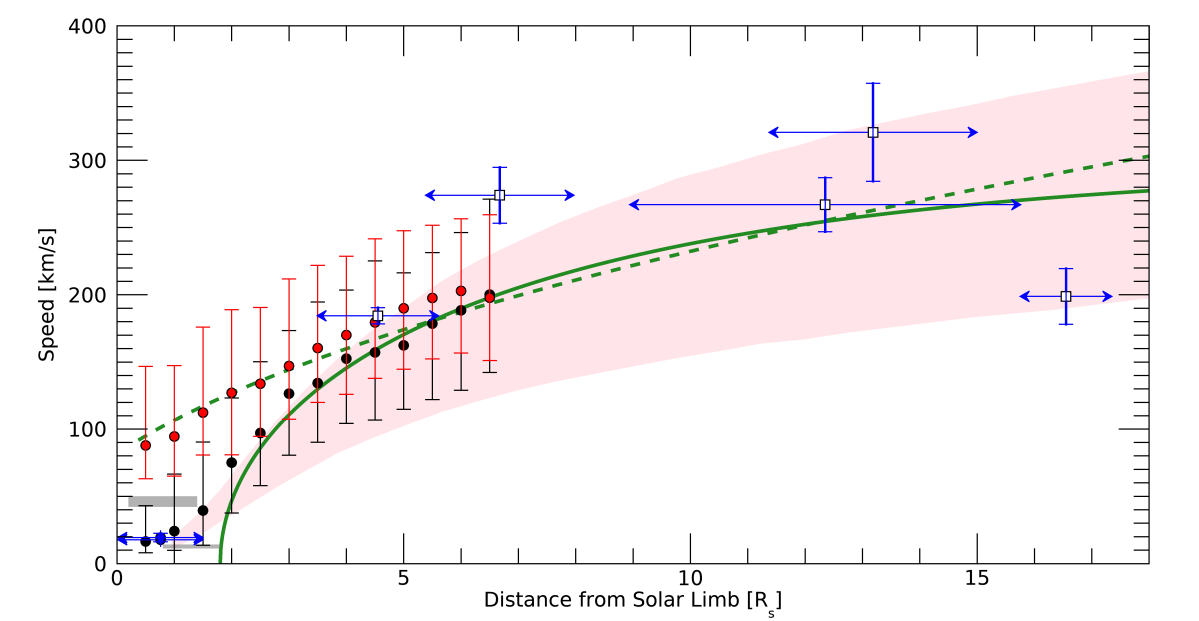 The evolution of vortex rings in the solar corona in terms of speed versus distance from the Sun. Credit: The Astrophysical Journal/Tracking the Evolution of Plasma Instabilities from the PCTR/Creative Commons Attribution 4.0 license/DOI 10.3847.
A new fleet of missions are currently underway to study the solar corona in detail. These include NASA’s PUNCH mission, and the European Space Agency’s PROBA-3 coronagraph missions, both launched in 2025 and 2024, respectively. The science is advancing to the point that we can now predict with fairly good fidelity how the solar corona will appear during totality.
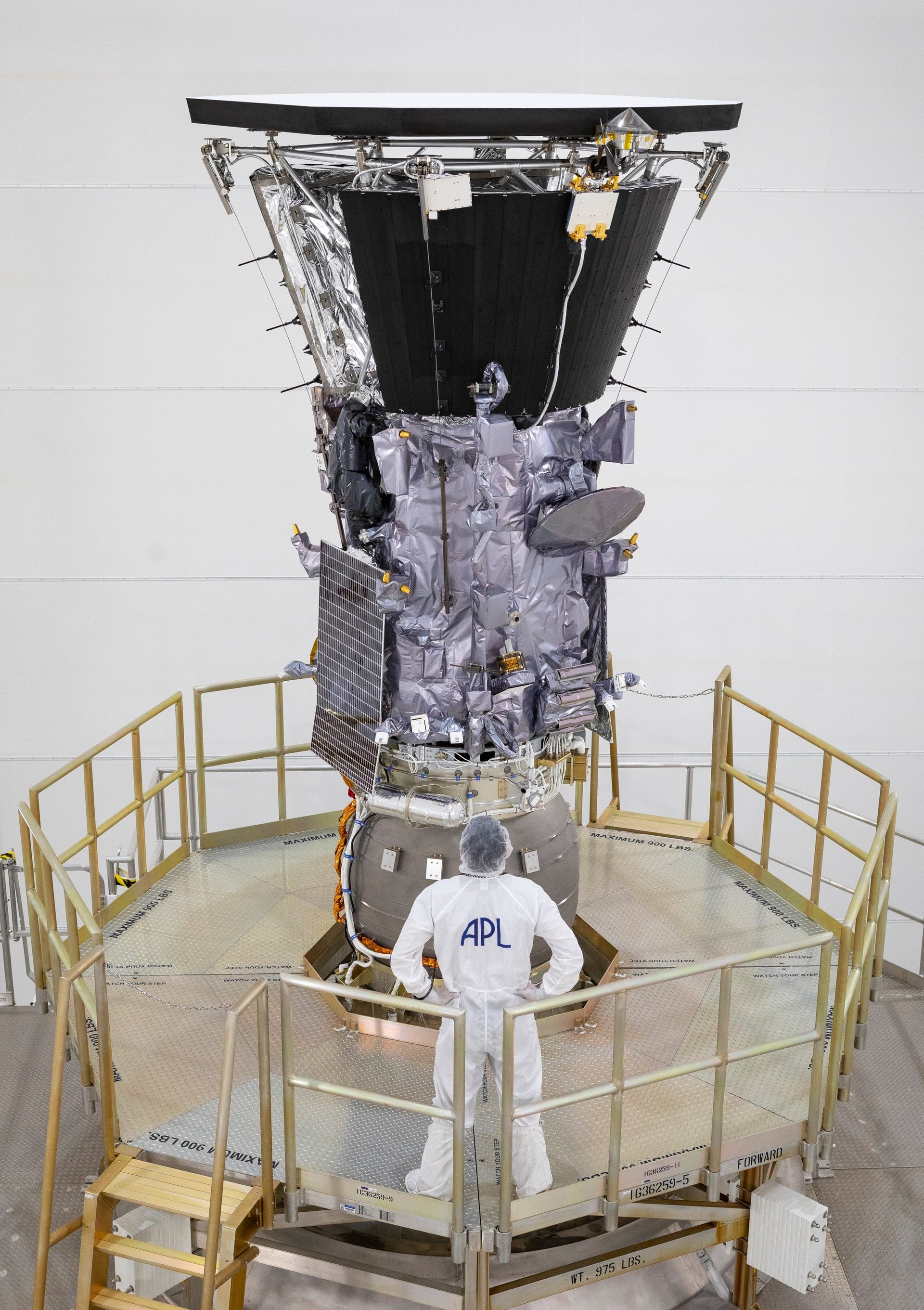 The Parker Solar Probe on Earth, ahead of launch. Credit: NASA/Johns Hopkins APL.
Finally, we have a chance to glimpse the solar corona once again coming right up on August 12th this summer, as the Moon’s shadow arcs across Greenland, Iceland the northern Atlantic and Spain. “We try not to miss any eclipses,” says Habbal. “These rare opportunities are always scientific gold mines.”
It’s great to see eclipses still cranking out valid and useful scientific observations. Sure, they’re just fun to watch unfold, but those beautiful images of totality are also helping us to understand how to live with the tempestuous whims of our host star.