
3h agoFri 20 Mar 2026 at 1:24amMarket snapshotASX 200: -0.6% to 8,443 pointsAustralian dollar: Flat at 70.84 US centsS&P 500: -0.3% to 6,606 pointsNasdaq: -0.2% to 22,090 pointsFTSE: -2.4% to 10,064 pointsEuroStoxx: -2.3% to 597 pointsSpot gold: -0.1% to $US4,653/ounceBrent crude: -2.6% at $US105.75/barrelBitcoin: +0.7% to $US70,395
 ASX 200: -0.6% to 8,443 pointsAustralian dollar: Flat at 70.84 US centsS&P 500: -0.3% to 6,606 pointsNasdaq: -0.2% to 22,090 pointsFTSE: -2.4% to 10,064 pointsEuroStoxx: -2.3% to 597 pointsSpot gold: -0.1% to $US4,653/ounceBrent crude: -2.6% at $US105.75/barrelBitcoin: +0.7% to $US70,395
Price current around 12:30pm AEDT
Live updates on the major ASX indices:
3m agoFri 20 Mar 2026 at 4:51amAnother ‘poor’ week for global share markets
Here’s the opening statement from AMP’s weekly investment note by Shane Oliver.
Global share markets had another poor week as the Iran War continued, and the Strait of Hormuz remained effectively closed.
Oil prices remained around $US100 a barrel – with West Texas down slightly but Brent up slightly.
Reflecting the worries about a boost to inflation and a hit to growth, along with another RBA rate hike, Australian shares fell around another 1.9% with energy, utility and consumer staple shares up but most other sectors down.
From this year’s highs US shares are down 5%, Eurozone and Japanese shares are down 9% and Australian shares are down 8%.
26m agoFri 20 Mar 2026 at 4:27am
Managing superannuation in volatile times
We covered the intersection of geo-politics and investments this week with the below piece.
Here’s a response to the article from the Super Members Council.
We’ve done some analysis on the impact of switching your super to more conservative investment options like cash during market downturns. The evidence suggests this typically makes you worse off: both individual and institutional investors have a poor track record of market timing and switching to cash risks missing the sharp recoveries that often follow declines.
For someone with a $100,000 balance, switching to cash at the COVID-19 trough could have left them around $50,000 (50 percentage points) worse off over five years; while during the 2025 tariff episode, someone switching to cash could be around $7,000 (7 percentage points) worse off over just one year. (see attached charts)
Superannuation fund declines during the Global Financial Crisis (GFC) and COVID-19 were less than a third of those of major equity markets. Funds recovered to pre-GFC highs more than a year earlier than the Australian stock market.
Disclaimer: as always, this is not financial advice. It’s best to seek personal financial advice before making any major investment decisions.
40m agoFri 20 Mar 2026 at 4:14am
‘Strong likelihood’ of oil price reaching $US120‑150
Here are some dot points from CBA economics on geo-politics, financial markets and the economy:
The current events in the Middle East are the starkest example we have seen of the growing battle between economics and geopolitics in this new economic era of strategic competition. Financial and commodity markets have reacted strongly, but not enough given the size of the disruption. To some extent, markets are still betting on economics to dominate politics, as it did with tariffs. This is possible, but less likely this time.It’s true, President Trump has the capacity to declare victory at any time, redefining what victory looks like as he goes. However, another ‘TACO’ moment here has far greater consequences. A US withdrawal will embolden Iran and its proxies; validate their defensive strategy; and undermine future US leverage, including in any nuclear negotiations.The US is seeking to minimise the near‑term economic impact through jawboning, releasing oil reserves and working to secure safe transit through the Strait of Hormuz. All while hoping the military campaign soon delivers a decisive stroke, either the re‑opening of the Strait or regime change. However, neither is likely to happen quickly or easily.We expect this strategy to wear increasingly thin as the war drags on. We judge there is a strong likelihood of the oil price lifting to between $US120‑150, sparking further material negative market reactions in coming days and weeks.
1h agoFri 20 Mar 2026 at 3:43am
Sequoia trading halt
“Trading in the securities of Sequoia Financial Group will be halted at the request of SEQ, pending the release if an announcement by SEQ,” ASX Compliance announced.
Please refer to the ASX website for more details.
1h agoFri 20 Mar 2026 at 3:37am
Commodities markets
Here’s a snapshot of the all-important commodities markets at 2:30pm AEDT.
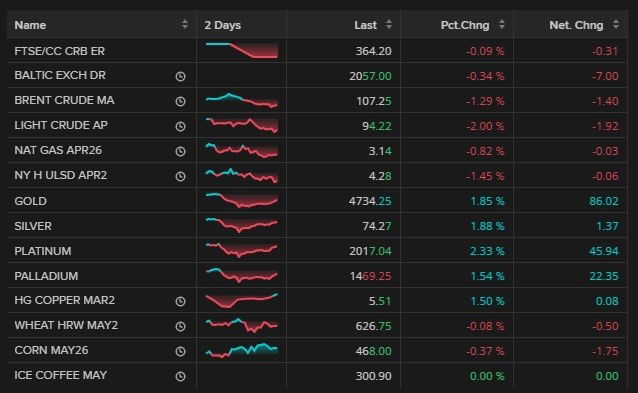 Commodities markets (LSEG)
1h agoFri 20 Mar 2026 at 3:22am
Australian dollar steady
The Australian dollar has been remarkably steady in recent weeks.
It has risen by a percentage point and fallen by a percentage point in recent days, but it’s remained range bound between 69.5 and 71.5 US cents for the past four weeks.
It’s buying 70.85 US cents at 2:25pm AEDT.
1h agoFri 20 Mar 2026 at 3:12amAustralian government bonds under pressure
Australian Treasuries are under significant selling pressure.
We know this because the yield on the Australia 10-Year Treasury bond has risen above 5%.
Bond prices move inversely to prices.
This makes government debt financial more expensive and can put upward pressure on the cost of fixed-rate mortgage products.
The yield at 2:15pm AEDT was 5.01%, up 3 “pips”.
2h agoFri 20 Mar 2026 at 2:45amMiddle East war has erased $250 billion from the value of Australian stocks

The month isn’t even over, but the Australian share market is on track to record its biggest monthly sell-off since June 2022.
That’s when inflation had surged to a three-decade high and the Reserve Bank responded aggressively with consecutive 50-basis point rate hikes.
The All Ordinaries has dropped by around 8% since the beginning of March — shortly after Israel and the United States started their war against Iran.
Expressed another way, more than $250 billion has been wiped off the value of Australian stocks.
If this conflict drags on (an increasingly likely occurrence), oil prices and inflation will keep climbing, which will probably drag stock markets down even further.
So if the All Ords falls by another 2%, the local share market will have officially fallen into correction territory.
A correction occurs when the market falls 10% from its record high. (And it just so happens the local bourse was trading at its highest level ever just before the outbreak of the latest Middle East war).
“I think the most likely scenario right here, right now is that we are in the midst of a correction,” AMP’s head of investment strategy Shane Oliver told ABC News.
“I thought at the beginning of the year that this year would turn out okay, a bit more constrained than last year, but somewhere along the way there would be another correction, possibly, probably, of the order of around 15%.
“And we seem on track for that at present.
“It’s not going to go in a straight line.
“Donald Trump will exercise jawboning every so often once markets come down heavily to try and sort of allay some of the fears, indicate that the war might be over very soon and so on.
“But we’ve seen that those things won’t necessarily stop markets from falling if the war quite clearly continues.”
2h agoFri 20 Mar 2026 at 2:28am
Stagflation: is it a worry?
ABC News recently asked NAB’s chief economist, Sally Auld, if she was concerned about stagflation developing in the Australian economy.
Stagflation is essentially higher inflation in a low-economic-growth environment.
“So stagflation, I think, is one of those scenarios where you have persistently high inflation, and you have a really meaningful lift in the unemployment rate,” she says.
“And that’s definitely not in our current set of forecasts at National Australia Bank.
“I don’t expect that to be in the RBA’s set of forecasts when they release those in early May.
“And so I do think we are some way away from that outcome.
“And so that’s not a word that we’re using to characterise the current set of circumstances we find ourselves in, nor the outlook for the rest of this year.”
2h agoFri 20 Mar 2026 at 2:18amTreasurer convenes financial regulators
Here’s a statement from the Treasurer, Jim Chalmers:
Today, I convened a special meeting of the Council of Financial Regulators to discuss the conflict in the Middle East, its potential implications for our economy and financial markets, and actions being taken to shore up resilience.
Australia has a strong and resilient financial system that is well placed to confront global instability, and that was the clear message from regulators today.
While Australia is not immune to global challenges, we have strong economic fundamentals and our banking system is well-capitalised.
The Government and financial regulators remain vigilant to emerging risks and we are working together in a coordinated way to prepare for all scenarios.
The Council of Financial Regulators (CFR) consists of the Treasury Secretary and leaders of the Reserve Bank, ASIC, and APRA and the meeting today was also joined by the head of the ACCC and Assistant Treasurer, Daniel Mulino.
The recent conflict in the Middle East has compounded uncertainty in the global economy and is having an impact at home, including on fuel prices.
Today, I briefed the Council on the decisive action we’re taking to make more fuel available to industry and households, help keep fuel flowing to the regions and empower the ACCC to ensure fair prices at the bowser.
We’ve appointed a Fuel Supply Taskforce Coordinator to work with the states and territories to get fuel to where it’s needed, released up to 762 million litres of petrol and diesel from domestic reserves and temporarily relaxed fuel standards to get more petrol to service stations.
We’re increasing surveillance, doubling penalties for misconduct and empowering the consumer watchdog to get to the bottom of what’s going in the fuel sector.
There’s more work to be done and we’ll continue to work closely with regulators to ensure we’re doing everything we can to maintain fuel security, economic stability, address price pressures and make our supply chains more resilient.
Yesterday, I also engaged with New Zealand’s Finance Minister, Nicola Willis, on our responses to the conflict and our fuel security plans, part of the government’s coordinated work with our international partners.
2h agoFri 20 Mar 2026 at 2:00am
Australian shares ease, Japan’s market closed

The benchmark ASX 200 share index is down 0.2% around the middle of the trading day, with the mining sector generally dragging.
There are more companies up (112) than down (88), but fairly hefty falls for some heavyweights like BHP (-1.5%) and Rio Tinto (-2.8%) are outweighing more modest gains elsewhere.
The biggest losers included a lot of the smaller resources companies.
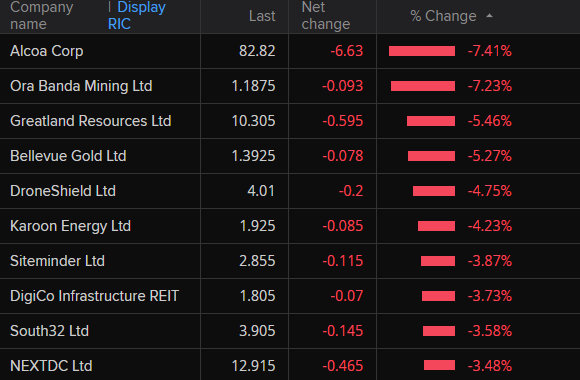 ASX 200 biggest losers around 12:50pm AEDT (LSEG)
Some of the biggest gains are coming in healthcare.
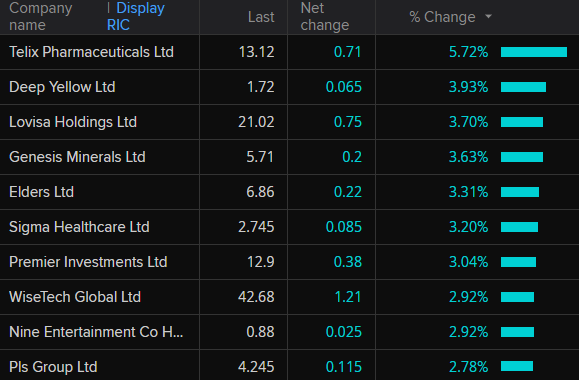 ASX 200 biggest winners around 12:50pm AEDT (LSEG)
Japan’s share market was down sharply yesterday, much more than Australia’s (-3.4%), but is closed today for the northern spring equinox holiday.
Let’s hope Japan’s footballers are still on holiday tomorrow when they play Australia in the Asian Cup final.
Go you Tillies!
Loading3h agoFri 20 Mar 2026 at 1:08am’Rising Risk of Physical Fuel And Food Shortages’, BMI says
BMI is a British multinational research firm and subsidiary of Fitch Solutions.
Its website sates that it provides macroeconomic, industry and financial market analysis.
Here’s an excerpt from its latest report on fuel shortages in “APAC” or Asia Pacific.
The Iranian attack on the Ras Laffan LNG facilities on March 18, in retaliation for an Israeli attack on its on South Pars gas field, marks a further escalation in the conflict.
The likelihood of the war being short-lived as our base case assumes is receding and the risk of APAC economies encountering physical shortages of key commodities is rising.
Beyond the likelihood of energy shortages, gas is a feedstock for fertiliser production and current shortages could jeopardise food supply later in 2026/2027.
Qatar Energy had already declared force majeure following the initial drone strikes on March 2.
However, the ‘extensive damage’ to Ras Laffan changes things: Even if the war were to end now, risks to LNG supplies may continue beyond the war.
This is highly consequential: APAC economies now confront rising risks of physical shortages of not just energy in the form of oil and gas, but also of fertilisers and by extension — food possibly later in the year.
The impact stands to be far larger than the minor growth and inflation revisions that we recently made to account for higher oil prices.
3h agoFri 20 Mar 2026 at 12:57amWestpac sees slower economic growth
Here’s the latest note from Westpac economics.
Westpac-Now points to [gross domestic product] GDP growth of around 0.6% [for the first quarter of 2026], lifting year-ended growth to 2.8%.
Our monthly activity index stalled in January, moving sideways for the first time since hitting a trough in May 2025.
The indicator heatmap shows that labour market, confidence, consumer spending and global activity indicators have lost some momentum, after finishing 2025 on a strong note.
This modest easing is likely to be welcomed by the RBA, with growth moderating toward their estimate of trend growth.
Importantly, this moderation predates the impacts of the Middle East conflict, as well as the February and March rate hikes, which are likely to weigh on confidence and activity.
4h agoFri 20 Mar 2026 at 12:44am
Don’t forget the Houthis, warns RBC analyst
While the bulk of the world’s attention is focused on the Strait of Hormuz, RBC’s highly respected head of global commodity strategy, Helima Croft, warns that there are other potential threats to remaining oil supply.
“We continue to watch for any signs that the Houthis may enter the conflict and imperil the Red Sea alternative export route,” she cautions.
“Currently, our data suggests Saudi Arabia is exporting around 3.8 mb/d [million barrels a day] from its west coast as it pushes incremental volumes on the East-West pipeline. It has proven to be a more secure alternative than the UAE’s Fujairah port, which has been targeted on multiple occasions.
“For now, the Houthis have stayed on the sidelines, unlike in 2019 when they targeted the East-West pipeline and joined the Iranian strike on Abqaiq following the termination of exemptions for importers of Iranian oil by the US.”
Ms Croft says the Houthis are viewed as quite independent of direct Iranian control and may choose to stay on the sidelines, especially after suffering heavy damage over the past few years from a US/UK-led military operation to stop attacks on shipping in the Red Sea, which leads to the Suez Canal.
However, there’s no assurance they won’t become involved as the conflict drags on, especially if the Iranian regime that has supported the rebels looks in danger of collapse.
“If the Yemeni group does become an active participant, we think it would materially alter risk perceptions about the Red Sea exports, and even just a few missiles or drones fired into the Bab el-Mandeb Strait would push oil prices several legs higher in the current environment.”
4h agoFri 20 Mar 2026 at 12:25am
Oil price falls
Global oil benchmark Brent crude has opened Asian trading down 2% to $106.47 a barrel (11:25am AEDT).
4h agoFri 20 Mar 2026 at 12:23am
RBC’s view on Draft Default Market Offer (DMO)
Here’s an excerpt from a Royal Bank of Canada (RBC) note today on the Default Market Offer.
The DMO is a government-regulated maximum price cap on electricity standing offers, designed as a “safety net” for customers in NSW, SA, and SE QLD.
Set annually by the Australian Energy Regulator (AER), it protects consumers from high prices and serves as a reference point for comparing electricity plans.
We view the FY27 Draft DMO as a negative for both AGL and Origin Energy, although somewhat expected as wholesale electricity prices have declined [year-on-year] yoy.
Origin previously stated it expects FY27 to benefit from ramp up of batteries coming online, offset by expected lower wholesale electricity prices.
AGL is largely hedged for FY27 and believes lower forward electricity curves for NSW and a lesser degree VIC are not reflective of electricity demand tailwinds.
The DMO is the maximum price a retail electricity provider can charge customers.
Flat rate DMO prices have decreased yoy across all regions for residential customers by a range of -1.3% (SA Power Networks) to -10.1% (SE QLD Energex), and for small business customers by a range of -8.5% (NSW Endeavour Energy) to -21.2% (NSW Essential Energy).
4h agoFri 20 Mar 2026 at 12:13amPremier Investments soars on estimate beat, miners tumble on weaker commodity prices

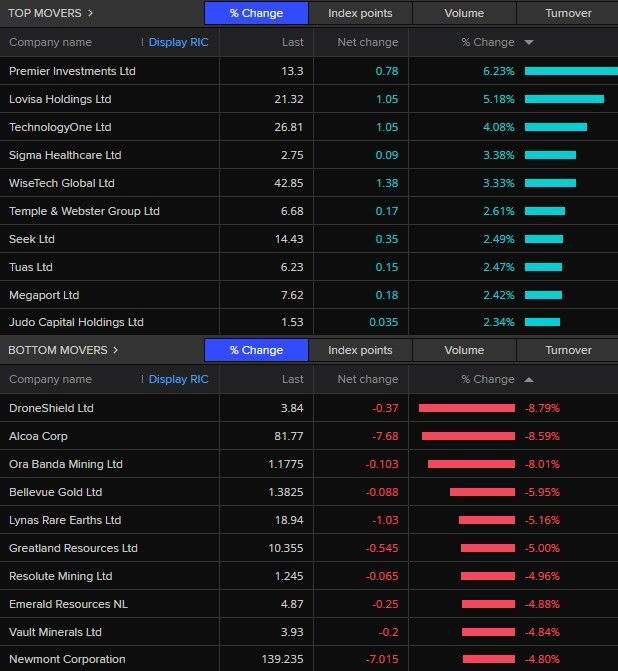
Losses in heavyweight miners have dragged the benchmark index lower as resource prices weaken, with the sub-sector losing 3.3% at open.
Aluminum company Aloca Corp (-8.6pc) and gold miners like Ora Banda (-8pc) and Bellevue Gold (-6pc), and Lynas Rare Earths (-5.2pc) were among the worst performers at open.
Bucking the trend, defensive sectors like healthcare and utilities rose 1% and 0.8%, respectively.
Consumer discretionary stocks advanced 0.5%, with Premier Investments and Lovisa surging 6.2% and 5.1%, respectively.
Premier Investments reported a 0.5% decline in Premier Retail sales to $452.8 million for the six months ended 24 January.
The retailer’s 4.9% increase in Peter Alexander sales was offset by a 10.7% decline in Smiggle sales.
“Peter Alexander performed strongly again in 1H26 and continues to consolidate its position as the country’s leading sleepwear and gifting brand,” Chair Solomon Lew said.
“Smiggle maintains strong brand fundamentals and a well-established multi-channel footprint.
“The strategic review has quickly identified growth opportunities available to Smiggle and we will be working on product repositioning, simplification and brand elevation over the second half and beyond with a clear plan to bring this brand back to growth in FY27.”
Citi said the company’s gross margin at 66.9% slightly better than its 66.7% estimate, aided by strong cost control schemes.
The stationary brand will pay an interim dividend of 45 cents per share.
Defence company DroneShield was the biggest losser at open, down 8.1% as its technology has been under scrutiny.
Here were the top and bottom movers at open.
 (LSEG)
4h agoFri 20 Mar 2026 at 12:11am
Market volatility and super
I feel that all super accounts have been hit but just sit as there will be a correction in the markets just dont panic
– chrisso
Hi Chrisso,
Thanks for joining the conversation.
Yes, it’s never a good idea to panic.
It is always a good idea to see personal financial advice before making any big investment decisions.
4h agoFri 20 Mar 2026 at 12:04amThree more RBA interest rate hikes?
IG’s Tony Sycamore has gathered some intel from Morgan Stanley regarding the interest rate outlook.
Here’s what he wrote this morning:
Global hawks force RBA repricing: Three More 25bp RBA Hikes viewed in 2026 – Cash Rate to Hit 4.85%
Following a hawkish trifecta of central bank meetings from the FOMC, ECB, and BoE over the past 24 hours in response to a jump in energy prices the Australian interest rate market has repriced hawkishly again.
We start the day with [0.18%] 18 basis points of tightening now priced in for the RBA’s May Board meeting.
Looking further out, there are now 67 basis points of RBA hikes priced in for the remainder of 2026.
This aligns closely with expectations for three more 25-basis-point increases this year, a path that would take the RBA’s cash rate to 4.85%—a level we haven’t seen in seventeen years, dating all the way back to November 2008.