
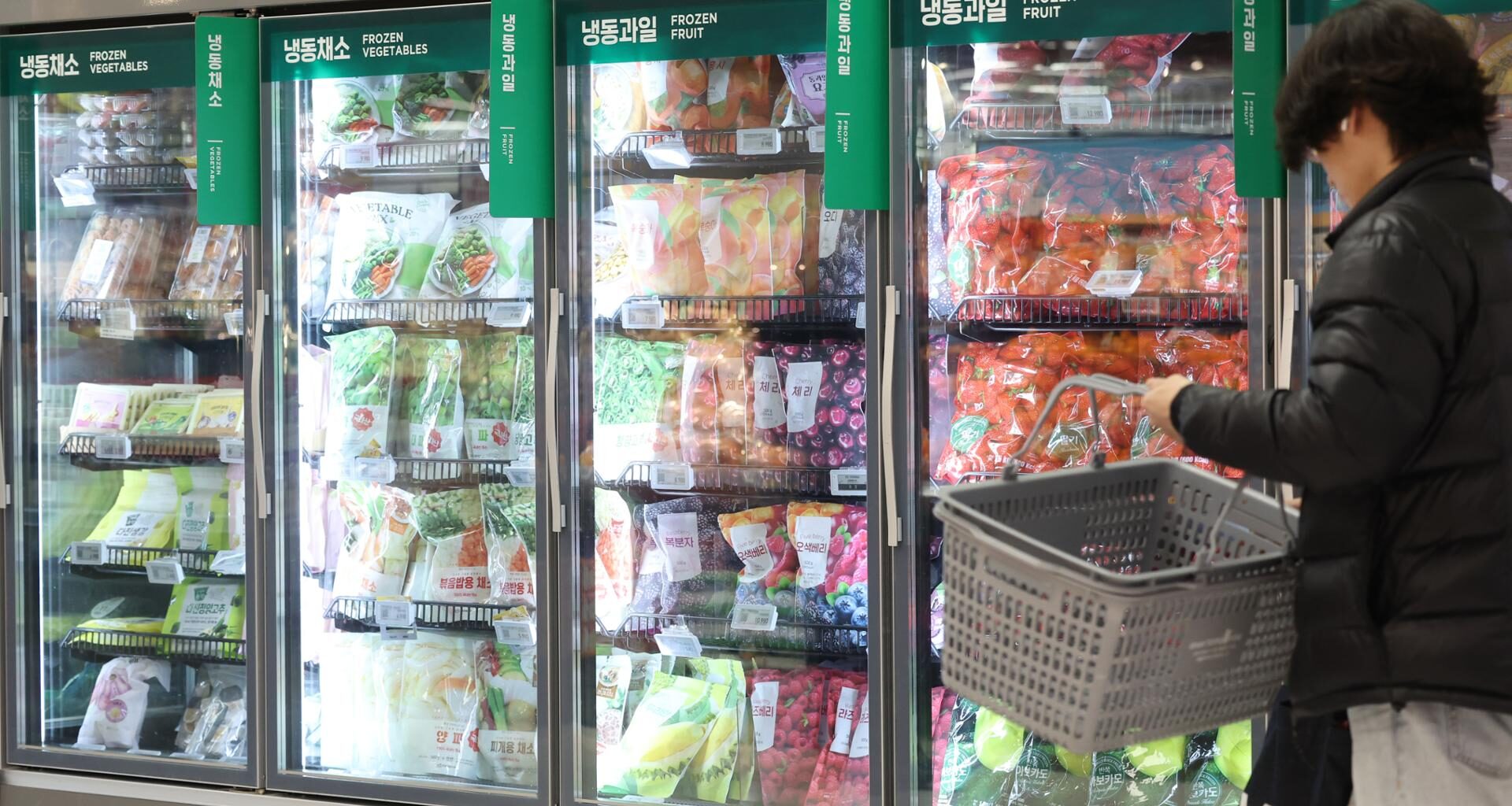
A shopper walks down the frozen aisle at a supermarket in Seoul. Yonhap
Even as official data shows a narrowing income gap, Koreans say they feel the wealth gap is growing due to the heavy burden of groceries and housing costs.
A report published Thursday by the Korea Institute for Health and Social Affairs, titled “Why do people feel inequality is severe?”, highlighted this gap between official data and reality. The research noted that the country’s Gini index — a key measure of income distribution where a lower number signifies less inequality — dropped from 0.418 in 2011 to 0.392 in 2023.
The official index was compiled by the Ministry of Data and Statistics. Analyzing this data, the institute concluded that an expansion of government transfers, such as state pensions and various public benefits, has helped narrow the statistical wealth gap. However, public perceptions moved in the opposite direction during the same period.
Perception vs. reality
Lower-income households see the gap between themselves and higher earners as growing wider, even if their actual earnings increased. The institute attributed this directly to the cost of living. Because groceries require a baseline expenditure regardless of household budget, food costs consume a disproportionately large share of lower-income households’ earnings, making them more acutely aware of the economic divide.
Beyond daily survival, a household’s net worth heavily shapes how people view inequality. The report indicated that people with more assets consider the wealth gap less severe.
Plight of middle class without property
For middle-income households, real estate is the main factor shaping perceptions of inequality. The non-homeowning middle class reported a strong sense of asset disparity based on their inability to secure property.
Conversely, property ownership did not significantly affect how low-income households viewed inequality. Instead, liquid assets such as bank deposits played a much larger role in shaping their economic outlook.
To ease public concerns about inequality, the institute recommended targeted support based on income brackets.
For low-income populations, the report emphasized expanding food vouchers to help cover the cost of living and strengthening emergency welfare programs to prevent families from falling into debt. For the middle class, researchers advised increasing the national housing supply and expanding financial support for first-time homebuyers.
This article from the Hankook Ilbo, the sister publication of The Korea Times, is translated by a generative AI system and edited by The Korea Times.