
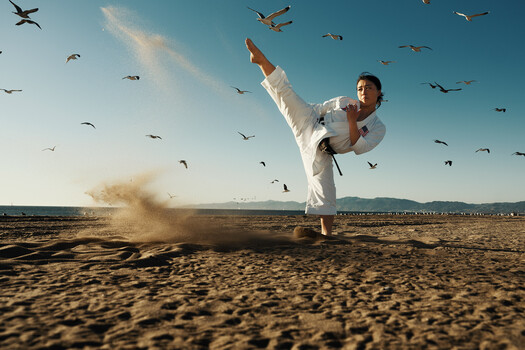
Aaron Anderson has built a career shooting for major corporations like Sony, Fujifilm, and Bosch through collaborations fostered on Instagram. Here’s how he did it, and how you might too.
Aaron Anderson has an enviable career, shooting for notable clients like Sony PlayStation, Fujifilm USA, Monster Energy, Goorin Brothers, KTM, Tamron USA, Husqvarna, Rockstar Energy, Bosch Global, and others. He credits it all to “personal work” — shoots done on his own without pay.
“I do tons of personal work. I’d say I average one to two a month,” he said. “It’s the way I built my entire career, and it’s how I got to work with the companies I want to work for.”
Olympian Jenny Arthur and her husband opened gym to train fellow weightlifters. Anderson contacted her on Instagram, and found a mutual benefit – she needed images for promotion, and Anderson needed to grow his portfolio. Win-win.
The Awakening
Anderson’s awakening to the possibilities of personal work came as a student at the Academy of Art in San Francisco.
“There was a friend of mine,” said Anderson, “and he was a very established photographer” who had already shot for notable magazines like Esquire. “He really introduced me to two things: one was doing personal work with a vision, and the other was involving other people in those projects.”
His friend was producing large-scale shoots, pulling in hair and makeup collaborators, assistants, wardrobe, and talent — “just all of these things he was getting for free.”
It’s where Anderson wanted his work to go, but he wasn’t in a position to call in high-end collaborators just yet.
“When you first get started, you have to build up a body of work. I always recommend you start shooting friends and family that understand you, that you can test and fail on. And to give myself chances to experiment with genres, people, and color — this gives me a chance to do all of those things.”
He built up a catalog of images worth showing around. “It’s important to have quality work out there, to have an established Instagram feed, so they know you’re not just a creeper.”
Anderson first met with snowboard company Never Summer 10 years ago at an outdoor retailers conference. “I stayed in touch for 9 years after that.” Last November the stars aligned and the time was right. “It’s just a long game mentality.”
“Then once I had more personal projects under my belt, I would go on Instagram and search by keywords.”
Olympic Gold
He was living near the Olympic training center in Colorado Springs at the time, so he searched Instagram for athletes by entering the word “Olympic” and then the name of a sport to see who came up in the feed.
He didn’t approach the most famous and well-funded athletes, but those with an unmet need. “Olympic athletes are unique,” he said. “They don’t get a lot of publicity and they need it. It’s the second seat on the bobsled, or a female boxer, and especially the para-athletes. Then I will typically follow them and get a feeling for their vibe, then invite them for coffee, and hear their story.”
His approach pitch was some version of: “Hey, I’ve been following your story. I like your vibe. I am a photographer and would like to see if we can get together and get some imagery.” Then he would direct them to his feed so they could see the quality of work.
He would then schedule a meet-up to discuss the project. “Then I send over a pitch with a mood board,” he said.
Simple, but not easy. “There is a big percentage of rejection. Usually it comes in the form of them just not responding at all,” Anderson said. Over time, he became desensitized to it. “You build a tolerance to the feeling.”
And that’s important because a trick to success is to keep making calls until people begin to respond and momentum builds. “The flip side is, the more yeses you get, the more yeses you get,” he said. “When you work with one female boxer, you start getting lots of female boxers.”
Mikaela Mayer, an Olympic boxer, was the first athlete Anderson reached out to on Instagram and the first he shot, which led to many more Olympic athlete shoots. “… the more yeses you get, the more yeses you get.”
As he got more notable subjects, he used Instagram to wrangle other pros to collaborate for more elaborate shoots. “I’ve built my community through Instagram, connecting with other creators and finding makeup people or wardrobe people.”
He looks at work by other photographers he admires to see who does hair and makeup on their shoots, for instance, then connects on Instagram and asks to collaborate. “Then they can use it in their portfolios to get work.”
As he built his reputation, assistants began to reach out to him. He makes sure it’s worth their while. “We will take whole days in studio to go over lighting, so they go home with something they can use,” he said. “And when I can pay them, I do.”
Who Do You Know?
The subjects of the photos also become resources. “One thing that I always bring up is that it is easier to get a location if they reach out, because they are more likely to get a favor than a photographer. ‘Who do we know, or who do you know, with a place we could shoot this?’ You usually don’t have to pay, and it’s some of the coolest places you’ll ever go.”
This was a shoot for Gasgas with trials rider Daniel Blanc-Gonnet. Gasgas is a corporate sibling of Husqvarna and KTM. Anderson eventually shot for all three. “It took years of messaging and lunch meetings before they trusted me enough to do this.”
Still, it takes persistence. Waiting in an hours-long line for the Fort Worth, TX, barbecue hotspot Goldee’s, Anderson was taken with a mural. “That was one gnarly, rad piece of wall art, and I was super curious about who did it.” The Instagram handle was on the art. “I did a deep dive.”
He discovered the muralist, painter, and punk rocker Peelander Yellow (given name: Kengo Hioki), who is given to Dadaesque costumes and artwork that looks like a wholly original mashup of Keith Haring, manga, and “Big Daddy” Ed Roth. “I was just like, ‘Oh my God, I need to work with this guy,'” Anderson said.
“I reached out and said I’d just love to tell your story.” Their schedules conflicted, and that could have been the end of it. But Anderson made a special trip to have coffee with the artist and started planning — though it still took another “three to four months” before the shoot came together. “It took well over six months of planning,” said Anderson.
But it paid off. One of his Peelander Yellow portraits took second place at American Photographic Artists in 2023.
It took six months (and a plate of barbecue) to arrange an award-winning collaboration with Peelander.
The personal work has led to paying work, but not through referrals. The athletes he has shot have little say over who photographs them when a magazine or sponsor comes calling. “It’s less about referrals and more about clout — building a portfolio that looks really expensive, then use that to get business.”
Bio: Aaron Anderson is a Colorado- and California-based visual storyteller who crafts images with creative, cinematic flair. Since launching Aaron Anderson Visuals in 2009, he’s collaborated with top-tier brands like Sony PlayStation, Monster Energy, and Bosch. After art school, he started as a retoucher at Sugar Digital, where he worked on images for Coca-Cola, ESPN, and Google, among others.
Explore his work at andersonvisuals.com and on Instagram: @aaronandersonvisuals. He will lead three instructional classes at B&H in conjunction with Fujifilm in March 2026.