
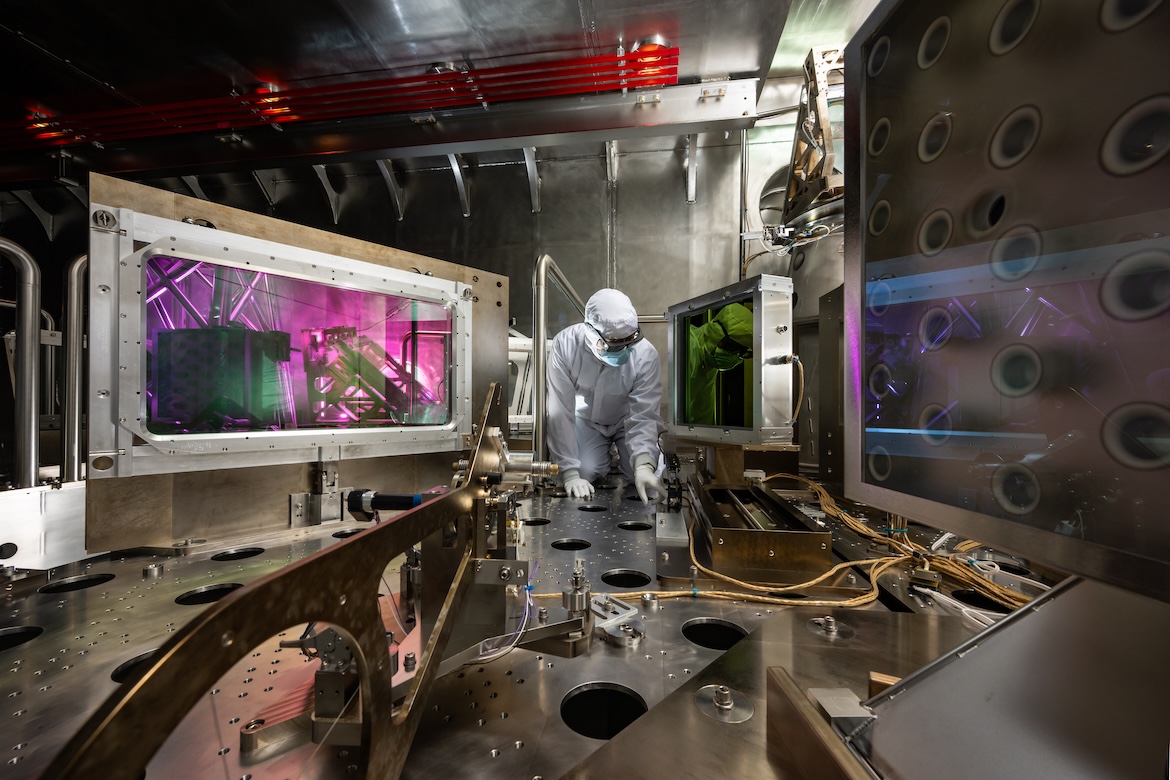
 The OMEGA extended performance laser system at the University of Rochester’s Laboratory for Laser Energetics | Photo: J. Adam Fenster / University of Rochester
The Rochester and Finger Lakes region is nearing a decision that could bring up to $160 million in federal funding over the next decade, positioning it as a national hub for optics, photonics, imaging and laser innovation.
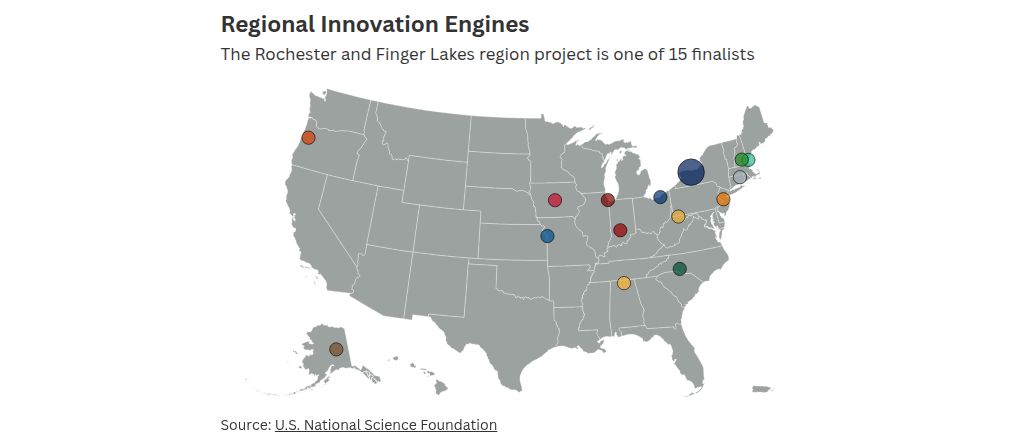
A coalition led by the University of Rochester is one of 15 regions vying to become a National Science Foundation Regional Innovation Engine. The competition has narrowed from nearly 300 letters of intent at the start of the program.
Last month, NSF representatives visited the region to assess whether its research institutions, companies and workforce have what it takes to build and scale the cluster. A decision is expected in a few months. The visit marked the final round, with interviews and due diligence assessing risks, resources and the region’s capacity to meet national needs.
“It was a great visit,” says Thomas Brown, director of the Institute of Optics at URochester. “Their job is to come and ask lots of hard questions and to really probe to see if we’re ready as a team to handle this scope of a program.”
More than 75 people from the community–from lawmakers to researchers and business representatives–showed up not just in the way of support, but also to illustrate the region’s enthusiasm, capacity and prowess.
“We spent a day and a half with the NSF folks. There was genuine warmth at the end of that,” Brown says. “(I) felt like they genuinely appreciated the effort that we have put in to clearly present our case. And that’s all you can hope for, right?”
The NSF funding would accelerate an existing ecosystem. But even without the award, project leaders say the process of competing for it has already brought universities, companies, and workforce and economic development partners together around a shared strategy.
Engines of innovation
The National Science Foundation launched its Regional Innovation Engines program to foster discovery and innovation nationwide, says Sethuraman Panchanathan, former NSF director. It aims to bring together universities, companies and other regional partners to turn research into real-world use and spur economic growth.
Each engine can receive up to $160 million over as many as 10 years to build those regional partnerships and support research, workforce training and business development. The program also includes an earlier planning phase, giving regions time to organize before launching a full-scale effort.
The goal is to boost innovation in parts of the country that haven’t fully benefited from recent technology growth, while helping regions turn research into companies, jobs and investment. That includes building stronger connections among industry, academia and government, supporting new technologies in areas of national importance and creating clearer pathways for workforce training and entrepreneurship. The program is also meant to test a different model—one that moves faster, works across sectors and is designed to translate research into economic impact at scale.
Panchanathan, who visited URochester in 2022 and called it a crucible of innovation, says through the engines program, NSF is investing across the country and harnessing the geography and demography of innovation. He stepped down from his role last April.
A chance to be ‘Stellar’
In 2023, URochester received $1 million, which launched the planning stages for its proposal titled “Catalyzing Upstate New York’s Future in Science, Technology and
Engineering of Laser and Laser Applications Research,” or STELLAR.
“This would revolutionize Rochester’s tech workforce, creating new programs from technical education at our community colleges for manufacturing careers to helping train the next generation of our nation’s top scientific minds, all while helping attract new employers and creating good-paying jobs,” said Sen. Chuck Schumer when the Phase One award was announced.
STELLAR proposes that it will create the next generation of laser-based systems with new levels of performance, power and precision over the next decade. URochester, Rochester Institute of Technology, the Laboratory for Laser Energetics and the American Center for Optics Manufacturing will serve as anchors for use-case research, informed by market needs. The research will encompass work on developing faster and precise lasers for use in communications, manufacturing, semiconductors and health care, and high-energy laser systems for use in national security, fusion energy, manufacturing and scientific research.
“STELLAR would empower our expert researchers to collaboratively focus on the frontiers of laser development,” noted Stefan Preble, RIT’s Bausch and Lomb Professor and PhD program director of microsystems engineering, after the NSF visit. “There is already brilliant research and development underway locally in ultrafast lasers, microchip-scale lasers, lasers for biotechnology and quantum networking using lasers. STELLAR would equip us to conduct even more laser research on a grander scale.”
The fields of advanced manufacturing, eye care, medical and remote sensing, precision measurement and communications technologies are potential use-case scenarios as well.
 STELLAR project team members | Photo: J. Adam Fenster / University of Rochester
To translate these innovations for commercial use, STELLAR plans to build on the region’s more than 150 optics, photonics, imaging and laser technology companies. The engine expects to connect economic development with business needs and requirements, using Greater Rochester Enterprise, NextCorps’ Luminate and NY Photonics. STELLAR aims to provide resources to support business growth—from a fledgling venture to a company building for scale.
“It’s been incredible to be a part of the team as a co-(principal investigator), just getting all of the stakeholders within the region excited and aligned around this,” says Leah George VanScott, executive vice president, business development and strategy at GRE. “It’s been a really, really cool undertaking.”
It is unusual for an economic development professional to be part of an NSF proposal, but that’s the intent of the NSF regional innovation engines program. It asks applicants to consider the various aspects of developing a cross-sector regional coalition.
“When we walked Photonics West (trade show) this year in California together as a team, we started to have strategic conversations with company executives that are making decisions on where to put their next laser division,” VanScott says.
If the U.S. is serious about investing money in this realm, these companies would pay attention, she maintains.
“(These companies) are telling us that if the U.S. actually shows (a commitment), by putting some money behind it and some skin in the game, that these companies will actually consider the U.S. And they won’t just consider the U.S.—they’ll consider our region because of what we’re trying to do here.”
Part of the aim is to attract laser technology startups to the region and helping them grow. That would include expanding programs like Luminate, with more targeted support around manufacturing, supply chains and industry requirements.
“The U.S. only makes about a third of the lasers used in this country, and that number is shrinking,” said Sujatha Ramanujan, managing director and chief investment officer of Luminate NY, following the NSF visit. “Applications from defense to medical devices to quantum depend on lasers. We are headed to a serious national problem if we don’t close that gap and start making our own lasers.”
STELLAR also aims to make the region more attractive to investors by presenting the optics industry as a coordinated ecosystem, rather than a collection of individual startups. The engine hopes to conduct a comprehensive data analysis to identify technology gaps, applications and models that attract investment. By presenting the ecosystem as a whole, instead of several one-off startups, the project plans to attract investment to the region and create a $100 million venture development firm over three years.
“What struck me most was how organically these pieces fit together. Workforce development, economic development, research—they aren’t separate tracks. They’re part of the same story,” says Alexis Vogt, endowed chair and professor of optics at Monroe Community College and executive director of workforce and higher education at AmeriCOM. “ You can’t have a thriving laser industry without a skilled workforce, and you can’t build a skilled workforce without robust educational programs tied to real industry needs.”
The proposal has a workforce component, which is Vogt’s expertise, building on partnerships among colleges, employers and community groups in the region. It would bring together institutions such as MCC, Finger Lakes Community College, URochester and RIT into a more coordinated system. The goal is to make it easier for people to find training programs, get support and connect to jobs in the optics and photonics field.
“The process of putting this proposal together reinforced for me that the Rochester–Finger Lakes region genuinely thinks in those interconnected terms,” Vogt says. “It also pushed us to be more intentional about who we’re building this workforce for—not as an add-on, but as a core design principle. Thinking about how to reach veterans, rural communities, and the Deaf community wasn’t peripheral to the proposal; it shaped how we thought about the entire workforce component.”
The plan also calls for staff who would help guide job seekers through training options and connect them with employers, as well as closer coordination among the groups already doing that work.
Showcasing an edge
VanScott and others pointed out the competition the nation faces if it doesn’t invest in innovation. China, for instance, has been ramping up efforts in emerging laser technologies. Take remote sensing technology LiDAR (light detection and ranging), first developed in the United States, for example. China’s Hesai Technology has become the world’s largest LiDAR maker. While its efforts focus on the automotive industry, the technology’s implications for national security are concerning to some industry watchers.
“This is what Asia is pouring money into,” VanScott says. “And the federal government right now is focused on the global economic competitiveness with Asia. … In all fairness, Asia and Europe have put a stake in the ground when it comes to laser and laser technology. The U.S. has not.”
She says while STELLAR is competing with other engine projects for the funding, the coalition hopes to partner with these hubs. STELLAR, the only project in the state at this stage, is up against 14 other ideas from across the nation.
“When you look at quantum, when you look at semiconductor, when you look at smart manufacturing, when you look at energy innovation, particularly defense sensing and space, those all rely on laser technologies,” VanScott adds. “So, we’re talking about developing and putting a stake in the ground for the U.S. to say we’re actually going to build this supply chain and lead this, versus offshoring it.”
Through that lens, the proposal outlines an effort to grow the region’s laser industry to scale tenfold over the next decade by:
■ Expanding the region’s laser workforce and retaining more workers
■ Improving the performance and reducing the cost of key laser systems used in manufacturing
■ Increasing investment in laser research, education and infrastructure, and moving more technologies into commercial use
Brown, a STELLAR principal investigator, believes that when it comes to optics and related technologies, the Rochester region is like no other.
“No matter where you look, especially when it comes to optics and photonics, we’re the thing that everybody else copies,” he says, pointing to the region’s many firsts, including the Institute of Optics, the optical systems technology program at MCC and Luminate NY, an accelerator for optics, photonics and imaging-enabled technology startups.
“It’s one of the most creative places when it comes to doing cool things with light,” he says.
Vogt agrees.
“The competition is very strong, but Rochester has an exceptionally compelling case. No region can match the depth of expertise we have in lasers, optics, imaging and advanced manufacturing,” she says.
“What makes the proposal particularly strong is that it builds on an existing ecosystem rather than trying to create one from scratch,” Vogt adds. “Because of that, I think our chances are very competitive. Regardless of the outcome, the fact that the Rochester-Finger Lakes region was selected as a finalist is already a recognition of the global importance of our light-based technology cluster.”
Ultimately, the engine’s program as a whole depends on funding, which will also dictate the number of projects chosen. The program has received bipartisan support in the past, Brown observes.
“In a sense, we’ve already won; we haven’t won the money, but what we’ve won is a community that has a springboard and an idea,” he says. “I hope NSF decides to fund it (and if, for some reason, it doesn’t) there’s a national need, there will be other people that will step in on parts of this. So I’m very, very confident in that.”
Says Vogt: “The connections made through STELLAR, the collaborative frameworks we’ve developed, the new pathways we’ve started designing for underserved communities—those are real, and we’ll continue to build on them. In many ways, the momentum created by STELLAR is already a win for the region.”
Smriti Jacob is Rochester Beacon managing editor.
The Beacon welcomes comments and letters from readers who adhere to our comment policy including use of their full, real name. See “Leave a Reply” below to discuss on this post. Comments of a general nature may be submitted to the Letters page by emailing [email protected].
Related