
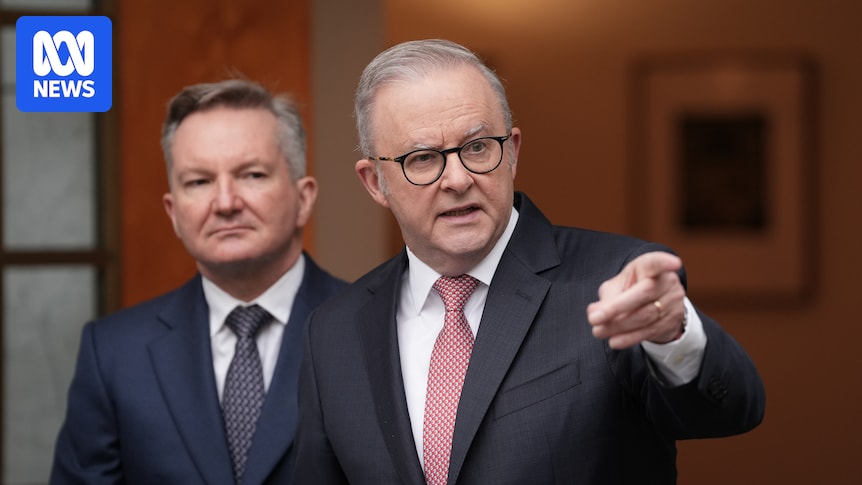
In Australia, a land of sweeping plains and Utopia-style governing, nothing can strike fear and alarm more than the sight of technocrats gathering to “make a plan”.
As domestic fallout from the war against Iran gets upgraded to the likes of an economy-wide category five cyclone, the rush to hold nation-wide meetings and appoint coordinating generals has become irresistible.
But what are they planning? What do they know that the rest of us don’t?
And why are we already talking about fuel rationing when we’re a nation that exports more energy than we import? Help it make sense.
In the meantime, whatever you do, don’t call one of these people a “Tsar”.
Unless referring to Nicholas II and his ilk that term has little place in our discourse. Had Russia’s tsars been half-decent at coordinating anything, the Bolsheviks wouldn’t have stood a chance.
Like that day in March 2020 when Tom Hanks revealed he’d contracted the coronavirus while filming on the Gold Coast — triggering the unofficial start of the COVID pandemic in the minds of many — this week felt portentous.
As Chris Richardson told our ABC colleague Samantha Dick on Wednesday, speaking of Treasury modelling of sky-high fuel prices, the “government’s given us two possibilities: the ‘oh dear’ or the ‘oh no'”.
In reality, they’re already working on a third scenario: “oh shit”.
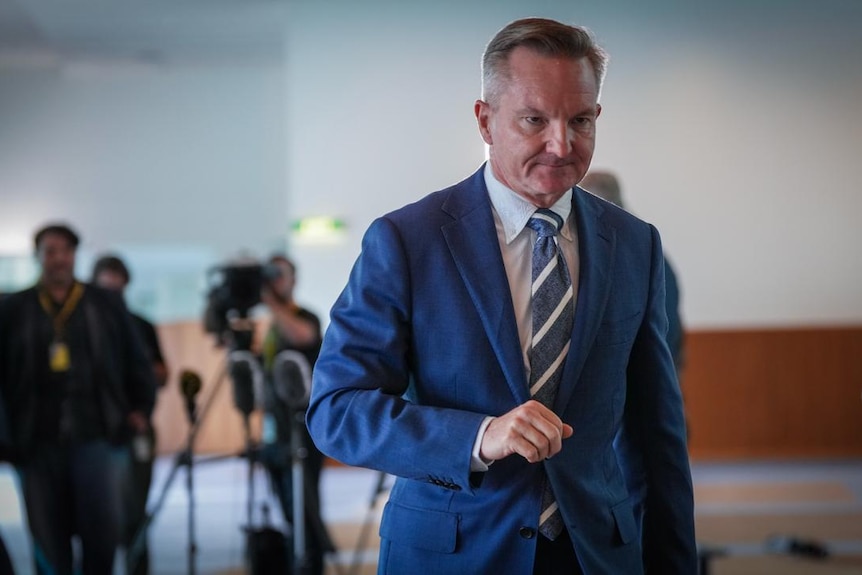
On Friday, Chris Bowen led a meeting of state, territory and federal energy and climate ministers. (ABC News: David Sciasci)
Australia’s shortcomings exposed
Meanwhile, the frightening imagery of distant war is being rendered in the ever-rising ticker at the petrol bowsers and widespread signs of growing scarcity.
Another crisis with no apparent end date appears to have landed on our shores.
It has again exposed our shortcomings and opened a door to radical actions.
And so, like cicadas that emerge from the soil every six to seven years, a swarm of bureaucratic actors are fizzing into gear as part of a nation-wide demonstration of apparent readiness.
The buzzing sound should only get louder from here.
On Thursday the federal National Emergency Management Agency hosted a “National Coordination Mechanism” where more than 500 participants crowded into a single epic Teams meeting to hear from every corner of the country about their fuel supply sitrep.
This week saw emergency meetings of fuel retailers and motoring groups supposedly “hauled in” by the government. Threats of harsh penalties from the competition regulator for price gouging came soon after.
National Cabinet on Thursday named a fuel supply taskforce coordinator (#notatsar!).
And on Friday, Chris Bowen led a meeting of state, territory and federal energy and climate ministers — even the New Zealanders were invited, which is how you know it’s serious.
“Every minister has powers; every minister has a role to play,” Bowen declared.
“Every state and federal department has information collecting powers, and we’ll be sharing that and we’ll be joined by the newly appointed fuel supply and supply chain coordinator Anthea Harris on that briefing this afternoon.”
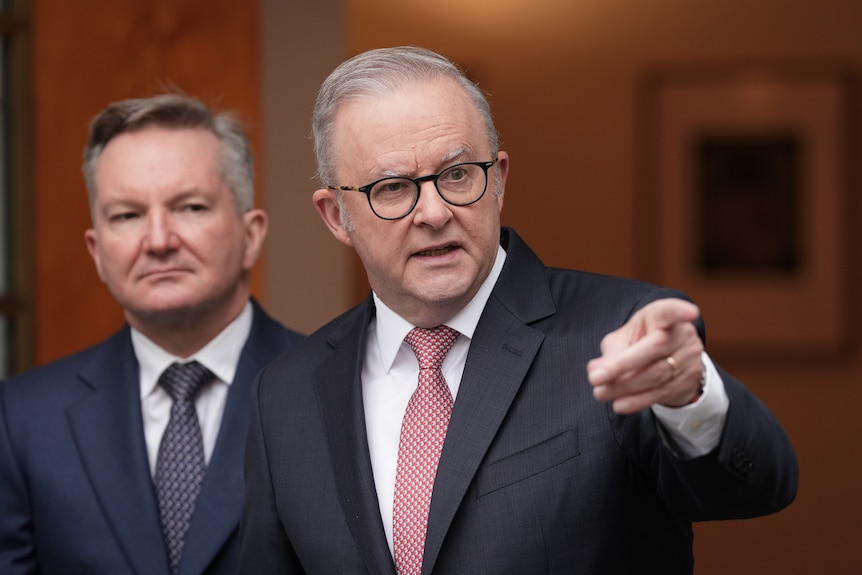
This week saw emergency meetings of fuel retailers and motoring groups supposedly “hauled in” by the government. (ABC News: Matt Roberts)
A lot of mixed messaging
Beneath it all that creeping sense that — just as in early 2020 — governments are tooling up for a worst-case scenario in which all the usual rules and practices will be suspended.
On Wednesday the prime minister left no doubt that he’s already contemplating more draconian actions, potentially fuel rationing.
“My government will be announcing more measures to prepare the nation for supply chain challenges over coming days and weeks.”
At the same time, there’s a lot of mixed messaging.
On Wednesday the prime minister insisted “I want us to be over-prepared” on fuel supply.
Labor explores new gas tax to shield from Iran war shock
A day later he told Australians to stop hoarding petrol. “That is the Australian way, to think of others, to think of their neighbours, to think of their community, but to think of the national interest”.
One man’s “over-preparation” is another’s “hoarding” it would seem.
And trust will play a huge role if this turns into a full-blown crisis.
Bowen has been dropping plenty of hints that things will go awry if the US and Israeli war against Iran is not resolved within the next two to three weeks.
“We’ve had indications from all the refiners and importers that we expect this current situation to continue well into April. That is, that fuel supplies will continue and are locked in, will continue to arrive,” he said.
“Obviously beyond that, beyond that late April period, we’re dealing with more uncertainty, [which] depends [on] how the international circumstance rolls out.”
Obviously, it would seem.
As is the reality that this could test the government like never before, assuming it gets really bad.
The pandemic showed that it’s possible to keep the economy going, maintain people’s jobs and businesses while underwriting social cohesion.
But it’s not easy and comes at an enormous cost, both in terms of the budget and political leadership.
The pandemic also demonstrated there’s much to be gained by governments taking out “insurance” to protect the economy and livelihoods.
Scott Morrison’s assertion that the chase to secure vaccines from the global market in early 2021 was “not a race” cost him dearly when it turned out that it was indeed very much a race.
A similar global contest is already underway, only this time it involves securing energy supplies.
Loading Government has fiscal firepower to intervene
Despite the doomsayers Australia is very well placed to manage this element of the looming crisis.
The federal government has the fiscal firepower to intervene in the market to make it happen.
One idea, floated to this column by someone with close ties to Labor’s leadership, could involve the Commonwealth subsidising fuel importers to establish a price cap.
For instance, Canberra could fund the difference between what import prices were prior to the war and the current going rate.
“In war-time governments do stuff,” said the person. “You have to think differently in a war-time situation.”
Whatever it takes, in other words, to secure that future supply. Costly? Yes. But that’s the nature of insurance.
A decision could then be made about whether to pass that cost to consumers, which would be Sir Humphrey Appleby-level courageous.
More likely would be allowing that cost to increase the deficit, shielding households and businesses from bowser pain.
And the government might seek alternative income, potentially via a “super-profits” tax on gas exporters.
Indeed the ABC reported on Friday that the prime minister’s department has asked Treasury to model options for a levy on gas companies.
There have been no denials from the government, which is not blind to what many backbenchers, unions and Labor supporters would regard as a moment of political opportunity.
The industry itself has few friends, with groups including the teals, independents, and One Nation all backing some form of a hit on exporters.
Even the Coalition, at the last election, saw fit to hit the industry with intervention to secure more gas for Australian consumers.
The government and prime minister are wary of upsetting Australia’s trade partners, but there is considerable leverage to hand as well.
Energy analyst Saul Kavonic told 730 this week that Australia could use its gas exports to ensure countries in Asia continue to send liquid fuels southwards.
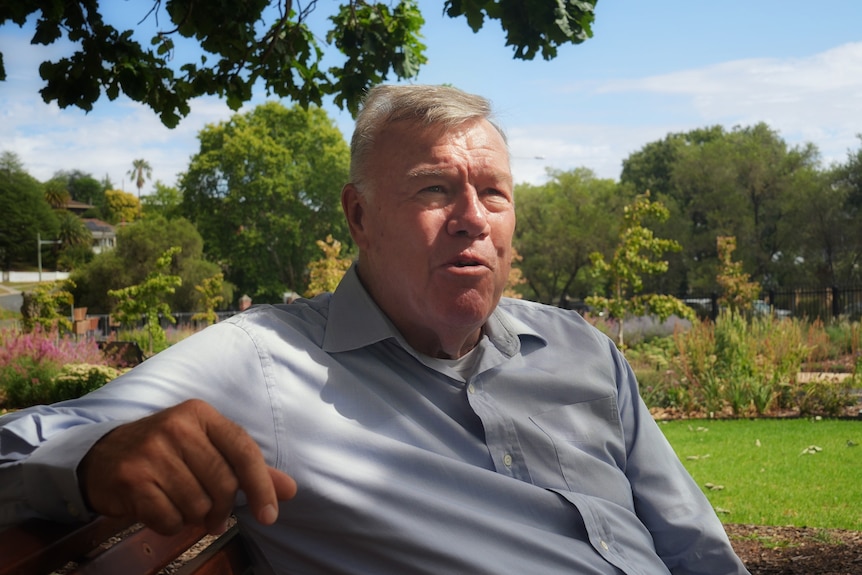
There’s a near-unity ticket in the Farrer by-election between One Nation’s candidate David Farley and the seat’s high-profile independent Michelle Milthorpe. (ABC News: Maani Truu)
A fortnight of gas politics ahead
Expect the politics of gas to get louder over the next two sitting weeks.
The Greens have already offered to legislate such a tax as quickly as possible.
And while there’s nervousness in parts of Labor over anything that smacks of a super-profits tax (memories of the Gillard-era’s attempts to introduce a mining tax run deep), the Coalition could also find itself on tricky ground.
There’s a near-unity ticket in the Farrer by-election between One Nation’s candidate David Farley and the seat’s high-profile independent Michelle Milthorpe.
“I think we’ve got to be able to look at what are all the revenue opportunities we’ve got. I think gas is definitely one of them,” Farley told this columnist in unpublished remarks from an interview last month for a 730 story on May by-election.
“I’m sure Treasury has modelled plenty of it, but we’ve got to ultimately model what’s best for Australia. Accumulating more debt is not good for Australia,” he said.
Likewise, Milthorpe told us; “it’s absurd that we’ve got people who are doing it really hard, and we’ve got these companies making billions of dollars who are not being taxed.
“It doesn’t pass the pub test. We’ve got people working really hard, being taxed a lot of money, and to not tax those big businesses just doesn’t make sense.”
It’s unlikely Labor will ignore these sentiments.
This is shaping up to become the second off-shore generated energy shock on its four-year watch. Doing nothing and allowing itself to be zapped into political oblivion seems unlikely.
Jacob Greber is political editor of ABC’s 7.30 program.