
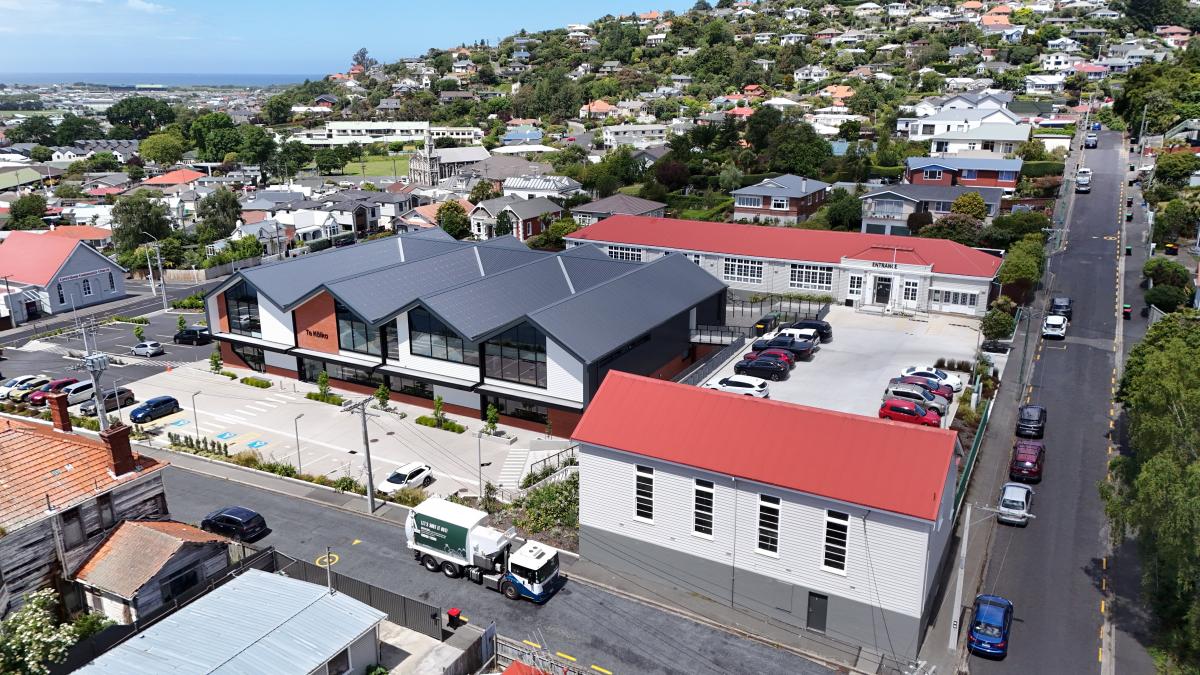
Te Kāika has only one part-time GP on site at its Dunedin hub, despite having thousands of patients on its books, sources say.
Te Kāika is the brand name for the charity Ōtākou Health Limited (OHL), currently under investigation by the Department of Internal Affairs (DIA) over a number of concerns. OHL is also being audited by Health New Zealand Te Whatu Ora (HNZ).
Sources said the surgery, which sits within Te Kāika’s Caversham wellbeing hub, has about 5000 to 6000 patients, but only one part-time GP on site. A doctor based elsewhere is said to offer some phone consultations and a part-time nurse can write some scripts.
Te Kāika did not respond to questions about medical staffing.
However, in a Facebook post, Te Kāika chief executive Matt Matahaere said “recruitment and retention of doctors and nurses remains a challenge across the country, not just for Te Kāika”.
Te Kāika remained focused on delivering accessible, culturally aligned healthcare and social services to its communities, he said.
The hub receives government funding to provide GP, dental and social services, including for high-need patients.
A string of GPs have come and gone.
One Dunedin GP, who formerly worked for Te Kāika and spoke to the Otago Daily Times in confidence, said doctors across the city wanted Te Kāika to succeed for the sake of people’s health and wellbeing.
However, the limited on-site GP cover, for a large patient base, “raises concern about patient safety, particularly as Te Kāika has high-need patients”.
It would be appropriate for Te Kāika to have about six fulltime equivalent GPs for its patient base, they said.
Another senior medic said they were also worried about the level of GP provision in light of the high needs of many Te Kāika clients.
Other former Te Kāika GPs have previously cited concerns about the charity’s management as a reason for leaving, despite the GPs’ support of Te Kāika’s stated vision of integrated health and social care for Maori, Pasifika and low-income whanau.
A ratio of about 1000 patients per GP is recommended by The Royal New Zealand College of General Practitioners.
A hike in patient numbers is mentioned in OHL’s annual report for 2024/25, published this week.
Patient numbers rose from 8383 the previous year to 11,701.
The numbers are thought to include patients at all three of the charity’s practices — in Caversham, Oamaru and Queenstown — and breakdowns are not provided in the report.
Similar to other GP practices, the government funds OHL provision of doctor care significantly, by providing capitation payments for every patient registered, regardless of numbers of GP appointments.
In 2024/25, the charity was paid $2,283,098 in capitation payments, up from $2,045,524 the year before, its annual report said.
Conversely, the report says there was a decline of nearly two-thirds in “clinical consults” — down from 44,939 to 15,874 over the same period.
When asked to define “clinical consults”, the charity did not respond.
A Dunedin resident, who considered joining Te Kāika this month, said the charity had told them it was still possible to register.
Dr Niranjan Sharma was named as the only GP working out of the Caversham hub, they said.
Some additional tele-health appointments were available from Dr Asheer Singh, who is based elsewhere — but, the resident said, “I was told no appointments were available with him until next month”.
Dr Singh hit the headlines in 2024 for evading nearly $140,000 in taxes.
Another source said they understood Dr Sharma was the only on-site GP, working four days a week, and Dr Singh worked remotely.
A nurse, authorised to write scripts, is also understood to be employed by the charity on a part-time basis, a source said.
One patient, who spoke to the ODT, said she gave up on the surgery after belatedly finding out she had been seen by a nurse, not a doctor.
Rochelle Hodge said she booked an appointment last October after rolling her foot and the pain not subsiding.
No-one mentioned her appointment was with a nurse, and she only realised when she read the signature on a script for anti-inflammatories.
“I was absolutely stunned,” she said.
A pharmacist later recommended she visit a physiotherapist, who organised an X-ray that found her foot was broken.
Ms Hodge said she went back to Te Kāika to confront the nurse, but was told seeing them was “just like seeing a doctor”.