
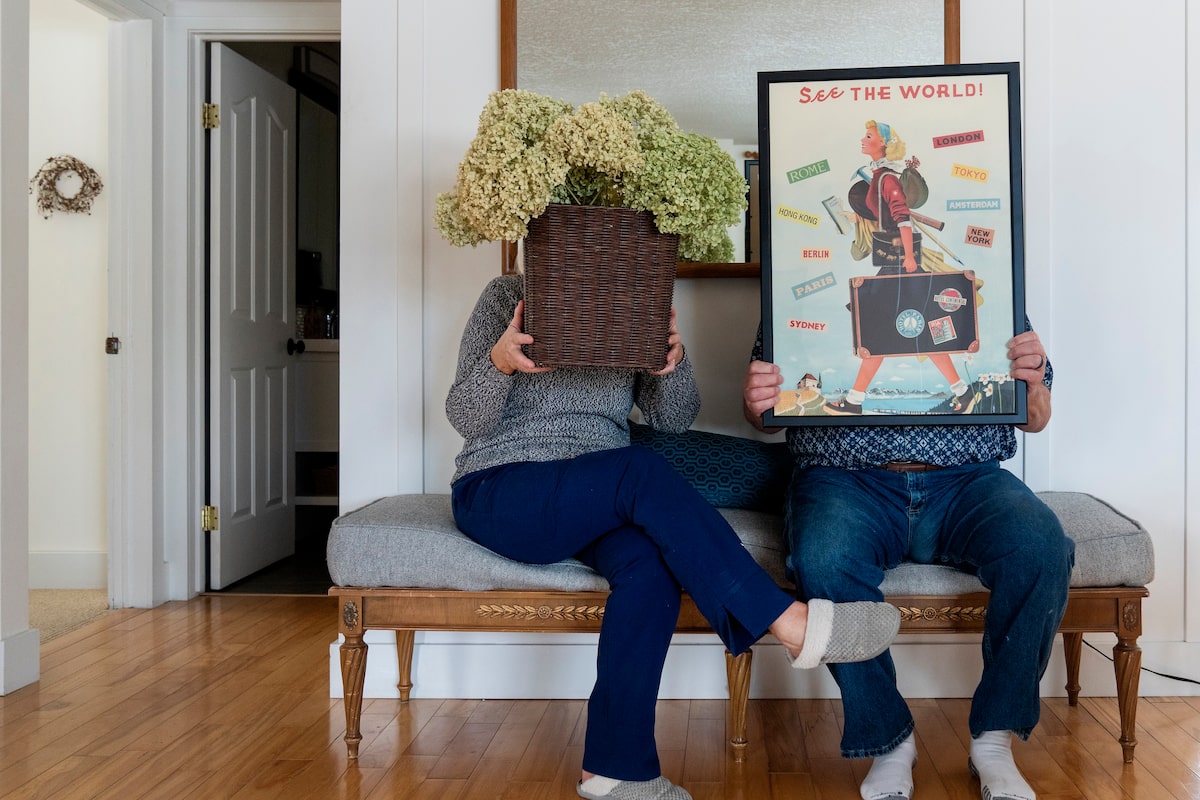
Tripti, 59, is hoping to retire soon from her job with a municipal government and her husband Trevor, 65, is semi-retired and works as a self-employed contractor.Todd Korol/The Globe and Mail
Tripti is 59 and hoping to retire soon from her job with a municipal government that pays $95,000 a year. Once she does, she’ll be entitled to a defined benefit pension of $26,320 a year, indexed to inflation.
Trevor, her husband, is 65 and semi-retired. He earns about $6,000 a year, or $500 a month, working as a self-employed contractor. As well, he gets Canada Pension Plan and Old Age Security benefits totalling $1,100 a month.
Between her registered plans and high-interest savings account, Tripti has nearly $600,000, with her investments held mainly in stocks and stock funds, she writes in an e-mail.
Tripti’s investments have done well over the past few years. “Now that I’m getting older, I am not sure if I should pull back and get some more bond exposure, but it’s been a good ride!”
As sometimes happens when people are self-employed, Trevor fell behind on his income tax and owes the Canada Revenue Agency money for late filings, penalties and interest, Tripti says. Trevor has no savings, and the family home is in Tripti’s name.
When Tripti retires, the couple would like to travel more, but they also want to leave something to their five adult children and five grandchildren. At some point, they might consider downsizing to a smaller home, she adds.
Tripti says she’s always been a saver. “We live simply and could get by nicely on $60,000 to $70,000 a year after tax,” she writes. “I’d love to retire at 63.” Can they achieve their goals?
We asked Warren MacKenzie, an independent financial planner based in Toronto, to look at Tripti and Trevor’s situation. Mr. MacKenzie holds the chartered professional accountant designation.
What the expert says
Tripti is wondering if she can afford to retire at age 63 – the answer is yes, Mr. MacKenzie says. “She could retire today if she wants to.”
One of Tripti’s concerns is that Trevor owes $20,000 to the Canada Revenue Agency. Because of that tax debt, she wonders whether she should avoid splitting her pension income with him.
Trevor is paying $700 a month toward the CRA debt so it could be paid off by the time Tripti retires. If not, “the best solution is for Tripti to use some of the $50,000 in her bank account and pay off the CRA,” the planner says. When she retires, Tripti should split her defined benefit pension – and eventually, her registered retirement income fund withdrawals – with Trevor to keep income tax to a minimum.
If he hasn’t done so already, Trevor might consider applying to have the penalties and interest on his tax account waived under the government’s taxpayer-relief provisions. He would still be liable to the CRA for the taxes owing.
“Based on the assumptions of an average rate of return on Tripti’s investments of 5 per cent with inflation running at 2 per cent, they are on track to leave their children and grandchildren about $1,700,000″ in today’s dollars, Mr. MacKenzie says.
When should Reid, 59, and Nikki, 62, begin selling their three rental properties to boost savings?
In terms of leaving a legacy, the planner says that giving financial help to your children before you die, when they are still young enough to need assistance with housing or child care expenses, often yields the best results for families. “This gives parents the opportunity to experience the joy of seeing the good they can do.”
Currently, the couple can help with gifts of a few thousand dollars each year, he says. “Until they either sell and rent or downsize their home, they’re not in a position to make larger gifts.”
At the moment, they are spending about $54,000 per year to maintain their basic lifestyle, plus another $1,000 per month for gifts and charity, the planner notes. That excludes savings, her pension plan contribution and his monthly CRA payment. In the planner’s financial projections, lifestyle spending has increased to $70,000 per year for basic living expenses, plus $15,000 a year for travel for the next 20 years.
In 2032, which will be Tripti’s first full year of collecting government benefits, the couple’s combined cash receipts will be about $24,400 from their CPP, $21,000 from their OAS, $29,800 from her pension (with inflation) and $30,000 from her registered retirement savings plan, for a total of about $105,000.
Cash outflow in 2032 is projected to include basic living expenses of $79,300, travel and vacation costs of $17,000, and $8,700 in income tax, also for a total of $105,000.
Tripti is a do-it-yourself investor, and her RRSP and tax-free savings account are almost 100-per-cent invested in stocks and stock exchange-traded funds. “Her thinking is that her CPP and work pension give her the security she needs and therefore she can take more risk with her investments,” Mr. MacKenzie says.
“So far this has worked out well for her – Tripti’s return over the past five years is about 10 per cent per annum.” About 80 per cent of her investments, around $335,000, is in the Vanguard Growth ETF. However, “given that stock markets are near their record-high, she should consider moving to a lower-risk asset mix,” the planner says.
Can this Vancouver couple in their 50s retire in five years and help their kids buy a home?
Tripti wondered about delaying CPP to age 70 so that she could get a 42-per-cent boost to her benefit. She has decided to start CPP at age 65.
Tripti was also concerned about the amount of income tax that will be triggered when she and her husband die. But “a large estate tax bill is unlikely to be a problem because the projections show that if Tripti lives to be 100, her entire net worth will be in her home and TFSA, neither of which are taxable.”
The couple’s youngest son is the executor of their estate. Mr. MacKenzie suggests they consider a corporate executor instead. “With five children and four spouses, it would not be unusual for differences of opinion to arise about when the different estate assets should be liquidated,” the planner says. “It is better for family members to be angry with a corporate executor than to be angry with a sibling.”
Most corporate executors charge about 5 per cent of the value of the estate. “But there is a lot of work involved,” Mr. MacKenzie says, “So I believe family members who act as executors should also get paid.”
Trevor and Tripti are not concerned about the possible cost of long-term health care. If a retirement or nursing home is required, the proceeds from the sale of their existing home will be more than enough to cover those costs, the planner says.
In order to have the information necessary to enjoy a retirement free of financial worries, Tripti and Trevor should keep their financial plan updated. “When a financial projection is prepared based on conservative assumptions, if there is a potential problem, it will give the retirees many years to make a small spending adjustment to avoid the future problem,” Mr. MacKenzie says.
Client situation
(Income, expenses, assets and liabilities provided by applicants.)
The people: Trevor, 65, and Tripti, 59, and their family.
The problem: Can Tripti afford to retire at 63, travel more, live comfortably and still leave something for her children and grandchildren?
The plan: Retire as planned, pay off Trevor’s loan and split her income. Shift to a lower-risk investment strategy. Revisit the plan regularly.
The payoff: A road map to achieving their financial goals.
Monthly after-tax income: $7,670.
Assets: Bank accounts $50,000; margin account $14,000; Tripti’s TFSA $207,000; Tripti’s RRSP $315,000; residence $1,100,000. Total: $1,686,000.
Estimated present value of Tripti’s DB pension: $550,000. (That is what someone with no pension would have to save to generate the same income.)
Monthly outlays: Property tax $500; home insurance $370; electricity $300; heating $200; maintenance, security $315; garden $75; car insurance $300; fuel $350; other transportation $300; groceries $500; clothing $120; CRA debt $700; gifts, charity $1,000; vacation, travel $500; personal care $40; club memberships $50; dining out, entertainment $90; pets $30; sports, hobbies $50; health care $50; life insurance $90; communications $280; RRSP $375; TFSA $585; her pension plan contributions $500. Total: $7,670.
Liabilities: $20,000 Trevor’s CRA debt.
Want a free financial facelift? E-mail finfacelift@gmail.com.
Some details may be changed to protect the privacy of the people profiled.