
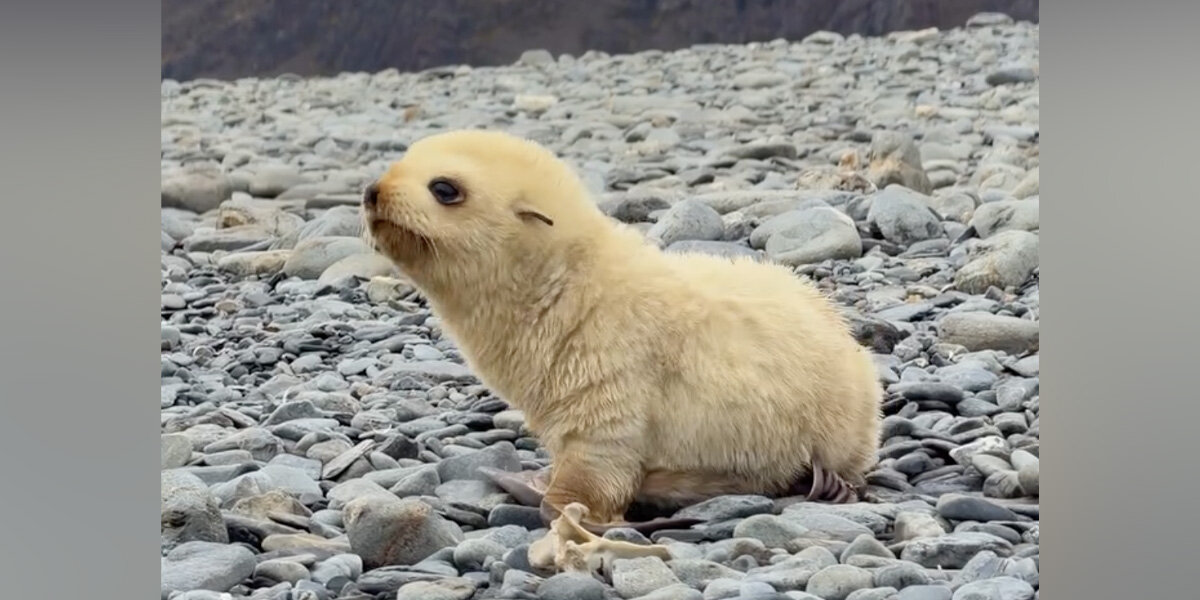
Every year in January and February, tourists and wildlife photographers flock to South Georgia, a sub-Antarctic island, hoping to catch a glimpse of newborn fur seals sunning themselves and waddling across the beach.
Earlier this year, one such visitor to the island named Arthur Artinian came upon a group of the pups lounging on the shore. As he got closer to the adorable animals, he realized one of them was not like the others. While every other seal was dark brown, this one had a cream-colored coat.
Artinian described the unique seal as a “miracle of nature.”
Artinian quickly pieced together that this pup’s unique coloring was the result of leucism, a rare genetic mutation. Leucism results in a partial loss of pigmentation, which is why the baby seal had been born with white fur instead of brown fur.
“Leucistic animals typically retain some pigment in their eyes and other parts of their body, distinguishing them from albinos,” Kristian Gillies wrote on Instagram.
Artinian was stunned. He couldn’t believe he’d just stumbled upon such a rare animal — who also happened to be one of the most adorable babies he’d ever seen.
In general, about one in every 10,000 fur seals is born with leucism. But in South Georgia, while white fur seals are still rare, they’re actually 10 times more common than everywhere else. The reason for this anomaly has to do with the history of fur seals as a species.
In the late 1800s and early 1900s, Antarctic fur seals were nearly driven to extinction by hunters. When their population had dropped to just a few hundred individuals, a few leucistic seals were among the survivors. When their numbers started to go up thanks to increased legal protections, those leucistic seals passed their genes onto future generations.
“[I]t’s likely that a leucistic individual (or two) that survived on South Georgia contributed to the prevalence of this trait there,” National Geographic wrote on their website.
There are now between 3.5 and 5 million fur seals on the island. Of those seals, it’s estimated that about one in every 1,000 individuals is leucistic. It’s become a distinct feature of South Georgia and one of the many reasons people like to visit.
Luckily, the leucistic seals don’t seem to be affected by their unique coloring in any way. So the trait keeps getting passed down, and visitors to the island keep getting to enjoy seeing the adorable blonde babies.
