
ANNOUNCER: You’re listening to Short Wave from NPR.
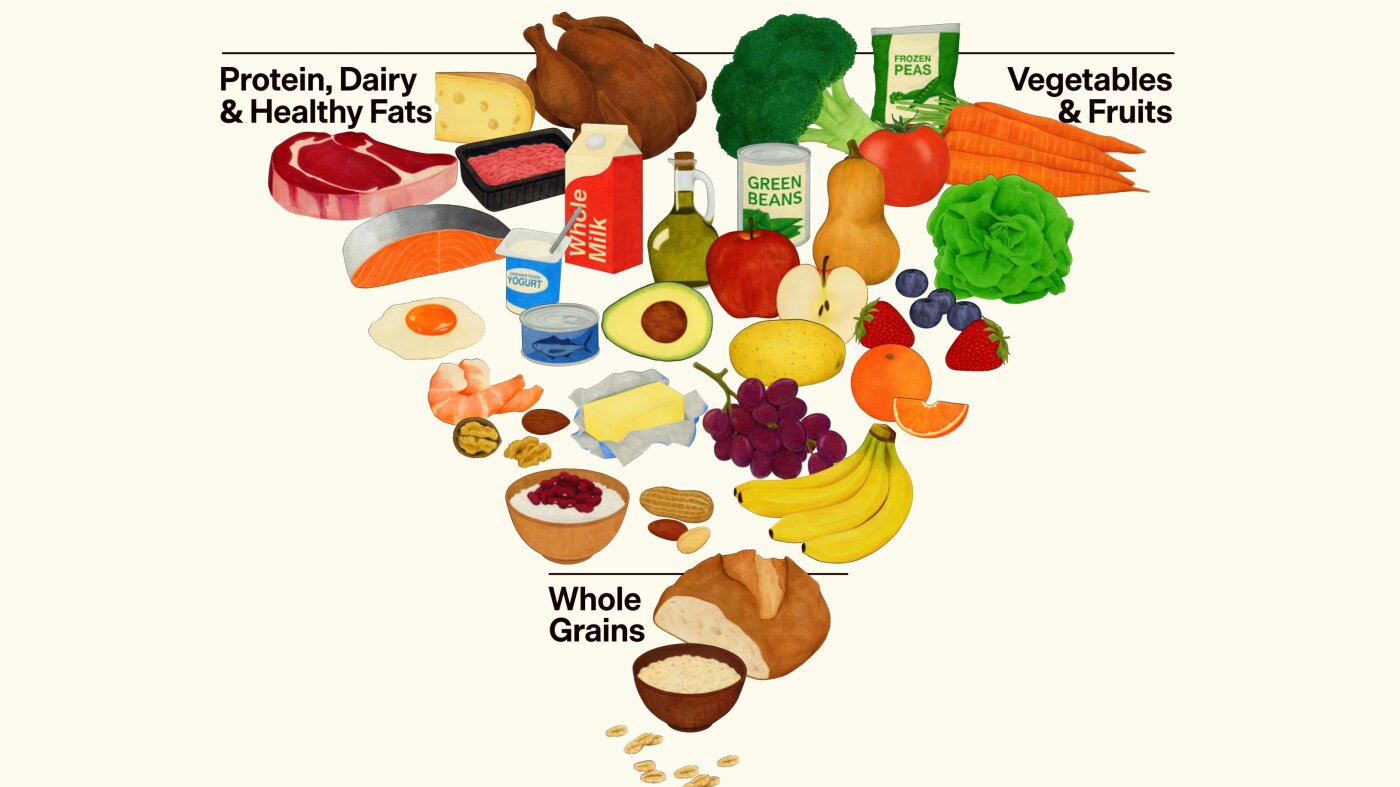
EMILY KWONG: Hey, Short Wavers. Emily Kwong here. So earlier this year, the new inverted food pyramid dropped, you know, the one that emphasizes protein, full-fat dairy, and what Health and Human Services Secretary Robert F. Kennedy, Jr., calls “healthy fats” at the top. This pyramid, it was big news for a couple days. Then maybe you forgot about it. But it is important because it reflects new dietary guidelines. These come directly from the federal government and could influence school lunches, food labeling, and programs like SNAP. So here to talk about how the food pyramid may change school lunch trays is Kadin Mills, NPR’s Reflect America fellow. Hey, Kadin.
KADIN MILLS: Hi, Emily.
KWONG: Hi. OK, so I’ve been out of school for a while. What are the kids eating these days?
MILLS: I actually got a tour of a kitchen at Mary H. Matula Elementary School in Maryland. And like a lot of schools, they rely on ready-made meals that they can easily heat up.
[AUDIO PLAYBACK]
KWONG: Mm, OK.
MILLS: With the exception of fruit and veggies, almost everything pre-packed. And what are you serving today?
ALICIA BASSETT: We have French bread pizza. We have rotini and garlic bread. We have broccoli and carrots and then our crispy chicken salads. And then we’ll have our juices here and our cut fruits here.
KWONG: Mozzarella stick day was prized at my school.
MILLS: The Bosco sticks?
KWONG: Yes, delicious, delicious. Who’s this?
MILLS: So that’s Alicia Bassett. She’s the food and nutrition manager at Matula Elementary. And the lunch menu she’s describing is based on the 2020 guidelines set by the US Department of Agriculture and HHS.
BASSETT: Down here, they can get a salad cup, a fresh apple, a fresh orange, bananas, zucchini, coleslaw, broccoli slaw. We got it going on down here.
[END PLAYBACK]
MILLS: They’ve got everything. So schools that receive federal funding for their school meals have to follow strict standards set by the USDA–
KWONG: Yeah.
MILLS: –from limits on added sugars and salt to the number of calories that come from saturated fats. And those standards must be in line with the dietary guidelines, which have now changed.
KWONG: OK. So with the new pyramid, how could school lunch trays look different?
MILLS: Yeah, so we don’t really know yet. USDA hasn’t released their nutrition standards based on this new pyramid yet. And it could take a few years. But one big difference in the new guidelines is protein.
KWONG: Oh, yes, our friends meat and dairy and eggs and more.
MILLS: Yeah. So right now, there’s no rule saying that schools have to include those proteins in breakfasts. But the new guidelines recommend eating protein with every meal.
KWONG: Oh.
MILLS: So we’ll have to wait and see if USDA will mandate that in the future.
KWONG: Today on the show, we dive into the science behind the updated guidelines, what it means for kids and for adults, and ask if we should change how we eat. I’m Emily Kwong. You’re listening to Short Wave, the science podcast from NPR.
[RELAXING MUSIC]
KWONG: If you haven’t already, look up the new food pyramid. It prioritizes protein, dairy, and, quote unquote, “healthy fats,” all of which is represented in this artful painting topped with a roast chicken and broccoli and cheese. So I will say this– aesthetically, the food pyramid could make for some very nice wall art. Whoever painted this ate– literally. And the pyramid as painted is interesting.
SHANA SPENCE: [LAUGHS]
KWONG: That laughter you’re hearing is from registered dietician Shana Spence.
SPENCE: Hello.
KWONG: And beautiful as it is, we wanted to ask Shana what she thought of the pyramid scientifically.
SPENCE: You know, as I expected, emphasis on protein. And I get it, right? I’m a dietician. We need protein in our diets, for sure. But this is a bit excessive. We’re seeing protein being added in everything, from, like, Pop Tarts to, you know, cereals, all this stuff. And I was actually pleasantly surprised. I’m like, oh, they did keep fruits and vegetables, at least. So that’s good. But, yes, I was not surprised at the emphasis on protein.
KWONG: And one thing that we’ve been especially confused by is the fats conversation. So this administration has talked about ending the war on healthy fats. What do they mean by that?
SPENCE: Yes, we need healthy fats in our diet, for sure. But they– they’re emphasizing still meat. And in my mind, right, as a dietician, someone licensed, healthy fats includes, you know, things like avocados, nuts, seeds, right, olive oil, things like that, not red meat. You know, when we’re talking about red meat, there has been a link towards cardiovascular illnesses and diseases because of the saturated fat.
KWONG: Yeah, and saturated fats, of course, these are fats that are solid at room temperature–
SPENCE: Exactly.
KWONG: –like–
SPENCE: Butter.
KWONG: It also includes butter, cheese, red meat.
SPENCE: Exactly, exactly, like, pretty much the sources that would come from animal products.
KWONG: Mm-hmm. And what does nutrition have to say about saturated fat? Like, what does a diet heavy in saturated fat do to our bodies?
SPENCE: So it’s linked to high cholesterol levels, like your LDL, which is the, quote unquote, the “bad” cholesterol, the cardiovascular diseases, right, leading to certain illnesses, like heart disease, strokes. So that’s why we really– “we” meaning health, dieticians– we really emphasize having a diet low in saturated fat.
KWONG: Yeah.
SPENCE: Red meat can be included. Like, you know, I always say all foods can fit. But we can go about it in a way that makes sense.
KWONG: Yeah. And you’d prefer fats that are, like, monounsaturated or polyunsaturated–
SPENCE: Exactly.
KWONG: –like you said, nuts, avocados. On the topic of saturated fats, it’s interesting that though the pyramid encourages more red meat consumption, at least visually– there’s, like, a big steak–
SPENCE: Visually, yeah.
KWONG: –at the top.
SPENCE: Yeah. That’s the part I remember the most when looking at it, the steak.
KWONG: The written guidance is the same as the 2011 MyPlate recommendations, which is to make no more than 10% of your calories from saturated fat. So the number is the same, is capped at that 10% saturated fat, no more, even though they’re saying, but please eat more red meat, people. Like, how do you square those two things?
SPENCE: And that’s what’s so frustrating, is that, you know, when I– when you first look at the triangle, you’re thinking, oh, my gosh, I have to– instead of making half my plate fruits and vegetables, I need to be making half my plate meat.
KWONG: Yeah.
SPENCE: And then you have to look at an entirely different section to look at the actual written out recommendations. And then the recommendations haven’t changed that much. You know, as a dietician, I agree with the do not exceed 10%.
KWONG: Yeah, yeah, yeah, yeah.
SPENCE: So it’s a little confusing. And they even have also written out plant-based proteins are great. They even mention fiber, I remember. And I was like, oh, my gosh, he mentioned fiber. Right? So I just think it’s very confusing.
KWONG: Thanks to registered dietician Shana Spence. And she’s totally right, by the way, about the protein thing. I mean, I don’t know if you all have noticed, but protein is everywhere. It is mixed into coffee drinks. Giant powdered tubs of it are flying off the grocery store shelves. But we on Short Wave, we wanted to know, like, how much protein do we really need?
SARAH KIM: That’s a really good question.
KWONG: That’s Sarah Kim, a professor of medicine at the University of California, San Francisco.
KIM: OK. So first of all, the guidelines say 1.2 to 1.6 grams of protein per kilogram of body weight. You can get all the protein you need from plant sources. And kudos to the food recommendations here. When it talks about proteins, it actually does say, “Consume a variety of proteins from animal sources, including eggs, as well as a variety of plant-sourced protein foods, including beans, peas, lentils, legumes, nuts, seeds, and soy.” And the amount of protein that one needs can really vary from person to person, depending on their circumstances. Extra protein, you know, that you eat in a day is not really stored as protein. Your body can’t store extra proteins for possible future use, like it can store fat. And so extra protein that you take in a day that’s more than you need in a day is then converted into sugar and fat. So eating tons of protein does not mean that you will make tons of muscle. You need to actually balance the amount of protein you eat with muscle exercise– muscle-building exercise–
KWONG: Whoa.
KIM: –in order to see the rewards of that.
KWONG: OK. I’m wondering, Dr. Kim, was there anything about the previous food pyramid that I grew up with or the MyPlate guidelines that were introduced later in 2011 that you were glad to see gone or anything that you wish had been kept?
KIM: Sure. Like, all of these foods I’m seeing on this pyramid and in the past pyramids, they look pretty good. They’re, like, healthy-ish foods, you know, minimally processed. And I would say that’s the one recommendation that I wholeheartedly agree with is, like, eat real food. I completely agree with that. What I would advise against is being fooled by products that are marketed as healthy because they have some feature of some food guideline, you know, that puts an artificial halo on that food product.
KWONG: Yeah.
KIM: That is where we went wrong.
KWONG: Yeah. Now, these dietary guidelines, because they come from the federal government, they do influence certain things, like school lunches, food on military bases. So how do you hope people use this pyramid, just knowing that it does have real-word impacts?
KIM: Looking holistically at the pyramid, I would say we might run into problems with an overemphasis on protein because of expense, you know, cost to the environment of making a lot of protein, and especially animal protein. That’s going to be tricky. Would I love to see, you know, animal proteins of some frequency or other protein sources for people who don’t want to eat animal proteins, plus all of those fruits and vegetables that I see on the pyramid, plus whole grains? Absolutely. You know, the quality of school lunches, I would love to see that get to the level of real food, whole foods, minimally processed foods. Because I think right now, it probably is fairly processed.
KWONG: That is completely consistent with these school cafeterias. So much of their world is, like, highly processed, ready-to-eat foods that are warmed up.
KIM: You know, if the school lunches look like that pyramid, I think I would be quite happy.
[UPBEAT MUSIC]
KWONG: If you liked this episode, please share it with a friend. It really helps our show out. And consider checking out our other episode featuring Sarah Kim. That’s the one on blood sugar. This episode was produced by Rachel Carlson and our showrunner, Rebecca Ramirez. It was edited by Brent Baughman. Aru Nair and Tyler Jones checked the facts. Kwesi Lee was the audio engineer. I’m Emily Kwong. Thank you for listening to Short Wave, the science podcast from NPR.
[UPBEAT MUSIC]
Copyright © 2026 NPR. All rights reserved. Visit our website terms of use and permissions pages at www.npr.org for further information.
Accuracy and availability of NPR transcripts may vary. Transcript text may be revised to correct errors or match updates to audio. Audio on npr.org may be edited after its original broadcast or publication. The authoritative record of NPR’s programming is the audio record.