
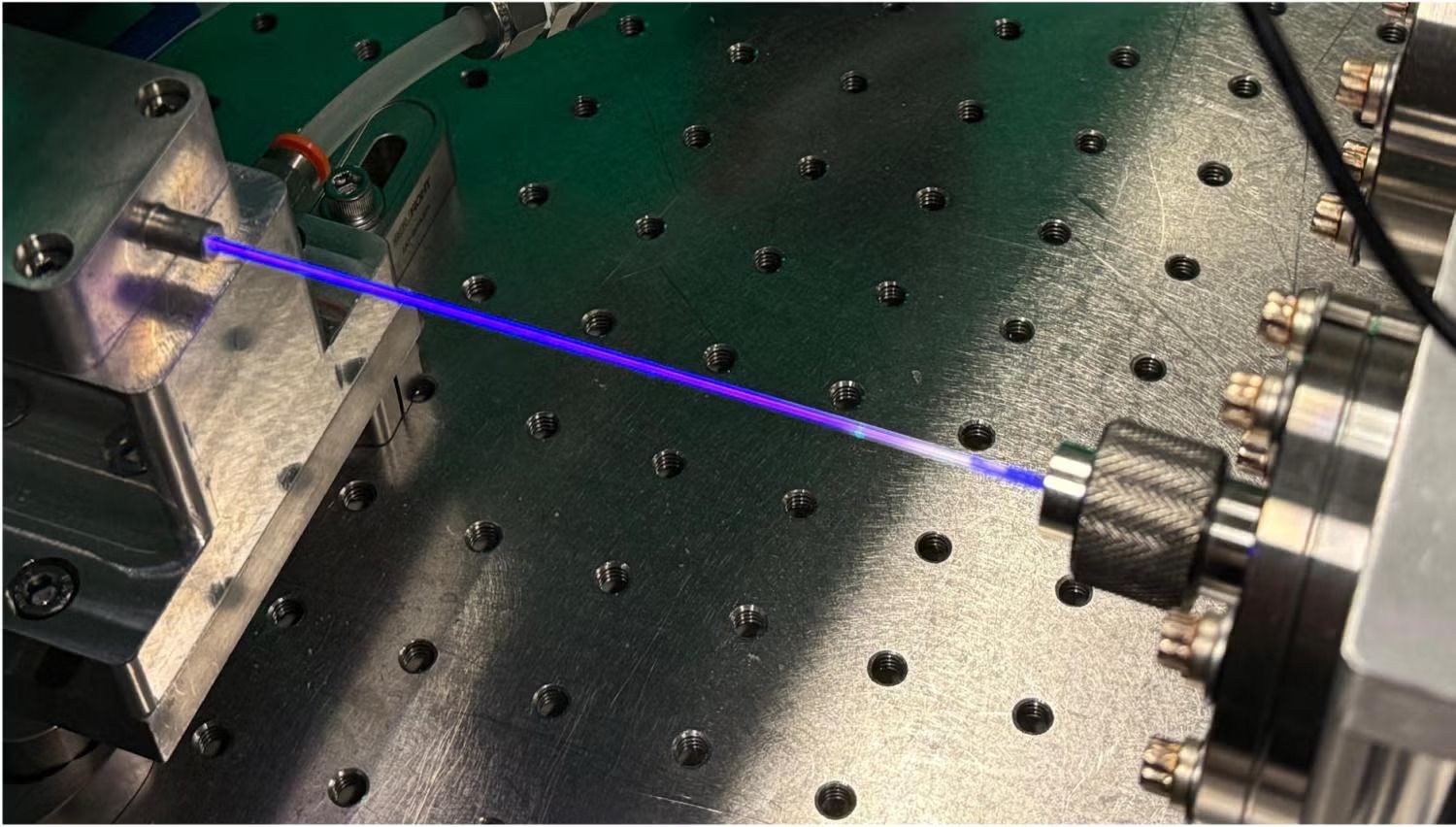
For decades, scientists have struggled to create lasers that operate in the vacuum ultraviolet region, a part of the spectrum with extremely short wavelengths between visible light and X-rays.
These wavelengths, typically around 100–200 nanometers, are highly valuable because they can reveal incredibly fine details of matter. However, they are also difficult to produce because most materials strongly absorb this kind of light.
Physicists at the University of Colorado Boulder have developed a powerful new type of vacuum ultraviolet (VUV) laser that is up to 1,000 times more efficient than existing technologies. The compact device (small enough to sit on a tabletop) could open a previously inaccessible region of light to scientific exploration. It also delivers strong, tunable, and coherent VUV beams, a major challenge in the field.
The breakthrough may allow scientists to observe processes once impossible to track, such as chemical reactions unfolding in real time or the formation of tiny defects in next-generation computer chips. It could also pave the way for ultra-precise nuclear clocks.
The work was led by Henry Kapteyn and Margaret Murnane at JILA, in collaboration with scientists at the National Institute of Standards and Technology (NIST). The team recently presented their findings at the American Physical Society’s Global Physics Summit.
Heat energy can travel through a complete vacuum
Kapteyn said, “Scientists have been working toward vacuum ultraviolet lasers for decades. We think we might have finally found a great route that can be scaled in power, and that is compact in size, two essential requirements for challenging applications.”
Scientists have struggled to make lasers work in the vacuum ultraviolet (VUV) range, which lies between X-rays and visible light. This is because nearly all materials, solids, atoms, and molecules absorb light strongly in this region. That makes VUV light both fascinating and very hard to control. To tackle the problem, researchers began by combining red and blue laser beams within a specialized structure called an anti-resonant hollow-core fiber.
This fiber contains a central hollow channel surrounded by smaller tubes. As laser light passes through, it interacts with xenon gas atoms, which absorb and re-emit the light at much shorter wavelengths. The team will present its preliminary findings in sessions on March 17 and March 19 at the American Physical Society’s Global Physics Summit in Denver. effectively converting it into VUV light.
Murnane said, “To our knowledge, no other approach, either at big or small facilities, has the VUV power levels, tuning ranges, and coherence that our new approach has shown.”
Physicists demonstrated how sound can be transmitted through a vacuum
Shorter wavelengths allow scientists to see smaller details. This makes the new laser especially valuable for nanoscale imaging.
Vacuum ultraviolet lasers could be very useful. Engineers might use them to spot tiny flaws in semiconductor chips, making everyday electronics faster and more reliable. Scientists could also use them to observe chemical reactions as they occur, providing new insights into phenomena such as combustion and materials science.
One of the most exciting applications is the development of nuclear clocks, which could surpass current atomic clocks in precision.
These clocks rely on specific energy transitions in thorium atoms, triggered by light at an exact VUV wavelength. Existing systems require large, room-sized lasers, but the new compact device could make portable nuclear clocks feasible.
Such clocks could revolutionize navigation, allow GPS-free positioning, and even help detect distant planets or test fundamental physics theories.
The team will present its preliminary findings in sessions on March 17 and March 19 at the American Physical Society’s Global Physics Summit in Denver.