SASKATOON — There is not much relief on the horizon for the drought-stricken region of the Canadian Prairies, says a weather expert.
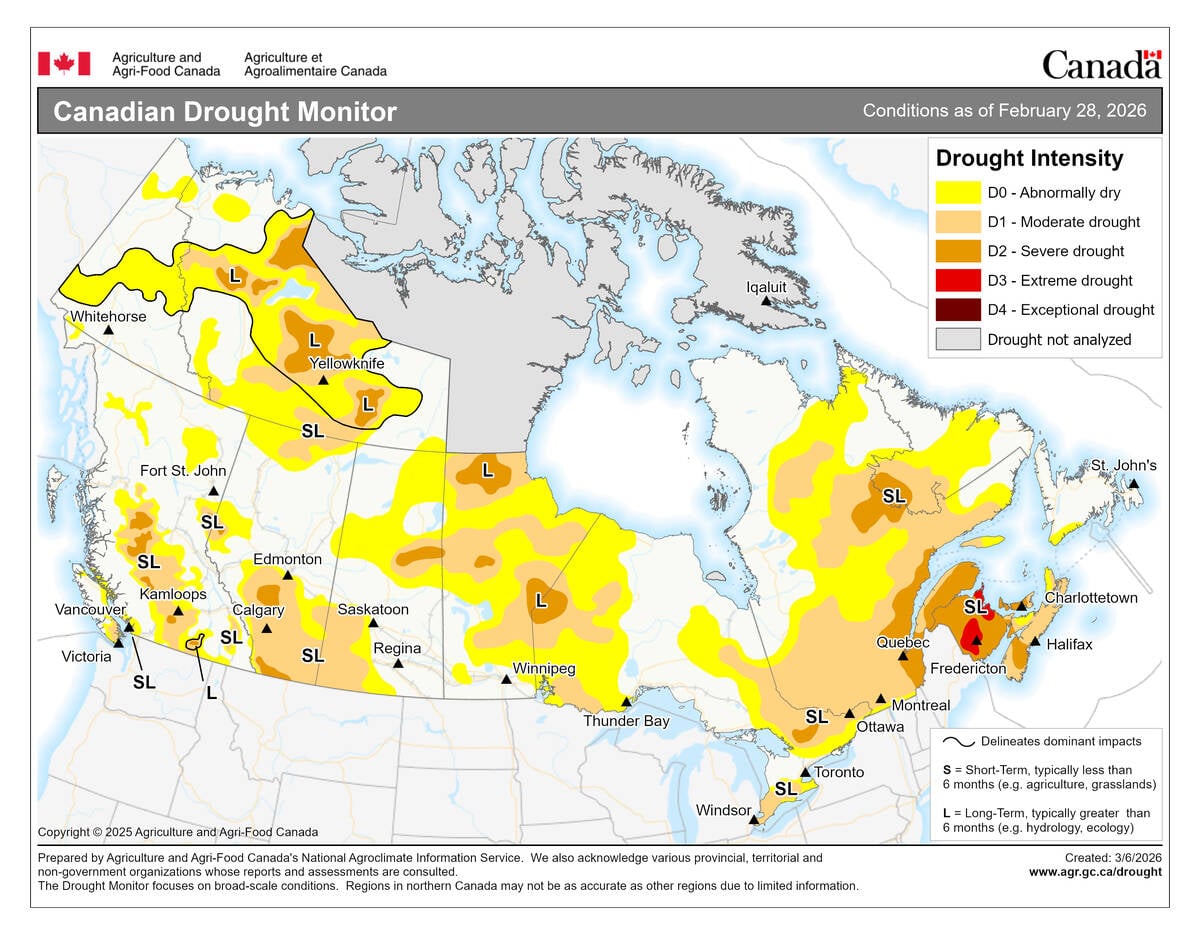
The latest Canadian Drought Monitor map shows that a large portion of western Saskatchewan and central and southern Alberta is experiencing moderate to severe drought.
“That drought in the southwest is a concern, a very big concern,” said Drew Lerner, president of World Weather Inc.
Read Also

Tractor and Implement Management system offers improved baling performance
Tractor and Implement Management allows a Massey Ferguson large square baler to control the speed of an 8S or 9S tractor to maximize baler output and improve bale quality.
“I certainly don’t see anything at the moment coming around that’s going to put a serious dent in this.”
There could be some rain events in early- to mid-April but not enough to make a big difference, which is worrisome.
“That’s never a good thing when you’re coming into the warm season and you haven’t eliminated the dryness,” said Lerner.
Why it Matters: Nearly half of the agricultural land in the Prairies is either abnormally dry or experiencing some level of drought.
A ridge of high pressure could settle over the dry areas, which would perpetuate the dryness.
Much of the U.S. Plains region is also parched and has been experiencing a heat wave, which will likely lead to an expansion of drought in that country.
He expects the “crazy warmth” to stick around through May.
“That’s probably going to put us back behind the eight ball again,” said Lerner.
He anticipates better precipitation potential in the Canadian Prairies in the June through August period as a northwest summer jet stream pulls in some moisture from the U.S. Midwest.
However, that will likely only deliver moisture to the eastern portion of the region.
“I am nervous about the southwest Prairies,” he said.
The southwest could get some rain, but the worry is that it will come too late.
“Will (the crop) manage to hang in there until the better rains come?” said Lerner.
“That is the big question.”
A developing El Nino will likely bring some precipitation to the Prairies, but that likely won’t happen until after harvest.
The potential of a high-pressure ridge developing over the U.S. Plains and southern portion of the Canadian Prairies this spring and summer increases if there is no significant moisture in the western half of the United States over the next few weeks.
When that happens over an area that is dry, the ridge tends to become more intense and entrenched, which wouldn’t help matters.
However, it is possible that the top of the ridge could periodically push east, pulling in some moisture from Pacific Ocean systems.
Lerner is not ready to provide any yield projections because the crop isn’t even in the ground, and as every farmer knows, long-range forecasts are fraught with risk.
“If you had asked me that same question last year at this time, I would have told you we’re going to have a terrible year,” he said.
However, timely rains turned things around and delivered a bumper crop.
Lerner said one encouraging thing about North America’s years-long drought is that there has been some improvement north of the tree line in the Canadian Prairies and also in parts of the U.S. Midwest and the Mississippi Delta.
The drought is not going to disappear all at once, but it is good to see there has been some gradual chipping away at the vast expanse of drought area in North America, he said.