
Bread, grains, fruits, and vegetables arranged in a circular pattern around a shrimp at the center. – Knowable Magazine
The curious case of low-protein diets
Protein dominates the grocery shelves: Protein chips. Protein cookies. Protein water. It’s in the headlines, too: January’s new U.S. dietary guidelines raised the recommended amount from 0.8 grams of protein per kilogram body weight to 1.2 to 1.6 grams.
Yet there’s a cadre of scientists studying a contrary phenomenon: In critters from single-celled yeast to insects to rodents, cutting protein intake to measly levels makes them live longer.
Could it work for people? To be clear: The body needs protein to build and repair its parts, and a diet with about 7% or less of its calories from protein is a recipe for malnutrition, not centenarian status. But studying protein restriction in lab animals helps scientists learn how animals sense nutrients, how their bodies strategically respond to excess or to shortage, and how all of this affects their health and longevity. And that could carry lessons for human beings, Knowable Magazine reports.
“There’s a lot to be learned from the principles of protein restriction about how we would manage aging, and aging well,” says Stuart Phillips, a physiologist at McMaster University in Hamilton, Canada.
The mouse food diaries
Protein restriction, Phillips says, is a sort of “lite” version of a more well-known longevity hack — caloric restriction. Cutting overall calories eaten, typically by 20% to 50%, has been linked to long lifespan in lab animals since more than a century ago. Some dedicated humans are trying a milder version.
Lab animals on low-calorie or low-protein diets are indeed long-lived. In one recent study, mice that ate all they wanted of normal chow lived for a maximum of 1,008 days. Mice given the same food, but only 80% of the calories, survived for up to 1,179 days — a ripe old age for a mouse. Those sets of mice received chow with 18% protein, but a third group feasted on an all-you-can-eat buffet with only 6% of calories from protein. Their survival was in between the others, with a maximum of 1,115 days.
These effects went beyond long life; restrictive diets also improved health. Mice on calorie-restricted or protein-restricted diets had lower levels of sugar and insulin in their blood, and lower insulin sensitivity — markers of metabolic fitness. These healthy signals continued as the mice on restrictive diets grew older, while their status deteriorated in the aging mice that ate normally. Not surprisingly, the mice on calorie- or protein-restricted diets also had lower body fat. Indeed, at a one-year check-in, they were downright gaunt, weighing in at about two-thirds the mass of their normally dining counterparts.
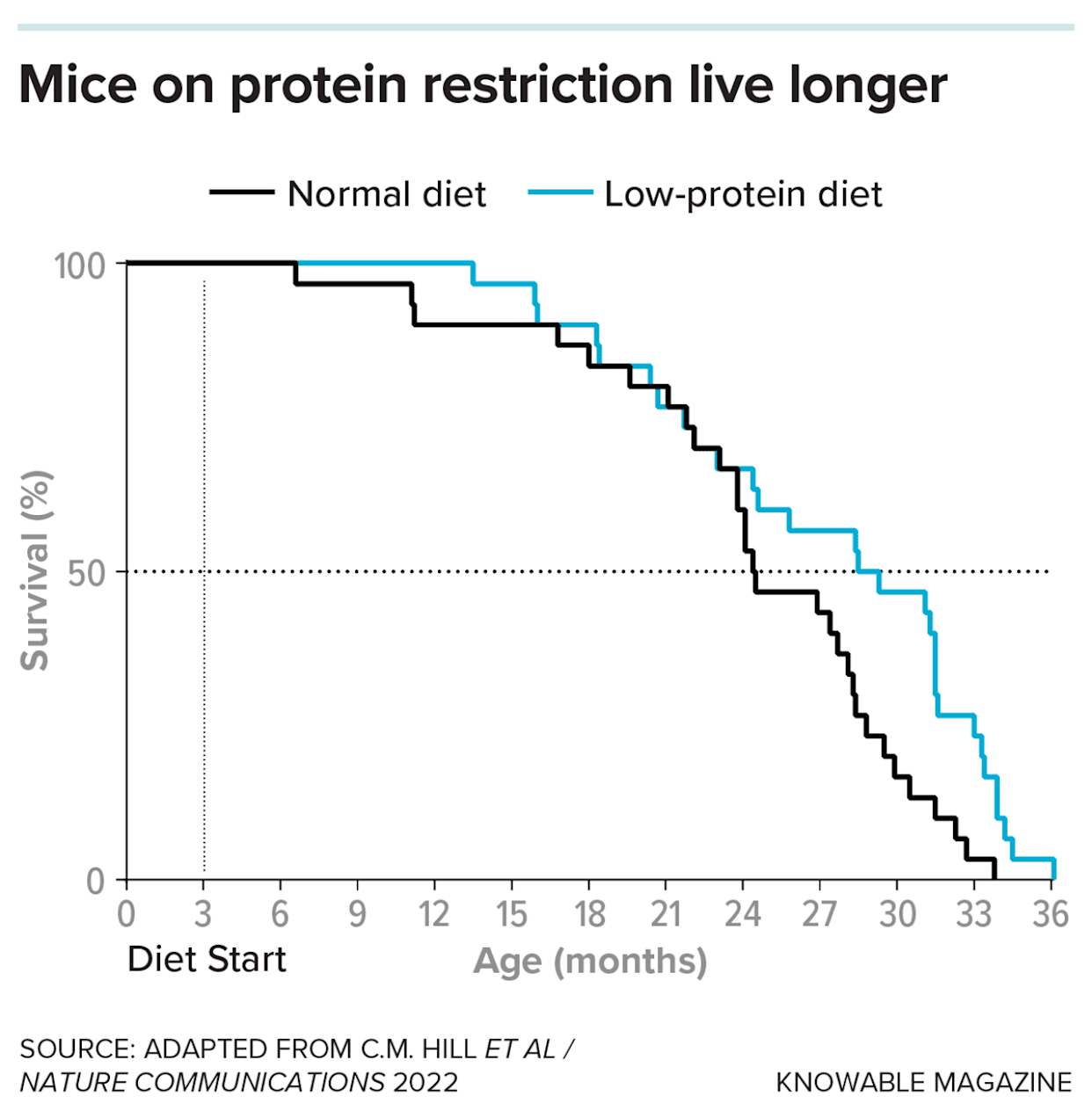
Researchers fed 30 male mice a standard diet with 20 percent protein, and 30 additional mice a diet with only 5 percent protein. Those that got less protein lived longer. – Knowable Magazine
In another recent study, researchers zeroed in on molecular signs of aging. As animals get older, their bodies undergo changes, such as the damage of tissues by unstable free oxygen radicals. Mice on a low-protein diet exhibited a variety of anti-aging features in their DNA and proteins, across multiple organs. For example, they boosted levels of protective, antioxidant enzymes. The benefits were most pronounced in middle-aged mice, suggesting that low-protein benefits aren’t the same across the lifespan.
Making hay or hunkering down?
Scientists don’t yet know all the biological factors that underlie how mice become thin, healthy and long-lived on restrictive diets. One obvious potential explanation for their skinny physiques is that they lack the nutrients to build and maintain their body parts or are dedicating their scant energy supplies to brain function — but that’s probably not the full story, says Christopher Morrison, a physiologist at the Pennington Biomedical Research Center in Baton Rouge, Louisiana. The reasons behind their metabolic health and longevity are less obvious, but scientists have ideas.
Think of the body like a car, suggests Clemence Blouet, a neuroendocrinologist at the University of Cambridge in the U.K. You can drive fast, using lots of fuel and putting wear and tear on the car. Or you can stick to a gentle 15 miles per hour, and the car lasts longer. Living in a high-protein or high-calorie fast lane, she muses, could lead to the accumulation of those pro-aging oxygen radicals. Protein, in particular, also turns on systems that promote growth as well as aging. Restricting the diet could mean fewer of those damaging radicals and less pro-aging actions, keeping the body in smoothly working order for longer.
Alternatively, suggests Phillips, imagine a body that is forced by a short supply of nutrients to go into high-efficiency mode, so it recycles more of the amino acid building blocks used to make proteins. “I think, then, a lot of other processes that are age-related also get more efficient … and function very, very well,” he says.
It is also becoming clear that the low-protein/long-life effect isn’t simply because the body is withering from a shortage of body-building molecules, says Morrison. There’s something more strategic going on. Morrison’s team studies a hormone called FGF21, made by the liver, and when protein is in short supply, FGF21 seems to tell the brain, “Hey! There’s not enough protein in this diet!” But if mice are engineered to lack FGF21, they don’t respond to low-protein diets with life extension — in fact, they die earlier. In other words, low protein extends life only if the brain gets the message and adjusts the body’s responses.
“The reduction in growth is a ‘choice,’ if you will,” concludes Morrison, who coauthored an overview of protein restriction in the 2025 Annual Review of Nutrition. And he thinks this choice occurs before bodies reach the point of wasting from too little protein.
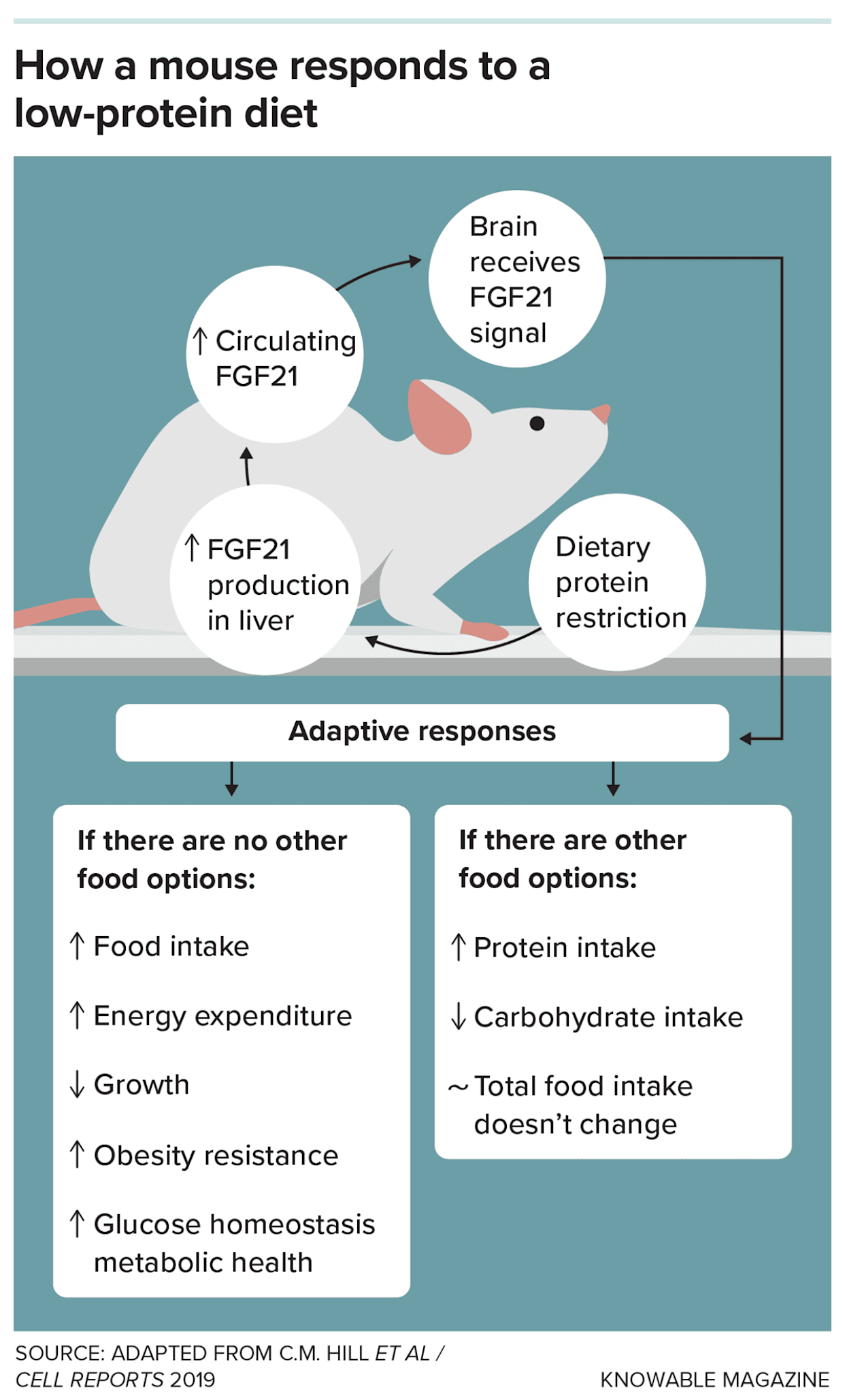
A graphic illustrates the response to protein restriction in a lab mouse: The hormone FGF21, produced by the liver, signals the brain to make a number of changes, including increased protein intake and slowed growth. – Knowable Magazine
If life extension when protein is scarce is a choice, albeit an unconscious one, then sticking with the default shorter life when protein is abundant could be a sort of choice, as well. While it might seem counterintuitive, this makes perfect sense for an animal that’s balancing survival with reproduction, says Stephen Simpson, a nutritional biologist at the University of Sydney. When nutritious, protein-rich foods are abundant, animals “make hay while the sun shines,” Simpson says, putting their energy and resources into growth and reproduction. That might mean they don’t quickly repair tissues damaged by oxygen radicals or other stressors. If the animal loses a few months off the end of its life, so be it. From an evolutionary standpoint, the additional descendants are worth that sacrifice.
Conversely, if nutrients are hard to come by, creatures “hunker down,” Simpson says. They activate protective and reparative anti-aging mechanisms in the hopes they’ll survive long enough to reproduce when good times return — even if it means they stay puny. Simpson’s research backs this up: Reproductive indicators such as sperm counts and ovarian follicle numbers are diminished in mice on a low-protein menu compared to those eating high-protein fare.
Researchers are starting to piece together the biology behind these “making hay” and “hunker down” programs — and the molecules they uncover might inspire medicines to help people age with ongoing health, suggests Phillips. It’s known, for example, that a physiological system mediated by the enzyme mTOR regulates growth, reproduction and aging. Low-protein diets shut down mTOR, as does a drug called rapamycin that has garnered interest as an anti-aging compound.
Protein for the people
But all these data come from nonhuman lab animals. “I don’t think we really know what long-term protein restriction will do in humans,” says Morrison.
Scientists can hardly put a large group of people on a decades-long low-protein diet and wait to measure how long they survive. But what they can do is correlate people’s diets, reported on questionnaires, to disease and survival. The results of such epidemiology studies vary, but overall, higher protein intake seems to correlate with a slightly higher risk of cardiovascular disease and type 2 diabetes, says Phillips. He cautions that people who eat lots of animal protein get the saturated fat that comes with it, which could skew the health results. Diets high in plant protein don’t show the same pattern.
Another kink in the science is that protein needs vary by age. One study found that for people aged 50 to 65, a low-protein diet correlated with a lower likelihood of death from cancer or any cause compared with those eating a high-protein diet. But for people older than 65, the pattern flipped: Low protein intake was linked to higher rates of cancer deaths and overall deaths. So keeping protein intake low to average in middle age, but getting more after age 65 could — perhaps! — be beneficial.
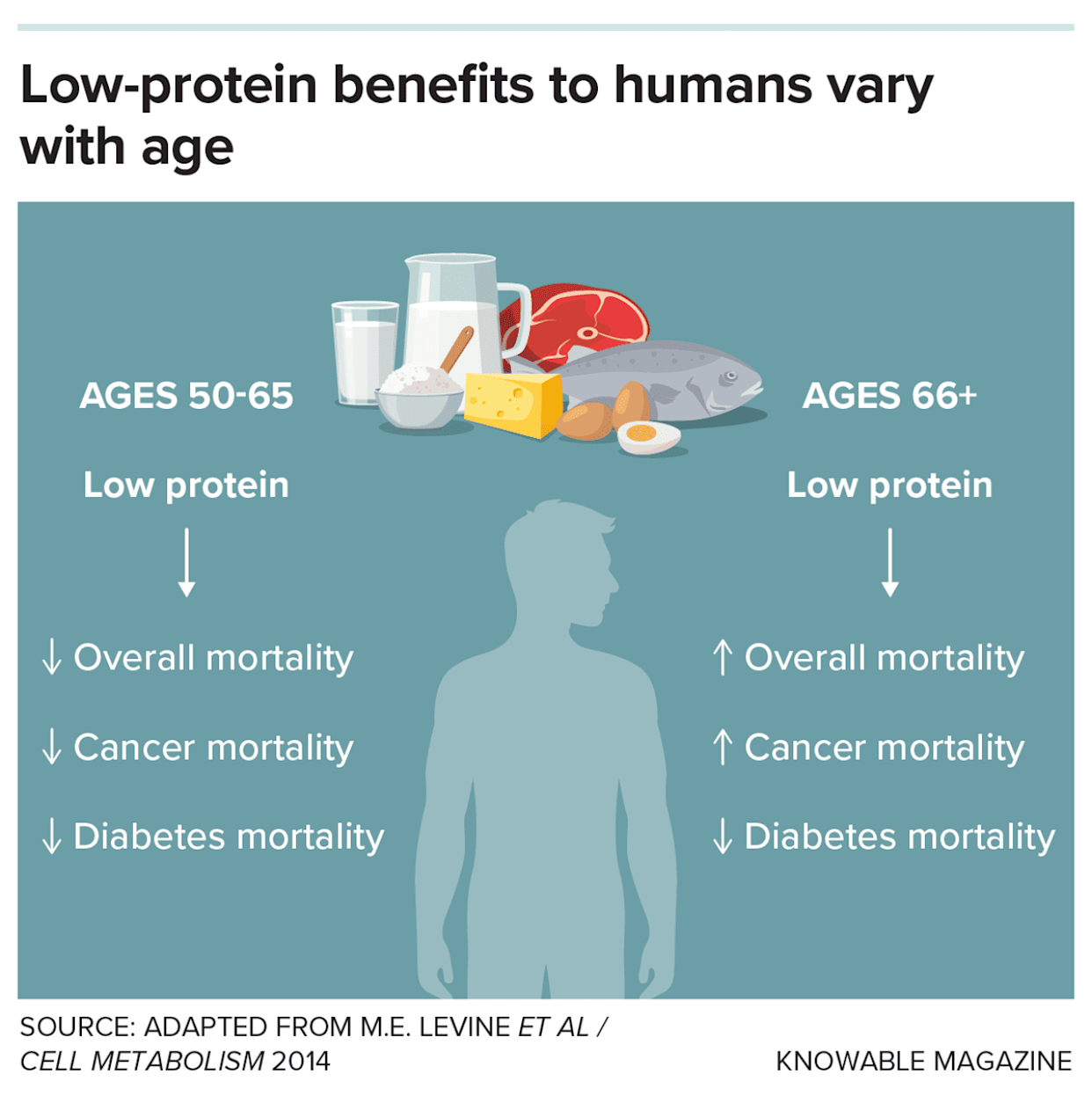
Graphic showing how protein needs vary with age, as do the effects of low-protein diets, according to observational studies of people. In adults aged 50 to 65, a lower-protein diet correlates with a reduction in deaths due to cancer, diabetes or any other cause. But in people 66 or older, the pattern changes: A low-protein diet is still linked with lower risk of death from diabetes but is associated with a higher risk of death from cancer or other causes. – Knowable Magazine
And that’s only if people could stand to follow such a diet for years at a time. It’s possible, Simpson muses, that a low-protein diet might feel less torturous than one that restricts calories overall, even though protein is known to help satiate hunger. But his own work, studying creatures from locusts to people, has shown that a body lacking protein craves the stuff. In one study, volunteers spent four days in a clinic and could select whatever they wanted to eat from a controlled menu where everything contained 10%protein. They responded by gorging on savory snacks, as if they were hankering for the umami protein flavor. As a result, they ate more calories in total — hardly a recipe for dietary success.
Tellingly, no scientists who spoke with Knowable Magazine were restricting their own protein intake. “I’m not a fruit fly or a mouse,” says Morrison. While he tries not to overdo it on protein, he’s not confident he could adhere to a protein-restricted diet. Plus, he adds, “I don’t want to be real scrawny.”
This story was produced by Knowable Magazine and reviewed and distributed by Stacker.