
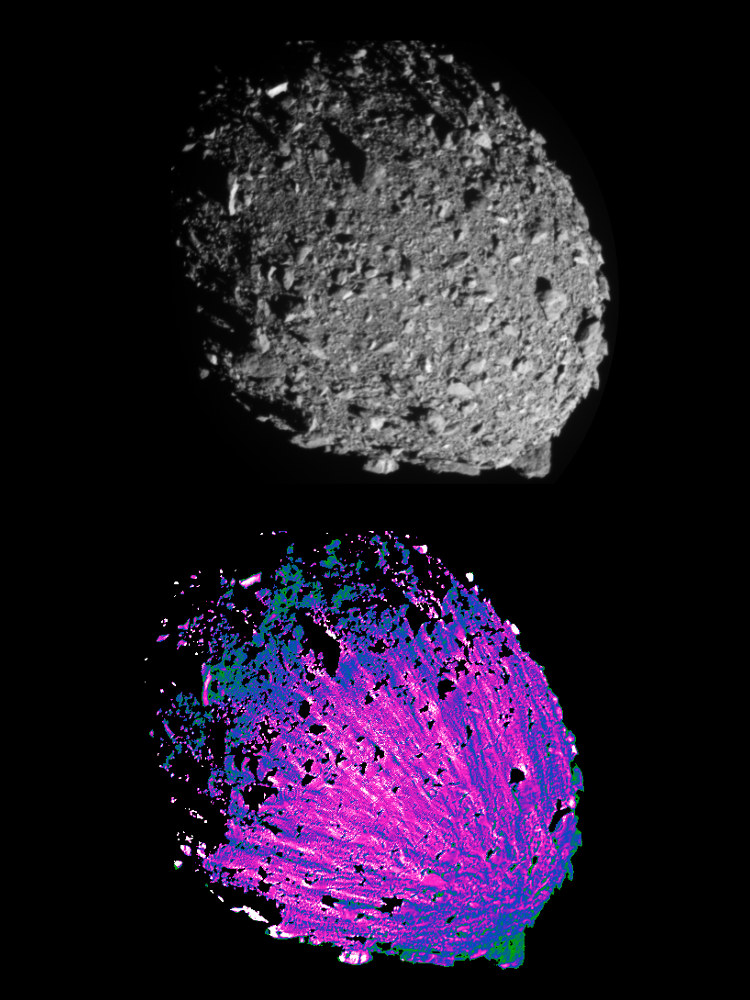
Asteroids that come in pairs constantly throw “cosmic snowballs” at each other, a new analysis of DART data reveals.
This research also highlights a concerning statistic: if the thought of a single planet-shattering space rock wasn’t alarming enough, scientists say that about 15% of near-Earth asteroids are binary systems — yes, even asteroids have moons.
And thanks to the data from NASA’s Double Asteroid Redirection Test (DART) mission in 2022, we’re now learning that these binary asteroid systems are surprisingly dynamic, with a constant low-speed material exchange occurring between its members.
An Eons-Long Snowball Fight in Space
Astronomers discovered this asteroidal interaction after noticing fan-shaped streaks on Dimorphos, the boulder-covered moon of the asteroid Didymos, in images taken by DART before it smashed into Dimorphos.
These streaks, as described in a recent study led by University of Maryland (UMD) researchers, were so incredibly faint and odd that they were initially attributed to error. “At first, we thought something was wrong with the camera, and then we thought it could’ve been something wrong with our image processing,” says lead author Jessica Sunshine, astronomer and director of the Small Bodies Group for asteroid and comet research at UMD.
“But after we cleaned things up, we realized the patterns we were seeing were very consistent with low velocity impacts, like throwing ‘cosmic snowballs.’ We had the first direct proof for recent material transport in a binary asteroid system.”
“Cleaned things up,” is no hyperbole, as the analysis required months of work, including 3D modeling, to confirm that the streaks on Dimorphos were not illusions of light and shadow.
Researchers at UMD then simulated Dimorphos’ surface using sand and gravel and mimicked the snowball effect by dropping marbles into this mix. High-speed cameras revealed that the marble drop created ray-like patterns like those on the real Dimorphos, a result confirmed by computer simulations performed at the Lawrence Livermore National Laboratory.
Improving our Planetary Defense Strategy
These experiments revealed another surprise. Compared to cosmic speeds, the dirty snowballs launched from asteroids travel at a snail’s pace. Calculations reveal that material leaves Didymos at just 30.7 centimeters (about 12 inches) per second — slower than the average human waking speed.
Finally, learning that asteroids throw cosmic snowballs at each other is vital to understanding their composition. Knowing one’s enemy is half the fight, and creating a database of asteroidal compositions is crucial for designing an Earth defense strategy to deflect a doomsday asteroid.