

Despite oil market turmoil and Iran’s effective closure of the Strait of Hormuz, energy experts report that Israel currently faces no shortages of crude oil or petroleum products.
Amit Mor, CEO of Eco Energy and senior lecturer at Reichman University, confirmed Sunday that Israel maintains robust strategic and commercial reserves, aligned with International Energy Agency (IEA) recommendations to store at least three months’ worth of fuel.
However, consumers will soon feel the pinch at the pump.
Mor predicts government-controlled gasoline prices will rise by NIS 1 per liter ($1.21 per gallon) next month. In response, the Finance Ministry is reportedly considering a fuel tax reduction of NIS 0.5 per liter to prevent prices from crossing the NIS 8 per liter ($9.69 per gallon) threshold, a move aimed at tempering inflation.
Since the start of joint US-Israeli strikes on the Iranian regime on February 28, oil tanker activity near Israel has slowed significantly. Real-time data from the Marine Traffic shipping site shows minimal movement near the ports of Haifa, Ashdod, and Ashkelon.
Get The Times of Israel’s Daily Edition
by email and never miss our top stories
By signing up, you agree to the terms
In Eilat, the state-owned Europe Asia Pipeline Company terminal remains quiet following Houthi attacks in Yemen during the Gaza war.

Amit Mor. (Yael Tzur)
In the northern city of Haifa, the Bazan refinery, previously hit twice in June, sustained minor damage from missile-interception fragments on Thursday. Bazan reported to the Tel Aviv Stock Exchange on Monday that its infrastructure is restarting, with physical damage and profit losses expected to be negligible.
The energy demands of the conflict are immense. Mor highlighted the scale of consumption required for the aerial campaign against the Iranian regime.
A single fighter round-trip flight to Iran consumes 12,000 to 24,000 liters (3,170 to 6,340 gallons) of jet fuel — equivalent to one or two decades’ worth of fuel consumption for the average automobile driver.
With two of three natural gas platforms temporarily halted, power plants have pivoted to diesel and coal. While these backups ensure the lights stay on, they come at a high price. Diesel is 20 times more expensive than natural gas, Mor says, while coal costs are double or triple. Furthermore, the shift to these fuels increases emissions of carbon dioxide, nitrogen oxides, and particulate matter, thereby aggravating respiratory health risks for Israelis.
The Energy Ministry and grid operator NOGA have declined to provide specific supply details due to wartime restrictions. However, experts are already looking toward long-term shifts.
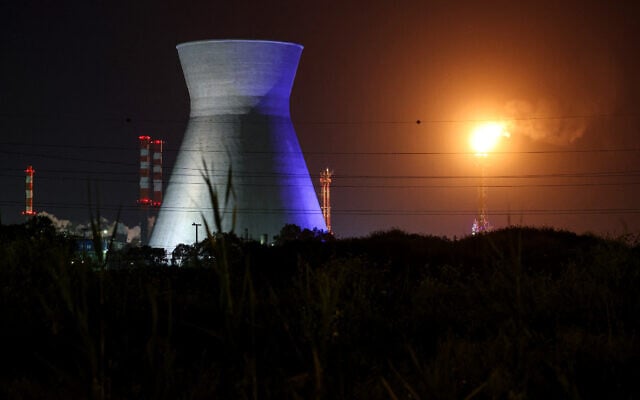
Excess gas is burned at the Bazan oil refinery in Israel’s northern city of Haifa late on March 19, 2026 (Odd Andersen / AFP)
Prof. Yigal Newman of Hebrew University noted that while Israel’s 200,000-barrel daily consumption is a fraction of the global 100-million-barrel market, a prolonged conflict could lead to much steeper price hikes.
Mor concludes that the ultimate lesson of the war is the need for energy decentralization. By shifting to solar power, Israel could move toward a system of tens of thousands of individual producers, making it impossible for an enemy to disable the national grid.
You appreciate our wartime journalism

You clearly find our careful reporting of the Iran war valuable, at a time when facts are often distorted and news coverage often lacks context.
Your support is essential to continue our work. We want to continue delivering the professional journalism you value, even as the demands on our newsroom have grown dramatically during this ongoing conflict.
So today, please consider joining our reader support group, The Times of Israel Community. For as little as $6 a month you’ll become our partners while enjoying The Times of Israel AD-FREE, as well as accessing exclusive content available only to Times of Israel Community members.
Thank you,
David Horovitz, Founding Editor of The Times of Israel