
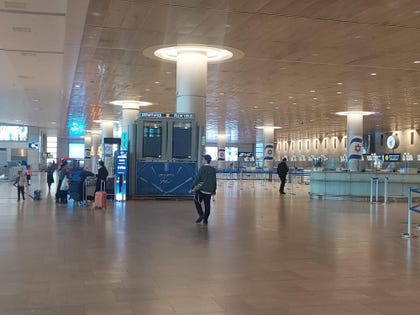
The number of daily departing passengers from Ben-Gurion Airport has dropped by 85 percent since Israel’s airspace partially reopened on March 5. Restrictions allow Israeli airlines to operate only one or two flights per hour, with a maximum of 100 passengers per flight, creating a severe bottleneck.
Taba Airport in Egypt and Aqaba Airport in Jordan, which initially served Israelis returning to the country after the war began, are now being used by those unable to secure tickets from Ben-Gurion ahead of Passover.
Between March 5 and Wednesday, March 18, about 46,500 passengers departed from Ben-Gurion Airport – an average of 3,300 per day, roughly 15 percent of normal traffic. At the same time, Israeli airlines continue repatriation efforts: by last Thursday, March 19, 83,000 Israelis had returned on such flights.
 Close
Close
Israeli airlines have canceled their original prewar schedules for the coming week and are now operating limited flights under the current restrictions. El Al announced it will serve 12 destinations through March 28, and passengers booked on those routes will be reassigned accordingly.
Israir has canceled flights through March 31 and suspended ticket sales for its original schedule until April 30. It plans to operate flights to 12 destinations through March 27, giving priority to existing customers, and will add nine more destinations during Passover. Arkia has also published an updated schedule through April 15.
The few remaining tickets on airline websites are selling out quickly. At the same time, uncertainty over return flights to Israel is high. As a result, airports in neighboring countries have become a viable, if inconvenient, alternative.
 Close
Close
Ben-Gurion Airport. Israeli airlines are limited to operating one or two flights per hour, with no more than 100 passengers on each. Credit: Miriam Meltzer
Ben-Gurion Airport. Israeli airlines are limited to operating one or two flights per hour, with no more than 100 passengers on each. Credit: Miriam Meltzer
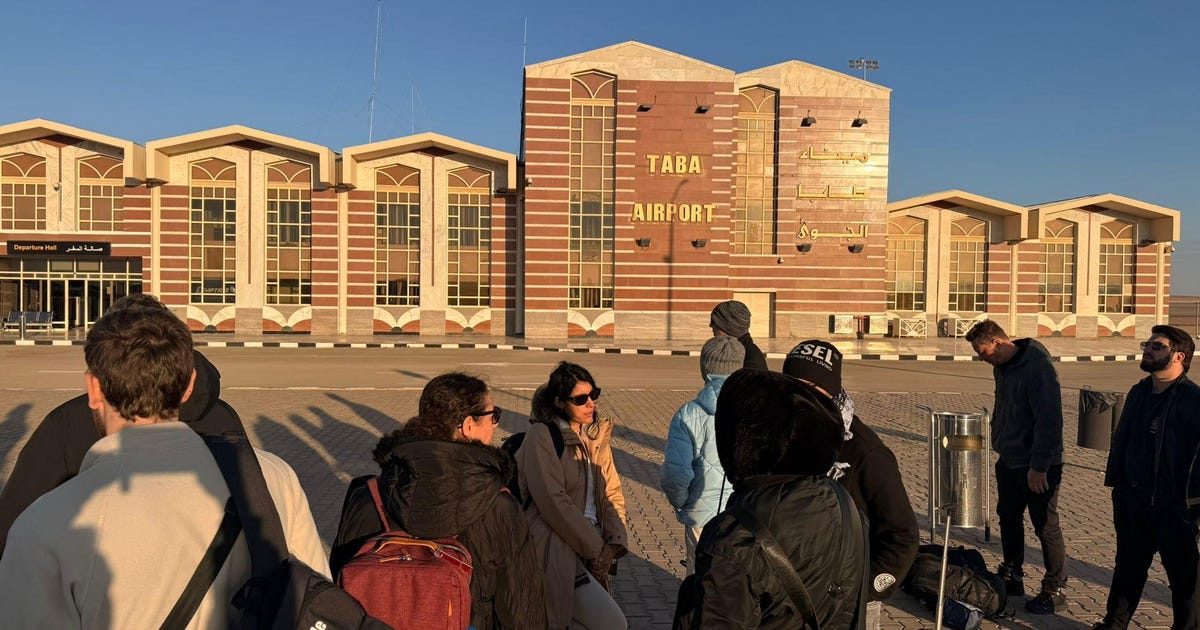
Taba Airport, usually quiet, is now busier than it has been in years. Before the war, it saw few international flights. In the first three weeks of the conflict alone, about 40,000 Israelis landed in Taba and Aqaba.
Consequently, both airports have since increased staffing, while local taxi drivers are seeing a surge in business.
The two airports, both located near Israel’s border crossings, are expected to serve as alternative gateways for Israelis planning to go abroad during Passover. Aviation industry sources say they may also serve Israeli travelers during the summer season, given the uncertainty surrounding the return of foreign airlines.
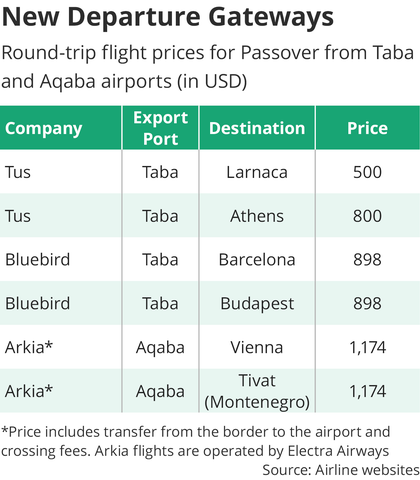
During Passover, flights will operate from Taba to several European destinations, including Rome, Barcelona, Prague, Budapest, Athens, Crete, and Larnaca, through the Greek airline Bluebird Airways and the Cypriot airline TUS, both of which are Israeli-owned.
Related Articles
According to Bluebird’s website, ticket prices are relatively high, starting at $300 for a round-trip flight to Larnaca and $500 for a flight from Taba to Crete. A flight to Budapest will cost $800.
The Issta travel company is offering flights to Paphos, Cyprus, via Aqaba Airport on Electra Airways. Tickets start at $495 and include a visa to Jordan and transfers from the land border crossing to the airport.
Arkia will operate flights from Aqaba to Tivat in Montenegro, Vienna and Bucharest. Its starting fare is $599, which also includes checked luggage, transfer from the Aqaba border crossing to the airport, and a transit visa.
Oz Berlowitz, Arkia’s CEO, said that “right now, Taba and Aqaba are the only airports that allow me to operate as many flights as I want.” He estimated that “most foreign airlines will not return to Israel before July or August. Many of them have found work elsewhere.”
Ilan Shalev, vice president of marketing at Kavei Hufsha, which owns Bluebird and TUS, said the company already has experience operating from the neighboring airports.
“During the war with Iran last summer, we operated in Aqaba,” he said. “This time, it was easier to operate in Taba because Jordan’s airspace was closed at the beginning of the war. We thought demand would dwindle once Ben-Gurion Airport reopened, but the planes are full. At the beginning of the war, we were mainly selling flights to Israel. Now the demand is primarily for outbound flights.”
According to Shalev, “today there is an overwhelming majority of one-way flights, but we’ve started to see that Passover is becoming a problem. People have committed to expensive hotels and bought tickets to shows and football matches.”
He added that passengers whose planned flights from Ben-Gurion Airport on Bluebird or TUS were canceled will not be able to exchange their tickets for flights from Taba, but “it is possible to receive a credit or voucher for a canceled flight and use it to purchase tickets from Taba.”
 Close
Close
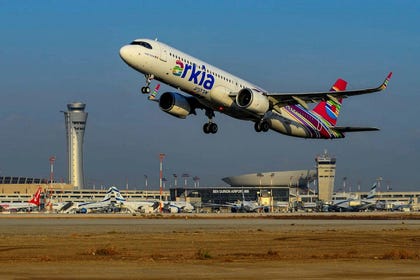
An Arkia aircraft. The National Security Council does not recommend flying via Aqaba or Taba airports or staying in Egypt or Jordan. Credit: Arkia
An Arkia aircraft. The National Security Council does not recommend flying via Aqaba or Taba airports or staying in Egypt or Jordan. Credit: Arkia
Flights from Taba are more expensive than flights booked in advance from Ben-Gurion Airport that were later canceled. Shalev added: “We will return to Ben-Gurion Airport as soon as that becomes possible. Our flights from Taba are scheduled until April 12, but we have no restriction on continuing. If we identify demand, we will add flights.”
Since the beginning of the war with Iran, more than 52,000 people, Israelis and foreign nationals, have left Israel via land crossings, mainly through Taba and Aqaba, and more than 37,000 have entered through them. Jordan and Egypt are both under National Security Council travel warnings.
A source in the Civil Aviation Authority said Israeli security officials are uneasy about the growing movement of Israelis through Taba and Aqaba airports. According to him, there has been coordination between Israeli security officials and their Egyptian and Jordanian counterparts.
In response to an inquiry from TheMarker, the National Security Council said it does not recommend flying through Aqaba or Taba airports, or staying in Egypt or Jordan. A similar message is expected to be circulated early next week.
Dr. Ofir Winter, a Senior Researcher at the Institute for National Security Studies and an expert on Jordan, said that “from Egypt’s perspective, and especially Jordan’s, there is also an element of economic compensation here for losses related to booking cancellations and the decline in tourism because of the war. The figures in Aqaba are particularly bad.”
He added that “the regimes in Egypt and Jordan hardly address the passage of Israeli passengers through their countries, and at this stage there is no significant public criticism from opponents of peace and normalization in either country.”
 Close
Close
A TUS aircraft. “We thought demand would dwindle once Ben-Gurion Airport reopened, but the planes are full,” said Ilan Shalev, VP of marketing at Kavei Hufsha. Credit: Markus Mainka / Shutterstock
A TUS aircraft. “We thought demand would dwindle once Ben-Gurion Airport reopened, but the planes are full,” said Ilan Shalev, VP of marketing at Kavei Hufsha. Credit: Markus Mainka / Shutterstock
Jordanian media coverage has focused on the damage to tourism. At Aqaba’s small airport, which is used mainly for charter flights, 12 flights were canceled in March, and Arkia’s activity is providing some compensation for that.
Flying from Taba or Aqaba is very different from flying from Ben-Gurion Airport. A drive from central Israel to the border crossings can take more than four hours. Passengers who crossed from Israel into Taba said the transit fee jumped from $25 to $60, without any official notice.
Some airlines arrange transportation from the border crossing to the airport, but some Israelis have had to manage on their own. During Passover, public transportation to the border crossing is not expected to operate, which will make it harder for Israelis to get there.
Yinon, an Israeli who flew from Taba at the beginning of the war and is currently in Lisbon, said that “the journey is rough. I took a bus to the Taba crossing, and then you have to wait for a taxi or a bus. We traveled under escort from Egyptian army vehicles.”
According to him, at Taba Airport, “everything moves slowly. You wait a long time, but there’s also no pressure, because the flight will be delayed anyway. Everything is handled on paper. There aren’t even buses from the terminal to the plane, so you have to walk several dozen meters in the sun.”
He added: “I didn’t feel any security threat. There are a lot of Egyptian security personnel around the airport.”
Israel’s aviation crisis is also affecting people who need to fly for work. Itay, a producer at a conference company, needed to fly to Krakow with a team of 15 employees.
“After El Al informed us there would be no flights, we looked for alternatives,” he said. “We chose Taba because Aqaba’s airspace sometimes closes. We left at 11 P.M. in order to make the Taba flight at 9 A.M.”
He said that at the Taba crossing, “the vibe is unpleasant. There isn’t much communication with the Egyptians, who don’t speak English.”
A direct drive from the crossing to the airport takes 45 minutes, but the group’s trip took about two hours.
“You have to wait about half an hour for a police escort, and then there are two more checkpoints along the way,” he said.
In total, he and his employees spent 21 hours traveling, including a flight from Taba to Athens and then on to Krakow. He estimated the one-way cost at more than $1,500, more than double the original El Al fare.