
Natalie Weber / Houston Public Media
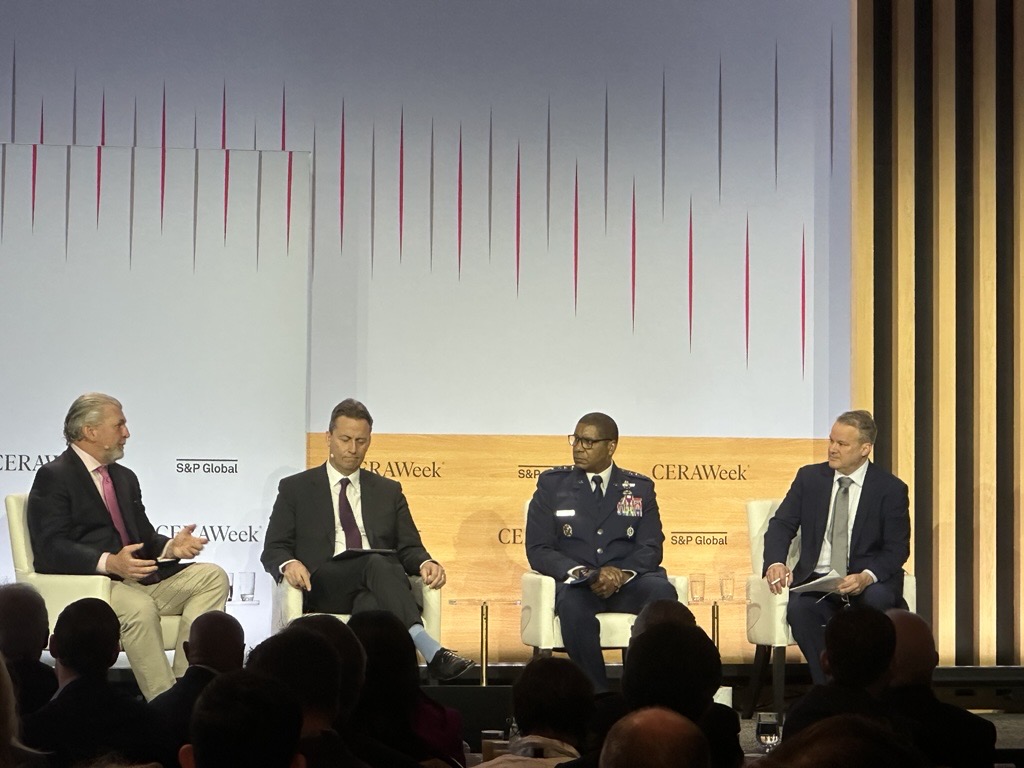
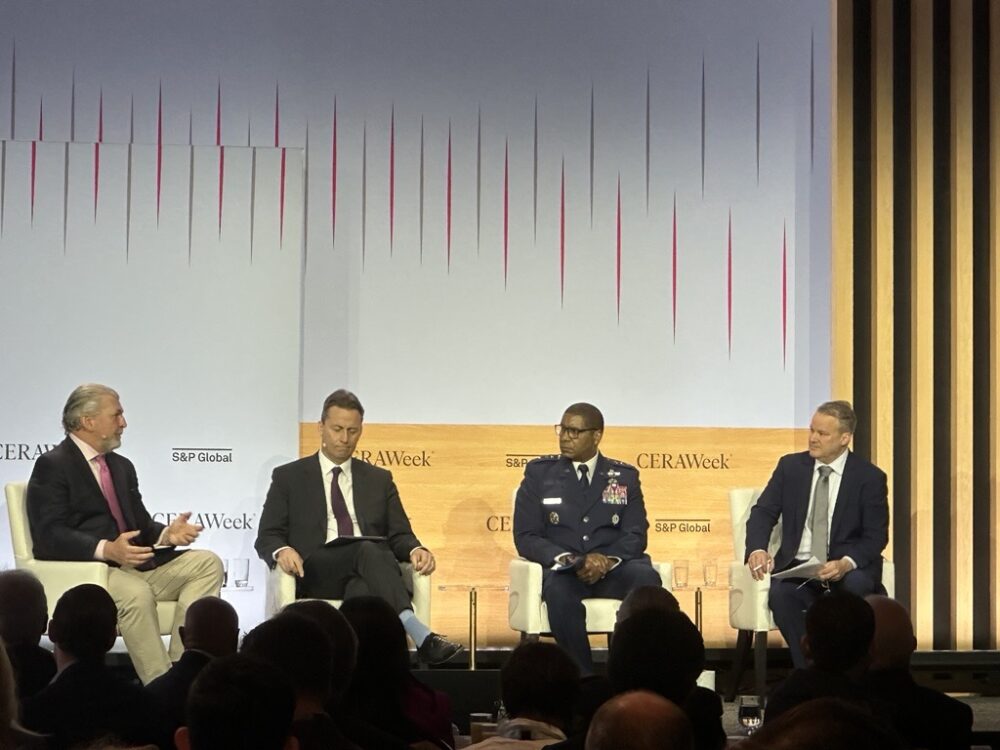
A panel discusses challenges to oil and gas supply chains at CERAWeek on March 24, 2026. From left to right: Paul Sankey, senior advisor at Oliver Wyman; Nick Studer, CEO of Oliver Wyman and Marsh Management Consulting; Randall Reed, Commander, United States Transportation Command; and Jim Burkhard, Global Head of Crude Oil Market Research, Energy & Mobility at S&P Global.
Addressing energy CEOs and foreign dignitaries at the more than 10,000-person CERAWeek conference in downtown Houston, U.S. Secretary Chris Wright offered reassurances about disruptions to the global oil market, amidst the country’s war with Iran.
“Prices have not risen high enough yet to drive meaningful demand destruction,” he said during opening remarks Monday at the Hilton Americas-Houston. “But Americans and energy entrepreneurs around the world are ingenious.”
Wright repeated the Trump administration’s assertions that the war was “temporary” and described it as a “short-term disruption … to end a multi-decadal problem and lead to a world that’s much more peaceful, can be much more prosperous and much more securely energized.”
Sign up for the Hello, Houston! daily newsletter to get local reports like this delivered directly to your inbox.
Energy experts and CEOs who spoke at the conference — many from companies headquartered in Houston — remained much less certain.
Chevron CEO Mike Wirth said during a conference session Monday that oil markets don’t reflect current supply constraints.
“Physical prices and physical supplies would reflect a tighter market than I think the forward curve reflects,” he said, referring to the market prediction of future oil prices.
The top executive’s remarks came as the Strait of Hormuz remains effectively closed, cutting off shipping for roughly a fifth of the world’s oil supply. The executive director of the International Energy Agency – a coalition of 32 countries – has warned that disruptions are worse than those caused by the two oil crises of the 1970s.
The ongoing impacts of the war have overshadowed CERAWeek, an annual conference where energy leaders gather to assess the year ahead in the industry.
Wirth said supply disruptions caused by the war are more severe than they were in 2022, after Russia’s full-scale invasion of Ukraine.
“We’ve got a lot of oil and gas now that is not flowing into the market,” he said. “And so there really is a difference in terms of physical supply this time versus what we’ve seen in prior incidents.”
Oil analyst Paul Sankey, who worked for the International Energy Agency in the 1990s during the first Gulf War, said he hasn’t seen this level of disruption since the oil crisis of 1973.
“The situation is extremely grave, as I would describe it,” he said at a panel Tuesday morning.
The world is just starting to see the beginning of energy shortages, Sankey added.
“Every day that passes, the shortage is going to get worse,” he said.
Texas-based companies, who operate mainly in the United States, could profit if prices remain higher, though that’s far from certain. For global companies headquartered in Houston, threats to production in the Middle East could outweigh the benefits of rising prices, the Houston Chronicle reported.
ConocoPhillips CEO Ryan Lance said many of his investments are in Qatar, and that he’s asked the Trump administration for protection of U.S. assets there.
“We’ve had to evacuate a number of our staff – our non-essential staff,” he said in a conference session Tuesday. “That’s been a chore over the last couple of weeks as well. And, you look [at] what’s going to happen in the markets, it’s a little bit difficult to assess.”
While there’s still uncertainty, Lance said he believes the conflict will raise the baseline price of oil, even after the war ends. Earlier this year, the industry faced lower prices due to an excess supply.
“I think we’re all trying to assess what the long-term implications are and what sets the mid-cycle price coming out of this when the conflict is over with,” Lance said. “And clearly, I think the floor probably has to rise, and the slope of the curve is probably going to increase.”
Shell CEO Wael Sawan said during a Tuesday conference session that although the future remains uncertain, he’s encouraging his team to consider the long-term impacts of the current disruptions.
“What I keep saying to my team is, ‘We need our people to deal with the here and now. But we also need to be thinking three months out, 12 months out, and eventually five [to] ten years out, when we think about the broader energy system and the longer-term implications of the current crisis towards that,'” he said.