
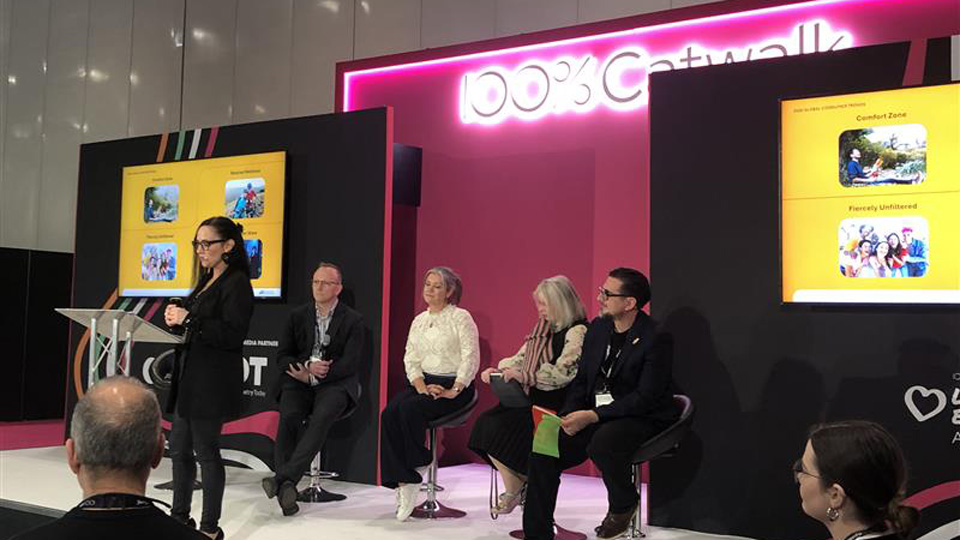
A panel of experts at 100% Optical (28 February–2 March) discussed a consumer trend for wellness and how businesses can respond in a session hosted on the Catwalk.
The session, Rewired Wellness: using science-led storytelling to showcase health outcomes in optics, took place on 1 March.
Natasha Cazin, global insights manager for eyewear at Euromonitor International, summarised the four consumer trends that analysts have identified as likely to have the most impact in the year ahead.
These are: ‘Comfort Zone,’ ‘Rewired Wellness,’ ‘Fiercely Unfiltered,’ and ‘Next Asian Wave.’
These trends have formed against a backdrop of ongoing external pressures in modern daily life.
“Life is fast-paced, it’s a bit complex, it’s overwhelming,” Cazin said, sharing that more than 70% of consumers remain concerned about the rising cost of living.
Euromonitor’s research learned that nearly 60% of consumers feel stress and anxiety affects them on a daily basis.
“Pressures like these are really influencing how people buy, what they buy, and where they buy,” she said.
“We think it’s really critical to understand consumer behaviour in order to understand how this impacts your business.”
Customised and tech-driven wellness
The session focused on the trend of ‘Rewired Wellness,’ which Cazin described: “Wellness is no longer slow; it’s personalised and fast-paced. It’s all about optimisation and consumers are embracing science-led products to improve everything, such as longevity, appearance, and also to improve their daily performance.”
The shift is fuelled by a desire for instant results and advanced self-care and treatments, the analyst noted.
Consumers are using artificial intelligence (AI) tools, smart wearables, and customised therapies to “take control,” Cazin said.
Older consumers are monitoring age-related concerns like blood pressure, while younger consumers like Gen Z are adopting preventative habits.
Cazin said: “Ultimately, wellness is becoming a premium product and people are willing to invest in a solution if it’s scientifically proven.”
Brands are responding by delivering wellness ‘on-the-go,’ Cazin said, with portable technology, mobile lab kits, and micro-treatments.
“Frictionless action is winning,” she said.
Tailoring and telling the science story
Cazin pointed to CooperVision as telling a “very interesting clinical story that empowers parental choice and eye care professional confidence.”
“The takeaway here is that business should be embracing clinical, proven technology in order to demonstrate confidence and clinical value, and deepen trust, and it’s all about storytelling,” she said.
Rodenstock was also cited as an example, with the company’s B.I.G Exact Sensitive lenses tailored exactly to the wearer through biometric eye data and individual visual sensitivity.
Cazin highlighted how brands are addressing the challenges of various life stages with “scientific, technology-backed solutions.”
How do practices respond?
For the eyewear consumer, Cazin suggested understanding the ‘Rewired Wellness’ trend could “help your business to connect with the eyewear consumer in this period of uncertainty.”
Key to connecting with this consumer is embracing innovation, and personalised, technology-driven solutions.
Storytelling was also emphasised as important, Cazin suggested: “The message must be simple, transparent and very clear, backed by science.”
Clear communication needs to demystify advanced technology and remove intimidation, she added.
“Educate and support; be the retailer that guides this consumer through the wellness journey. Help them interpret the data and also understand the treatment options,” Cazin said.
She said: “Deliver with clarity – empower your consumers to navigate uncertainty with confidence.”
Biometry and bespoke
After Cazin’s presentation, a panel joined the stage for a discussion of the key points around wellness, storytelling, and artificial intelligence.
Led by optometrist Garry Kousoulou, managing director of Loving Social Media, the panel featured Sarah Morgan, communication specialist and staff development consultant at Eyecommunicate, Elizabeth Lumb, director of global professional affairs at CooperVision, and Jason Halsey, product and training manager at Rodenstock UK.
Halsey spoke about bespoke lenses, commenting: “The myth has always been that ‘a lens is a lens’, and I will always tell you that this is about as true as a car is a car – that will get you from A to B, but we would all rather drive a luxury or sports car.”
Biometry is changing the way lenses are designed, telling the audience: “Rather than using a model, we have the technology now to measure patients’ eyes bespoke, and we can design lenses for them.”
Discussing what brings consumers to these bespoke products, Halsey commented: “There are lots of ways of improving our patients’ lives now, and they’re prepared to invest – they see the value in it.”
Halsey explained that he uses the analogy of television sets: “We can make lenses in 8K resolution now, but most of the patients are still walking around with standard definition lenses, and that’s the difference. It’s about improving quality of life.”
Myopia management: a standard of care
Panellists spoke about ‘predicting the future’ in terms of myopia management.
Lumb spoke about the responsibility of the profession to “Start thinking about myopia management as a standard of care and introduce it at the earliest opportunity.”
Discussing the acceptance of myopia management, Lumb said: “The good news is that in recent attitude surveys there has been a shift towards proactivity.”
Lumb pointed to the latest research from the International Myopia Institute which still has single vision spectacles as the most frequently prescribed form of vision correction for children with myopia, however, this frequency is shifting over time.
She observed: “If we think about projecting those trends forwards into the future, we’re likely to see that prescribing frequency shift downwards in the single vision space and upwards in the myopia control space.”
“I think that still rests predominantly in the hands of the eye care professional. It’s down to them having those conversations. But I think as we start to increase global and consumer level awareness, that will start to shift as well,” she continued.
Morgan reflected on a recent trip to Hong Kong and Singapore where she observed parents talking about ‘myopia hygiene.’
She highlighted the importance of engaging parents in the conversation about myopia management.
The human story
The importance of storytelling in eye care was also discussed.
Lumb explained the journey she has seen myopia management take since 2017, when the conversations were very scientific and data-based, towards a “more human story.”
“Those human stories become really powerful, and those are very positive stories,” Lumb said.
This year, at 100% Optical, Lumb introduced Elaine Shaw, aged 67, who shared her experiences of living with myopic macular degeneration.
“We think about that through Amsler chart grids or reduced contrast in a clinical environment,” Lumb acknowledged, but emphasised that Elaine is “living the challenges of the impact of myopia every single day.”
Dry eye technology
Morgan shared that she is excited to see technology develop around dry eye.
“We’ve got so much potential to help our patients,” she said.
Morgan spoke of the ways in which technology and imaging can help to communicate the topic of dry eye with patients.
“I think a picture does paint a thousand words. When you can show them the meibography, the tear break-up time and these sorts of things, I think that’s really brilliant,” she said.