
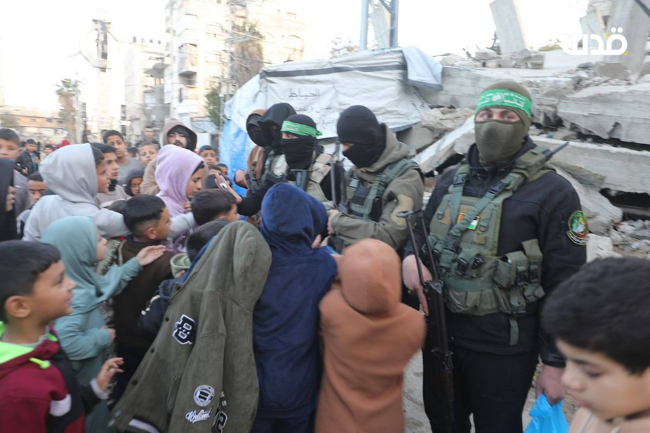
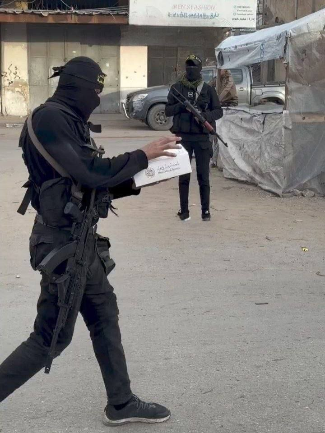
 Armed operatives of Hamas’ military wing in the Nuseirat refugee camp (Quds Agency, March 20, 2026).
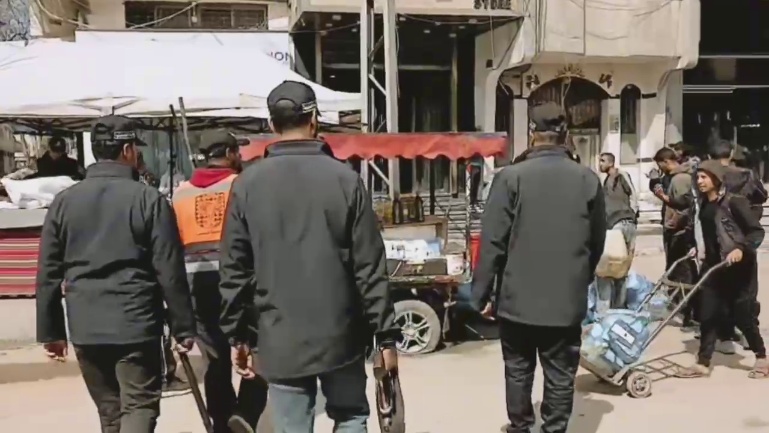 Hamas police maintain order and patrol the markets (Facebook page of the Palestinian police, March 5 and 19, 2026)
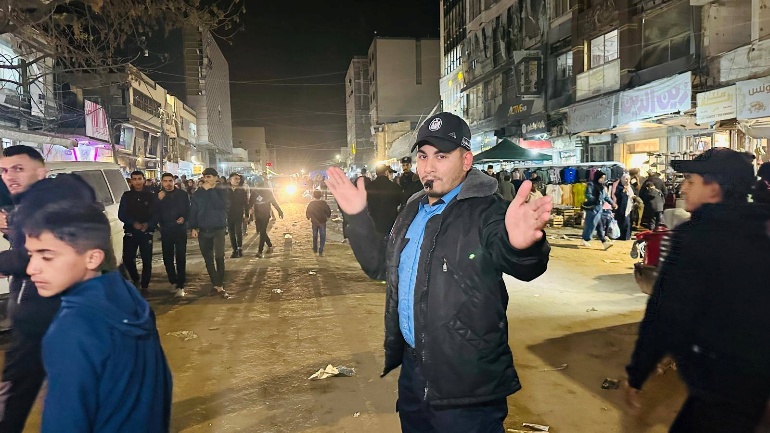 Hamas police maintain order and patrol the markets (Facebook page of the Palestinian police, March 5 and 19, 2026)Dr. Igal Shiri
Overview[1]
The war in Iran and disputes regarding the activity of the new committee for managing the Gaza Strip are delaying the second phase of the ceasefire agreement, according to which Hamas is supposed to relinquish control of the Gaza Strip and disarm.
Hamas is exploiting the situation to tighten its security control using violence and force against those who are critical, labeled “collaborators” or members of militias receiving Israeli support. Hamas’ growing confidence is reflected in the public presence of armed operatives from the military wing and the security forces.
Hamas is also continuing its efforts to rebuild its military capabilities by smuggling arms from Egypt and independently developing weapons which pose a threat to IDF forces in the Gaza Strip and to the State of Israel.
Hamas is also strengthening civilian governance in the areas under its control through a wide deployment of police forces, some of whom are openly armed, and the ongoing activity of government ministries. That is manifested by tight supervision over merchants in the markets and the distribution of financial aid to Gazan civilians.
In ITIC assessment, as long as Israel and the United States focus their attention on the wars in Iran and Lebanon against Hezbollah, Hamas will continue to entrench its dominance in the Gaza Strip regardless of Israeli attacks, pressure to relinquish control and disarm, and criticism from Gazans over the high cost of living and the collapse of services. Hamas will continue to tightensecurity and military governance, including accelerating its rearming and the recruitm ent and training of operatives. It will continue to strengthen civilian governance, combining violence and intimidation with the battle for hearts and minds to ensure it remains a power in Gaza even if the second phase of the ceasefire agreement is implemented and Hamas (ostensibly) transfers control to the Palestinian technocratic committee.
Delays in Implementing the Second Phase
In mid-January 2026, the second phase of the ceasefire agreement in the Gaza Strip officially began with the establishment of a temporary Palestinian technocrat committee called the National Committee for the Management of Gaza, intended to replace Hamas rule and lead the overall reconstruction of the Strip. In addition to ending Hamas control of the Strip, the second phase is supposed to begin disarming Hamas and the other terrorist organizations operating in Gaza.[2]
However, the members of the committee have still not left Egypt, according to Palestinian claims because of restrictions imposed by Israel. In addition, disagreements remain between the new committee and Hamas, particularly the issue of integrating ten thousand Hamas police officers into the new Palestinian security forces which will operate under the National Committee. Moreover, in practice, the outbreak of the war in Iran has halted the efforts to advance the second phase of the agreement.[3]
Before the ceasefire in October 2025 and since, Hamas declared it was prepared to relinquish control of the Gaza Strip. However, the movement continues to exploit the delays in implementing the second phase to continue tightening its governance in the areas under its control, both through its security forces and its civilian governing mechanisms, along with its continued efforts for military buildup.[4]
Tightening Security Governance
An Open, Armed Presence
Hamas’ recent, growing self-confidence and defiance of the demand for its disarmament are manifested by the overt presence of armed operatives from the security forces and the military wing in areas under Hamas control, despite the continued Israeli targeted killings in response to violations of the ceasefire agreement:
A video distributed on social media in the Gaza Strip showed a convoy of Toyota pickups with armed Hamas terrorists. According to the caption it was a military display by the security forces in the Khan Yunis district “to strengthen security, impose control on the ground and deal with any violation or incidents of chaos” (al-Sayyad Telegram channel, March 12, 2026).
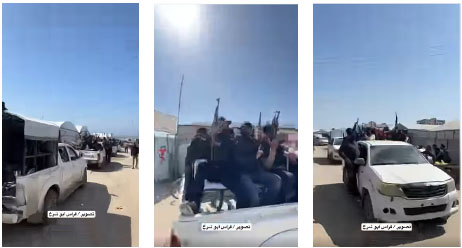
Pictures from the video (al-Sayyad Telegram channel, March 12, 2026)
Hamas’ Shehab news agency issued a video of Hamas’ military wing operatives distributing water and dates to break the Ramadan fast (Shehab Telegram channel, March 15, 2026).
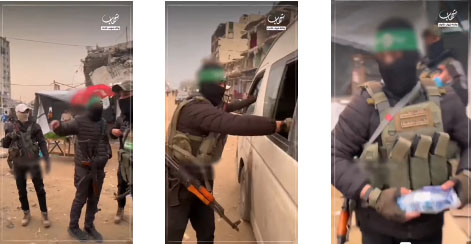
Armed Hamas operatives distribute water and dates to break the Ramadan fast (Shehab Telegram channel, March 15, 2026)
Armed operatives of Hamas’ military wing were videoed distributing candy and cookies to children in the Nuseirat refugee camp in the central Gaza Strip for Eid al-Fitr[5] (Quds Agency, March 20, 2026). Armed operatives of the military wing of the Palestinian Islamic Jihad (PIJ) were also videoed with weapons and distributing candy and cookies to displaced children (Palestinian Media Center, March 20, 2026).
 .
.
Right: Armed operatives of Hamas’ military wing in the Nuseirat refugee camp (Quds Agency, March 20, 2026). Left: Armed operatives of the military wing of PIJ (Palestinian Media Center, March 20, 2026)
Persecution of Hamas Opponents
Hamas security forces continue to operate against Gazans who criticize the movement, with kidnappings, arrests and torture, despite the fact that sources in the security apparatuses deny physical assault or other forms of abuse during the interrogation of civilians (al-Sharq al-Awsat, March 11, 2026).
Hamas reportedly operates command and control centers inside major hospitals in the Gaza Strip, including Nasser Hospital, al-Aqsa Martyrs Hospital, al-Shifa and al-Ahli, and in smaller medical centers. According to the report, elements affiliated with Hamas, including media personnel acting on its behalf, monitor opponents of the movement on social media and pass information to security elements, who in turn repress the opponents, kidnap and torture them, “disappear” them and on occasion execute them in public. Gazans live in fear and their sense of security has been damaged, not only by IDF activity but by the pressure and violence Hamas uses against the population, including seemingly innocent summonses for a conversation with “security personnel” that end in torture and dumping bodies into the street (Facebook page of Moumen al-Natour, February 15, 2026).
An example of a “disappearance” appeared in a post by Mustafa Asfour, who said his father, Adel Asfour, who was a released prisoner, was kidnapped from his tent because of the political opinions he published on Facebook and on his X account. Asfour said he had no information about his father’s whereabouts or who had taken him, but said Hamas commanders in Khan Yunis were fully responsible for his father’s safety. He called on international bodies, human rights organizations, activists and journalists to expose his father’s fate and to act for his release (Facebook page of Mustafa Asfour, February 15, 2026).
Hamza Huwaidi, a Palestinian activist born in Gaza who currently lives in Germany, said that since the war in Iran began, Hamas has intensified its repression of the Gazans with executions, shootings, kidnappings and torture. He wrote that “the list of atrocities grows day by day and the pure sadism being displayed goes beyond anything that can be understood (even for those of us who were born and raised in Gaza and saw Hamas’ cruelty up close for years). We thought we had seen the bottom of their moral corruption. There is no bottom for these people” (X account of Hamza Abu Huwaidi, March 14, 2026).
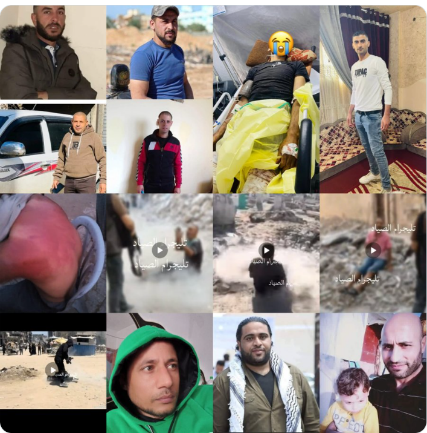
Gazan victims of Hamas attacks (X account of Hamza Abu Huwaidi, March 14, 2026)
Persecution of “Collaborators” and Members Of Militias
Hamas “security” apparatuses, led by the Sahm Unit and the Rada Force, continue operations against those labeled as “collaborators” with Israel, especially against operatives in militias which receive Israeli support. The forces announced arrests of “collaborators” and “agents” and the execution of ambushes intended to disrupt militia activity in areas under Hamas control and outside the Yellow Line:
Security sources in the Gaza Strip reported a clash in the al-Nasr neighborhood in Gaza City between members of the Popular Army militia headed by Ashraf al-Mansi and armed Hamas terrorist operatives. Following the incident, large Hamas forces were deployed in the neighborhood, searches were conducted in vehicles and a pursuit of the cell members was launched (al-Sharq al-Awsat, March 6, 2026).
Operatives of the Rada Force of Hamas’ “resistance security” announced that in southern Khan Yunis, beyond the Yellow Line, its operatives had ambushed a militia operating under Israeli patronage and reported killing and wounding militia members (Telegram channel of the Rada Force, March 16, 2026).
“Resistance security” in the Strip announced that it prevented the assassination of a senior “resistance” figure in the central Strip thanks to “high-quality intelligence activity.” According to the announcement, two suspects described as “collaborators” with Israel were arrested, and weapons with silencers, photography equipment and camouflage clothing were found in their possession. The two allegedly confessed to belonging to the militia of Shouqi Abu Nuseira and had received training from Israeli intelligence officers, including an officer known as Captain Abu Omar (Telegram channel of Sahm Unit 103, March 19, 2026).
A security source in the Gaza Strip said the Rada Force, acting with the security forces, tribes and clans, had caused some members of the “collaborator gangs” surrender. It was called “the result of tireless work and diligent monitoring” combined with a “commendable national stance” by the families. The source added that “the noose is tightening day by day around the collaborator gangs” (Shehab Agency, March 21, 2026).
Efforts to Rebuild the Hamas Arsenal and Repopulate Its Military Wing
Despite the demand for Hamas to disarm, reports continue about efforts by the military wing to obtain weapons and expand its ranks:
Reportedly, Hamas has shifted to focusing on smuggling from Egypt via the sea for the renewed the production of rockets. According to information from a foreign intelligence organization operating in the Strip, Hamas uses containers with adjusted weight that move beneath the water surface to help them evade radar. The smugglers throw the equipment about nine km off the coast of Sheikh Zuweid in northern Sinai Peninsula, and the current takes the containers to the coasts of Deir al-Balah and Khan Yunis within 12 hours. According to the source, the operation is managed by several networks operating in the Sinai Peninsula, at sea and in the Strip, while a diversion is carried out by launching UAVs at the Israel–Egypt border to occupy the IDF’s monitoring systems (Israeli Kan News X account, February 23, 2026; Kan website, February 24, 2026). It was reported by sources in the Strip that Hamas had produced dozens of rockets using the smuggled materials. The rockets are produced in workshops scattered throughout Deir al-Balah and Gaza City; Hamas reportedly transferred some of the rockets to PIJ (Kan News X account, February 26, 2026). In response, sources in Hamas called the accusations “completely baseless, especially in light of the fact that Israeli naval forces control the entire sea off the Gaza Strip coast” and their purpose was to give IDF forces a green light to attack new targets in the Gaza Strip. They also claimed “the resistance[6] had the right to keep all its weapons to deal with any new “aggression,” and the leadership of the military wing was currently focusing on organizing the ranks while preparing to deal with “possible attacks” (al-Sharq al-Awsat, February 24, 2026).
A senior figure in the IDF Southern Command stated that every day attempts were made to smuggle weapons from Egypt into the Gaza Strip using drones. Israeli security sources admitted that Hamas continued to manufacture improvised weapons, and therefore in recent weeks attacks on weapons warehouses and production facilities had been increased, although according to the IDF Hamas suffered from a shortage of ammunition (Telegram channel of Almog Boker, March 18, 2026).
On March 18, 2026, Yahya Abu-Labda was eliminated. He was a commander in the Hamas supply department who was responsible for the procurement and transport of military equipment and weapons for the military wing. He was involved in delivering dozens of tons of raw materials for the production of rockets and advanced electronic components, which were used by Hamas’ production facilities for its precision missile project (IDF spokesperson, March 18, 2026).
Strengthening Civilian Governance
The Hamas Police
Although the committee for managing the Gaza Strip has been appointed, Hamas appointed five police commanders affiliated with the Izz al-Din al-Qassam Brigades and new senior figures to the ministry of the interior and national security and the ministry of economy. The spokesperson for the Hamas government claimed they were “temporary” appointments to prevent an “administrative vacuum” and ensure the continued provision of essential services (Reuters, February 19, 2026).
Hamas police continue operating in areas under the movement’s control in the Strip, directing traffic and patrolling in markets and displaced persons’ camps. The director of the Hamas government media information office, Isma’il al-Thawabta, said that in light of Israeli targeted killings of police forces, “precautionary measures” had been taken, including reorganizing the movements of the police and their deployment in the field. He did not give specifics, but according to reports, most of the police were unarmed and wore naval police uniforms (Reuters, March 18, 2026). However, in pictures published by the Hamas ministry of the interior and national security, police were seen armed during supervisory patrols in the markets (Telegram channel of Hamas police in the Strip, March 12, 2026).
Hamas police maintain order and patrol the markets
(Facebook page of the Palestinian police, March 5 and 19, 2026)
The Gazans’ reactions to Hamas’ activity and the demonstration of governance were mixed. On the one hand, they supported Hamas for restoring order and organization, while emphasizing the importance of a police presence to instill order and a sense of security, with the hope the Gaza Strip and its leadership would be safe. On the other hand, there was considerable criticism of the difficult situation in the Gaza Strip, especially the gap between the celebratory rhetoric and the living conditions, displacement, tents, cost of living, shutdown of the education system, moral deterioration and a wave of thefts. Also criticized was the publication of photos of police officers in the media, with claims they provided Israel with free information which could lead to further targeted killings of police personnel (analysis of user responses on the Facebook page of the Palestinian police, March 19, 2026).
Hamas Activity against Merchants
One of the tools Hamas uses to manifest its governance is the activity of police forces and government ministries against merchants and vendors who they claim operate contrary to directives, especially regarding price supervision in light of the sharp rise in prices of basic goods. For example, the Rada Force of Hamas’ “resistance security” reportedly deployed in the markets and carried out price supervision, while at the same time the police supply investigations department, in cooperation with teams from the ministry of economy, monitored product availability and prices and worked to prevent hoarding and exploitation. According to reports, 29 merchants were arrested and 11 shops and businesses were closed for violating directives related to preventing hoarding, raising prices and price gouging (Facebook page of the Palestinian police and Telegram channel of the Rada Force, February 28, 2026).
The Hamas ministry of economy later announced the cancellation of customs duties and supervision over the supply of frozen goods, claiming there had been a “significant improvement” in the entry of goods through the crossings and for the end of the month of Ramadan. The cancellations were reportedly made after monitoring trade in the markets and shops, in coordination with chambers of commerce and the private sector, to ease the arrival of basic goods and improve the regularity of supply. The ministry reiterated that adherence to the official price list was mandatory and warned that any deviation or price gouging would lead to legal measures, while calling on merchants and residents to report violations (Telegram channel of the Hamas government media information office, March 19, 2026).
The Israeli Coordinator of Government Activities in the Territories (COGAT) rejected Hamas claims that the activity had been intended to lower prices in the markets. In a personal appeal to the Gazans, he accused Hamas of taking control of goods and stated that hundreds of aid trucks entered the Strip daily, with large quantities of food which were supposed to meet the Gazans’ daily needs for Eid al-Fitr. He said Hamas took control of humanitarian aid and imposed taxes on merchants, thereby pushing market prices to extreme highs (COGAT Facebook page, March 18, 2026).
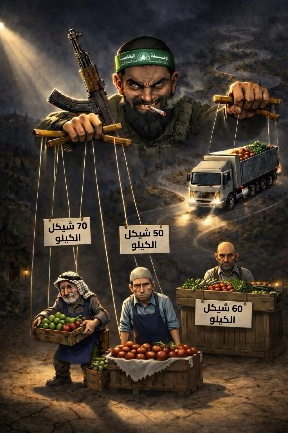
Cartoon of Hamas control of the markets (COGAT Facebook page, March 18, 2026)
Distribution of Funds
Hamas also tightens its grip on the Gazans by distributing funds under the guise of aid. At the beginning of February 2026, the Hamas ministry of social development launched operation We Are Your Support, which was supposed to ease Gazans’ financial burdens, especially those of the most needy families. Hamas claimed the operation was funded with money confiscated by a committee, appointed after the ceasefire went into effect, to combat economic crimes carried out by merchants who exploited the Gazans’ needs during the war. According to reports, in the first phase of the operation, more than 9.6 million shekels (almost $3.1 million) were distributed to 19,306 widows of shaheeds who were killed in the war. In the second phase, a grant of 500 shekels (about $160) was transferred to families of Palestinians who were arrested during the war in the Gaza Strip and who were registered with international organizations (Facebook page of the Hamas ministry of social development, February 8, 2026). Money was also was distributed to cancer patients and Gazans suffering from kidney failure and to amputees whose injuries occurred after October 7, 2023, and to families of prisoners held in Israeli prisons who did not receive the grant in the first phase, families of Gazans missing since the beginning of the war and widows who did not receive funds in the first phase (Shehab Agency, March 9, 2026).
[1] Click https://www.terrorism-info.org.il/en to subscribe and receive the ITIC’s daily updates as well as its other publications.
[2] See the January 2026 ITIC report, The committee of Technocrats Who Will Manage the Gaza Strip.
[3] See the weekly ITIC updates, “Spotlight on Terrorism and the Israeli-Palestinian Conflict.”
[4] See the October 2025 ITIC report, Hamas Activity to Restore Security Governance in the Gaza Strip after the Ceasefire; the November 2025 report, Hamas activity to restore its civilian governance In the Gaza Strip after the ceasefire; and the February 2026 report, Hamas Deploys to Recover and Retain Its Military Strength and Influence over the Gaza Strip.
[5] The holiday marking the end of the Muslim religious month of Ramadan.
[6] The terrorist organizations operating in the Gaza Strip.
Related Articles