
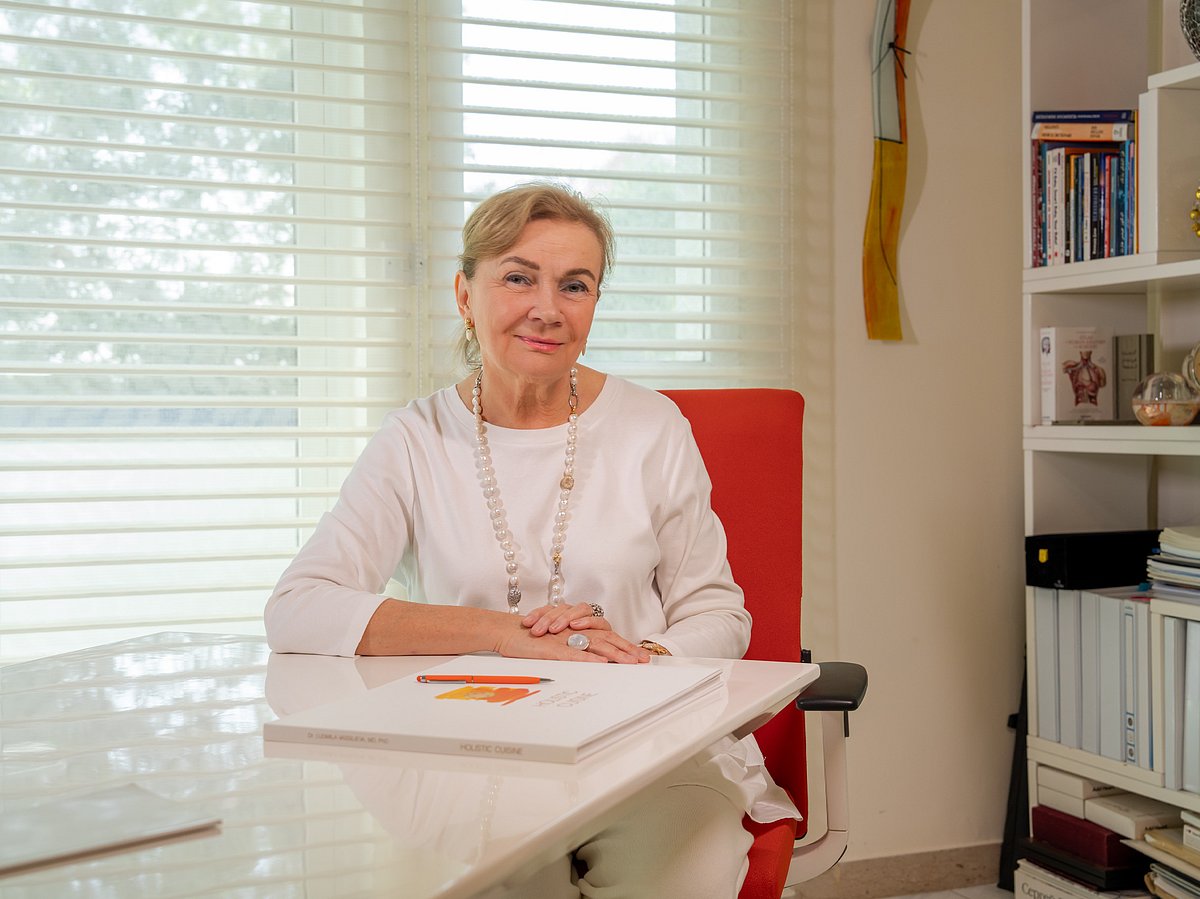
Health is a daily practice
At the heart of her philosophy is a straightforward idea: health isn’t something you have, it’s something you constantly create. “Health is not a status quo,” she explains. “You every day need to eat, to sleep, to be active, and tomorrow start again.”
Working alongside the body, not against it
For Dr Ludmila Vassileva, modern medicine and holistic approaches are not in opposition, they simply operate at different points in the healing journey.
Her work centres on what she sees as a crucial distinction: while conventional care often addresses immediate symptoms and acute conditions, there is also value in understanding what those symptoms might be signalling within the body.
“Modern medicine suppress symptoms,” she says, describing it not as a flaw, but as a function of a system designed to manage illness in the moment. In her view, symptoms can also serve as indicators, subtle messages that something deeper may need attention.
“If you support it, the body heals it. If you suppress, the body creates new condition and new symptoms.”
Her approach focuses on creating what she calls ‘optimal conditions’, an internal environment where the body can carry out its natural processes of repair and regeneration.
To explain this, she turns to a familiar example. “If you cut the finger, doctor heals it or life heal it itself? Life heals it.”
The point, she suggests, is not to replace medical care, but to recognise the body’s inherent role in healing. In that balance, between intervention and support, lies the philosophy that underpins her practice.
The rise of energy-based healing
This belief led Dr Vassileva to explore disciplines that work beyond the physical fields like homeopathy, Ayurveda and acupuncture, which she describes as operating “on the level of energy, on life force.”
“Homoeopathy has 250 years of activity, Ayurveda 5,000 years… acupuncture 5,000 years,” she notes, positioning these systems within a longer historical context compared to modern pharmacology.
Her centre integrates these approaches with scientific diagnostics, aiming to bridge what she calls “western science with eastern wisdom.”
“We check flow of energy, vital force in the body,” she explains, describing the use of specialised equipment to detect imbalances before they manifest as illness.
The process, she says, begins with identifying disruptions, followed by detoxification and regeneration. “The body needs to heal it faster when the body doesn’t have toxicity.”
Building a practice and a philosophy in the UAE
Establishing this approach in the UAE wasn’t immediate. Dr Vassileva recalls that it took years to gain acceptance. “It took for me seven years to talk, to show the people,” she says, referring to the early days of introducing homeopathy and holistic practices in the region.
But persistence paid off. Today, she describes her work as part of a broader shift toward integrative medicine, supported by growing institutional interest.
“Now even there’s a committee for integrated medicine developed in UAE,” she notes, pointing to a changing landscape where holistic approaches are gaining recognition.
Her centre, she adds, was “made in UAE, developed in UAE, built in UAE”—a point of pride that ties her personal journey closely to the country’s evolution.
A different definition of success
While Dr Vassileva doesn’t define success in conventional terms, her story is rooted in longevity and conviction. For her, success isn’t about expansion or scale, but about changing how people understand their own bodies.
“Ask yourself, how I feel in the morning,” she says, returning to a question she considers fundamental. Waking up energised, she believes, is the clearest sign that the body is in balance.
And if not? That, too, is information. “Humanity always was famous to looking for golden pills,” she says. “But golden pills are inside.”
Lakshana is an entertainment and lifestyle journalist with over a decade of experience. She covers a wide range of stories—from community and health to mental health and inspiring people features.
A passionate K-pop enthusiast, she also enjoys exploring the cultural impact of music and fandoms through her writing.