
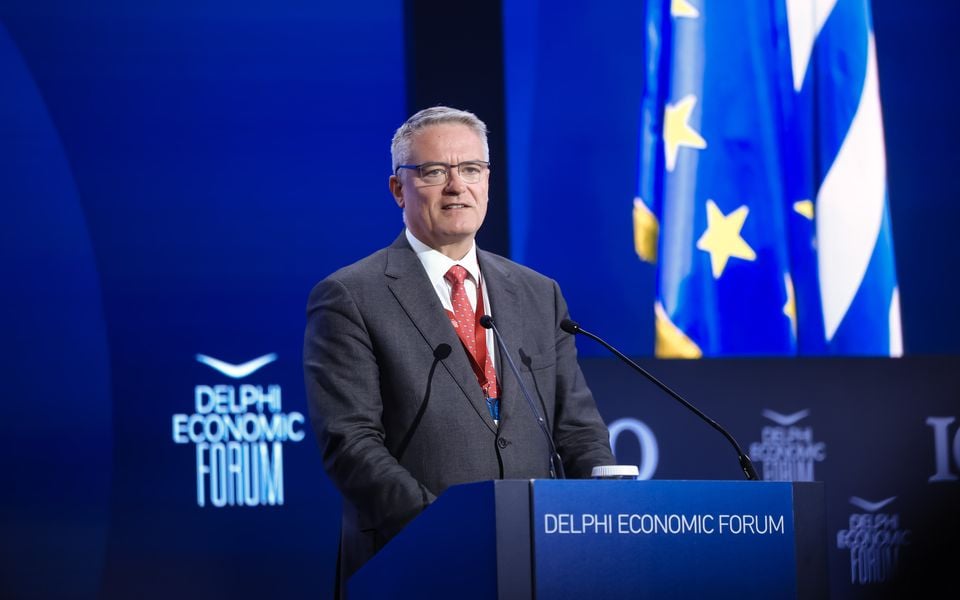
Mathias Cormann welcomed the launch of Pharos, one of Europe’s first dedicated AI factories, as ‘a positive step.’
For Greece to continue seeing its public debt declining, it needs to strengthen reforms that will increase productivity and offset the loss of resources from the expiration of the EU’s Recovery and Resilience Facility (RRF), the secretary-general of the Organization for Economic Cooperation and Development (OECD), Mathias Cormann, tells Kathimerini.
Acknowledging the progress achieved in the Greek economy, he notes, however, that productivity is at 64% of the OECD average and speaks of a “legacy of low investment,” which sees then at 17% of gross domestic product against the OECD average of 22%.
Referring to the impact of the war in the Middle East, Cormann, who is slated to speak at the Delphi Economic Forum – running April 22-25 – says he is “cautiously optimistic” of Europe’s ability to react effectively, following the experience of Ukraine.
As we approach the completion of the Recovery and Resilience Facility, questions are emerging about the “day after” for the Greek economy. How do you assess the impact of the program on Greece so far, and what is your own assessment of the country’s growth prospects once the Recovery Fund is no longer in place?
The National Recovery and Resilience Plan has been a key driver of Greece’s strong post‑pandemic performance and medium‑term growth prospects. This is due in part to the investment unlocked by the plan, totaling about €23 billion between the launch of the plan in April 2021 and the end of 2025. Equally important is the reform momentum triggered by the plan. Greece has advanced a significant number of reforms to boost competition and business investment, enhance the functioning of labor markets, and enable the digital and energy transitions. Recent reforms, including stronger tax laws, the promotion of electronic payments to curb tax evasion, and streamlined licensing as well as enhanced market transparency in network industries, are already yielding tangible results. Stronger tax revenues have supported the rapid decline in the public debt‑to‑GDP ratio, which fell from 183% in 2019 to 154% in 2024, with a further decrease to 134% projected for 2027. Greece also recorded a sizable primary surplus equivalent to 4% of GDP in 2024, well above the target of 2.5%.
‘Currently, the OECD sees the highest levels of AI adoption in sectors like information technology and professional services. Boosting adoption in these sectors in Greece would have economy-wide benefits’
Looking beyond the Recovery and Resilience Plan, Greece’s growth prospects will depend on maintaining the reform momentum. Productivity will need to grow to improve living standards. In parallel, Greece faces mounting long‑term fiscal pressures, driven by population aging and the substantial investment needs associated with the digital and energy transitions. Continued reforms to enhance public‑sector efficiency, strengthen the tax base, improve the business environment and raise productivity will be critical to keep debt on a firmly declining path while enabling strong, sustainable and inclusive growth.
You have spoken about the challenges Greece faces in terms of productivity. Where do you see the core of the problem and, by extension, the most effective solutions?
Greece’s productivity challenge is long‑standing. Labor productivity growth since 2019 has remained below the OECD average, and its level is currently about 64% of the OECD average. Our analysis shows that this productivity gap exists across key sectors in the economy, including manufacturing and information technology, pointing to structural factors that hold back innovation and growth. A major factor is the legacy of low investment. Although investment has increased from 10.8% of GDP in mid‑2019 to 17.7% in mid‑2025, it remains well below the OECD average of about 22%, limiting technology adoption, especially among Greece’s many small businesses. Business creation has also been low, held back by limited access to finance, skill shortages and administrative burdens. Reducing regulatory burdens should remain a top priority. Greece has made real progress in improving the business climate since 2018, but there is still plenty of room to make rules in the services sector simpler. It will be important to speed up the review of current regulations in close cooperation with businesses and unions, while more consistently assessing the potential effects of new regulations. Improving access to finance for small firms and start‑ups remains central. The improving capacity of the Greek banking sector to provide finance, together with the new insolvency framework and recent judicial reforms, should gradually make it easier for firms to obtain credit and adjust to fast‑changing economic conditions. At the same time, regularly reviewing loan‑guarantee schemes and subsidized lending programs will help ensure they are effective and deliver good value. More efforts are also needed to tackle skill shortages and mismatches. Greece should raise both the quality and participation in adult training. Expanding childcare options and improving systems for recognizing workers’ existing skills would help more women and foreign workers find good jobs. Plans to further develop vocational education, with stronger involvement from employers and social partners, are a welcome step.
Greece is among the European countries facing the most acute demographic pressures. Can the integration of artificial intelligence into the economy reduce the need for labor? And, if so, does Greece have the right profile to achieve this, given the sectors in which its economy is most active?
Greece faces particularly strong demographic pressures, driven by low fertility rates, the outward migration of many young workers during the crisis years and a rapidly aging population. These trends put pressure on long‑term growth and they increase the importance of raising productivity as the labor force shrinks. Innovation and the adoption of advanced technologies, including AI, will play a key role. Currently, the OECD sees the highest levels of AI adoption in sectors like information technology and professional services. Boosting adoption in these sectors in Greece would have economy-wide benefits – including for the tourism and agriculture sectors, which are key parts of the Greek economy and which would benefit from more affordable, accessible digital tools and services. To fully capture these gains, Greece will need to address persistent barriers linked to digital skills, research and development, and innovation capacity. The recent launch of Pharos, one of Europe’s first dedicated AI factories, which provides computing infrastructure and specialized support to help firms and researchers develop and deploy AI applications, is a positive step in this regard.
How do you assess the impact of the Middle East war on European economies? Let’s not forget that it comes in addition to a number of other factors, such as trade tariffs, the weakening of the dollar and the trend of increasing defense spending.
European economies are operating in a more challenging international environment. The global trade landscape has become more complex, with rising trade barriers and trade policy uncertainty. The evolving conflict in the Middle East has contributed to higher energy prices, at least in the short term, further complicating the outlook for households and businesses. At the same time, the need for increased defense spending across Europe will place additional pressure on public finances that are already constrained. Yet recent experience has shown that Europe can adapt quickly and give us reasons to be cautiously optimistic. The swift and coordinated response to the energy shock following Russia’s invasion of Ukraine, and especially the rapid diversification of energy supplies, demonstrated the region’s ability to respond effectively to major disruptions. Taken together, these challenges reinforce the urgency of advancing structural reforms to strengthen Europe’s competitiveness. Deepening the European Single Market and capital markets remain essential, especially as fiscal policy must remain prudent while reallocating resources toward new priorities such as defense. Reducing regulatory burdens and further integrating Europe’s electricity markets would help lower costs, support innovation and business dynamism, and bolster competitiveness. More broadly, boosting productivity, encouraging innovation and investing in digital and low-emissions energy technologies will help European firms adjust to a more fragmented global economy and become more resilient to future shocks.