
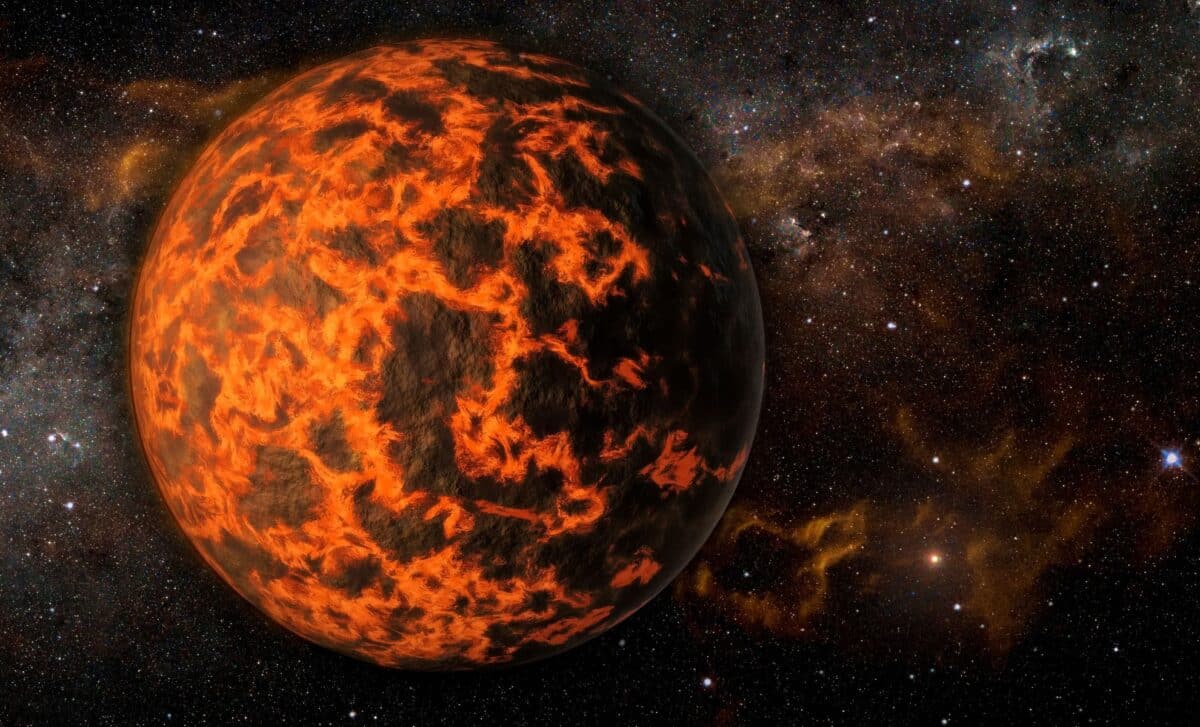
LHS 3844b, an exoplanet with a permanent day and night side, may seem like the last place you’d expect to find life. Located 48.5 light-years away, LHS 3844b orbits a small red dwarf star, LHS 3884. Unlike Earth, where day and night bring temperature variations, this planet is tidally locked, meaning one side always faces its star while the other side remains in eternal darkness.
However, new research suggests that this “hellish” planet could, against all odds, support life beneath its surface. Scientists are now reconsidering whether even the most extreme exoplanets could have conditions suitable for life.
What Makes a Planet Habitable?
For years, astronomers have focused on finding exoplanets similar to Earth, worlds with temperate climates and regular cycles of day and night. ButDaisuke Noto, a researcher at the University of Pennsylvania, and his team are questioning that narrow view. They’ve been studying how tidally locked planets like LHS 3844b could potentially offer habitable environments. Their research suggested that the planet’s extreme temperature contrast might actually create moderate conditions beneath the surface.
Published in Nature Communications, their study proposes that tidal locking could help distribute heat more evenly across the planet through mantle convection, especially in regions between the extremes. According to Noto:
“Many celestial bodies like moons and planets that are very close to their parent stars are what we call tidally locked,” he explained. “Meaning, as they spin around on their axes and orbit around their parents, those rates or frequencies match, leading to the phenomena like us only seeing one side of our moon.”
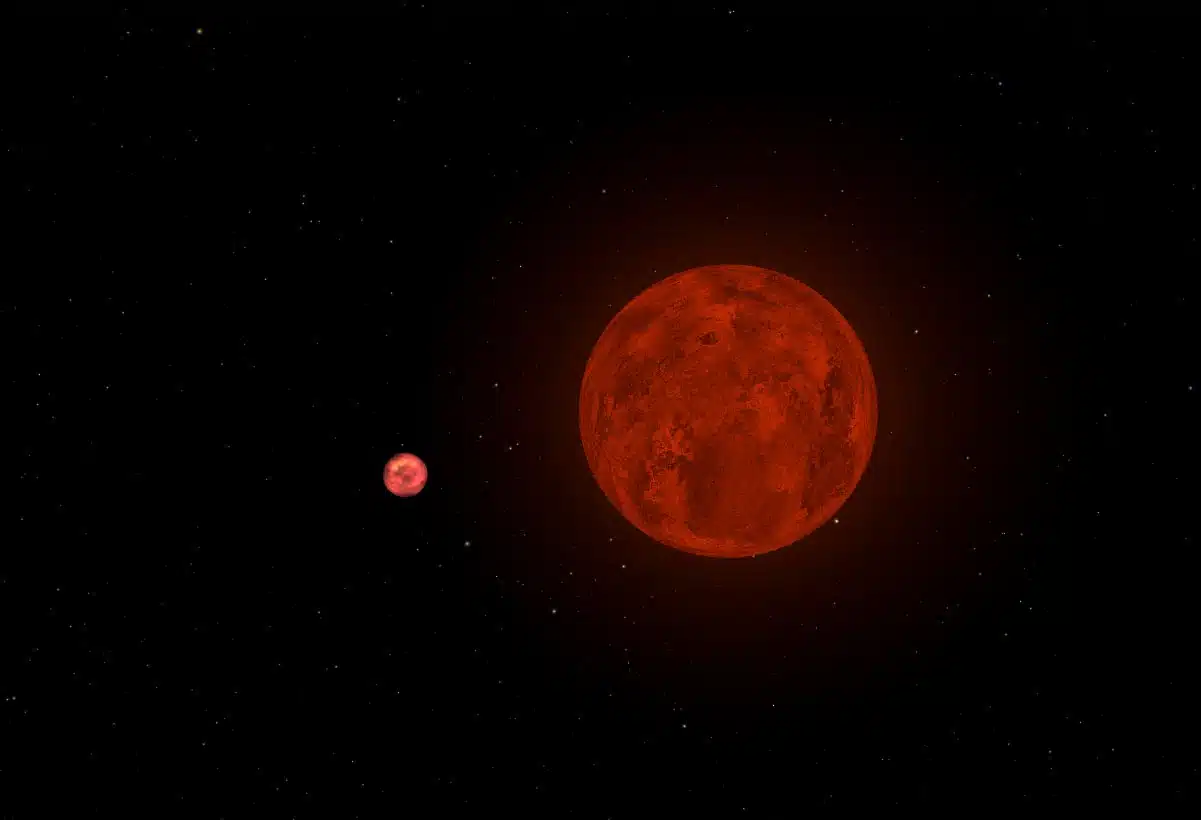 Exoplanet LHS 3844b (left) has 1.3 times Earth’s mass and orbits the star LHS 3844 (right). Credit: NASA
How LHS 3844b’s Interior Might Work
To test this hypothesis, Noto’s team conducted a lab experiment simulating the temperature differences between the day and night sides of a tidally locked planet. By filling a tank with glycerol and using thermochromic liquid crystals that change color with temperature, they observed how the material moved under various heat gradients. The experiment showed that hot material would rise on the day side, flow across the top, cool on the night side, and sink back down, creating astable convection cycle.
While this model was small-scale, it provided important insights into how mantle convection could operate on a planet like LHS 3844b. Noto pointed out that:
“It’s not chaotic like Earth’s mantle.” He added, “It’s slow and steady. Predictable. Kind of boring but in a good way.”
The experiment also revealed stationary hot plumes, similar to Earth’s hotspots but fixed in place. This suggests that the exoplanet could have geothermal activity in specific regions, potentially creating habitable “twilight zones” between the extremes of day and night.
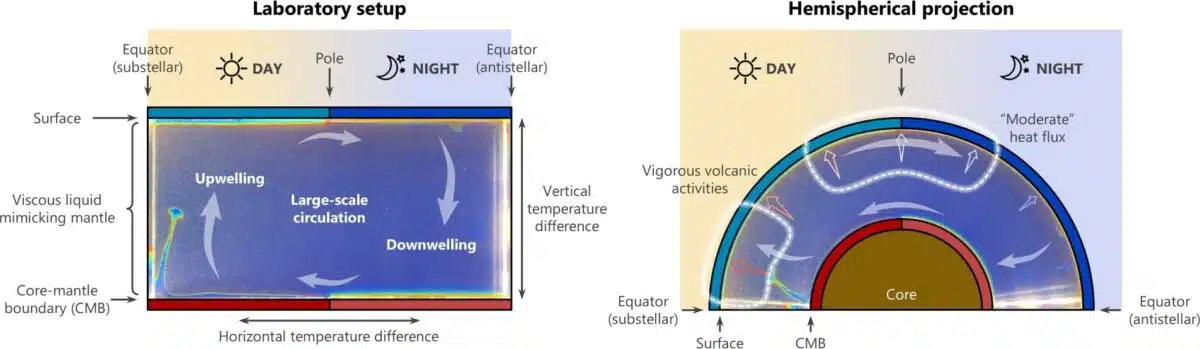 This diagram shows Daisuke Noto’s experiment simulating temperature differences on a tidally locked exoplanet, illustrating convection patterns in its mantle. Credit: Daisuke Noto
Magnetic Fields: A Product of Geothermal Activity?
But the story doesn’t end there. Noto also suggests that this internal convection could impact the planet’s liquid core, potentially generating a magnetic field. Although this hasn’t been tested yet, he argues that such a field could protect the planet from cosmic radiation, much like Earth’s magnetic field does. This protection could make the exoplanet more suitable for life.
Also shown in the study, geothermal activity could create stable, habitable environments in specific areas. Just like Earth’s hot spots, these regions could support microbial life, especially in mid-latitude zones where the temperatures are more moderate.
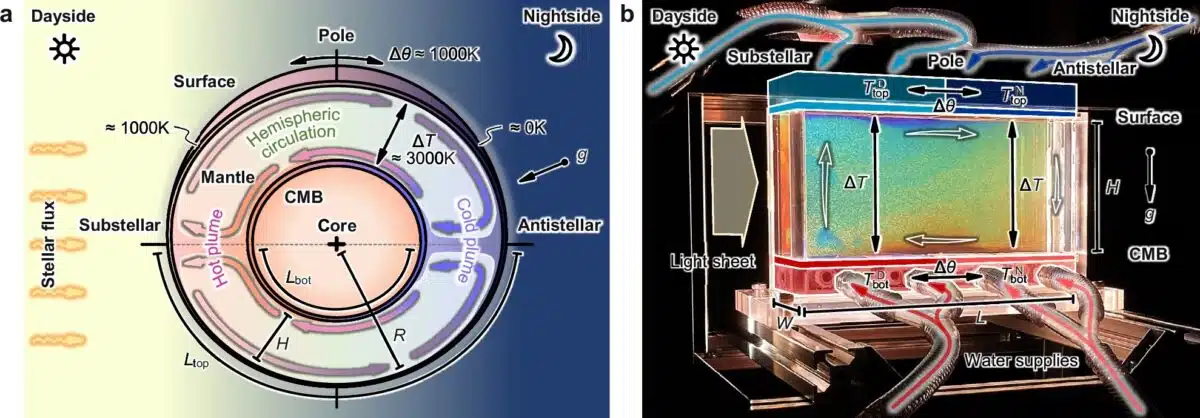 This diagram shows how temperature differences drive convection in the mantle of a tidally-locked exoplanet, using both setup (b) and projection (a). Credit: Nature Communications