
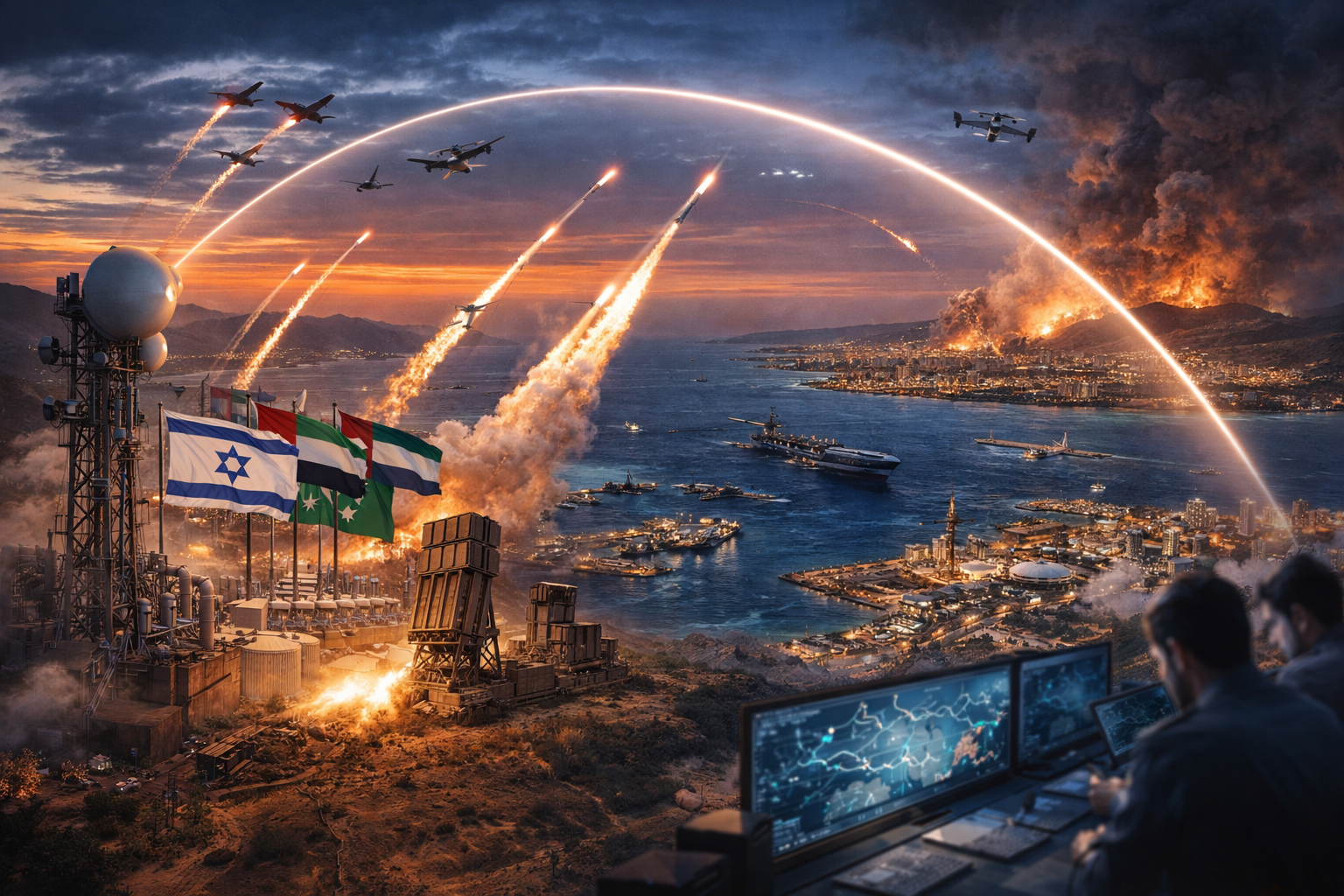
Iran did not break the Middle East. It revealed who can defend it.
For years, Arab capitals tried to treat Israel and Iran as separate problems. That fiction is over. Missiles, drones, maritime coercion, and attacks on critical infrastructure have made one fact unavoidable: the more Iran escalates, the more Israel becomes indispensable.
That is good for Israel but also for the region.
The choice is no longer between Israeli power and some imaginary neutral order. It is between order backed by strength and disorder enforced through blackmail. Iran has done what diplomacy could not: it has pushed Gulf states to see Israel not as a tolerated anomaly, but as a strategic necessity.
Israel offers what the region now needs most: deterrence, intelligence, air defense, missile interception, cyber capability, military innovation, and the will to use them. Iran offers the opposite: instability, proxy warfare, coercion, and sabotage disguised as resistance.
States under fire do not run toward the arsonist. They run toward the fire brigade.
That is the deeper meaning of this war. The Gulf is learning that ports, airports, desalination plants, oil facilities, trade corridors, and cities are not protected by diplomatic theater. They are protected by systems, intelligence, deterrence, and force. In that environment, Israel does not look optional. It looks essential.
That lesson now extends beyond the Gulf. After the strike on Natanz, Iran hit Arad and Dimona and fired long-range missiles toward Diego Garcia, the joint U.S.-U.K. base in the Indian Ocean that underpins Western military reach across the Middle East, East Africa, and South Asia. That matters because it shows the war is no longer a narrow Israel-Iran clash. It is a test of the wider security order.
In policy terms, that matters because once Iran shows a willingness to strike core U.S. and allied military infrastructure at greater range, pressure on the Trump administration to shift from offshore punishment to more direct military commitments will grow. That does not make a U.S. ground deployment inevitable, but it does make it more likely if escalation continues and airpower fails to reestablish deterrence.
Every time Iran widens the battlefield, it increases the value of the states willing and able to confront it. That makes Israel more central, not less.
This means more than warmer ties. It means structural change. Israeli defense systems, intelligence, and military technology become more valuable. The Abraham Accords begin to look less like symbolic diplomacy and more like the foundation of a serious and unbreakable regional security architecture.
At that point, normalization is no longer a ceremony. It is alignment.
This war may also reshape Israel itself. The more Gulf states seek Israeli systems, technology, and defense integration, the more the Jewish state can expand production, deepen exports, and reduce long-term dependence on Washington. A state that arms its neighbors, secures trade corridors, and anchors deterrence does not remain a client. It becomes the arsenal of the new Middle East.
And once Arab states begin buying their survival from Jerusalem, decades of anti-Israel posturing will be exposed for what they were: vanity sustained by geography, not geopolitical strategy.
That matters for the nuclear file as well. A Gulf directly exposed to Iranian coercion will be less willing to indulge fantasies about living beside a threshold nuclear power armed with missiles and drones. The more Iran terrorizes its neighbors, the more it builds the coalition that will seek to contain its expansion permanently. Iranian aggression is not only driving arms demand. It is driving strategic clarity, and that favors Israel.
The old lie was that Israel destabilized the region. The truth is that the Jewish State is the only country with the capacity, discipline, and legitimacy to anchor a durable regional order against coercion, collapse, and terror.
Iran wanted to push the region away from Israel. Instead, it crowned Israel the guardian of the Middle East.
Jose Lev is an American-Israeli scholar focused on Middle Eastern security doctrine.
A multilingual veteran of both the IDF’s special forces and the U.S. Army, he holds a B.S. in Neuroscience with a Minor in Israel Studies from American University in Washington, D.C., three master’s degrees (international geopolitics, applied economics, and security and intelligence studies), and a medical degree. Currently, Lev is completing a Ph.D. in Intelligence and Global Security in the Washington, D.C. area.
Alongside his Times of Israel blog, he contributes to the U.S.-based think tank Middle East Forum, regularly appears on Latin American television to provide analysis on geopolitical and security affairs, and is a member of the Association for Israel Studies.