
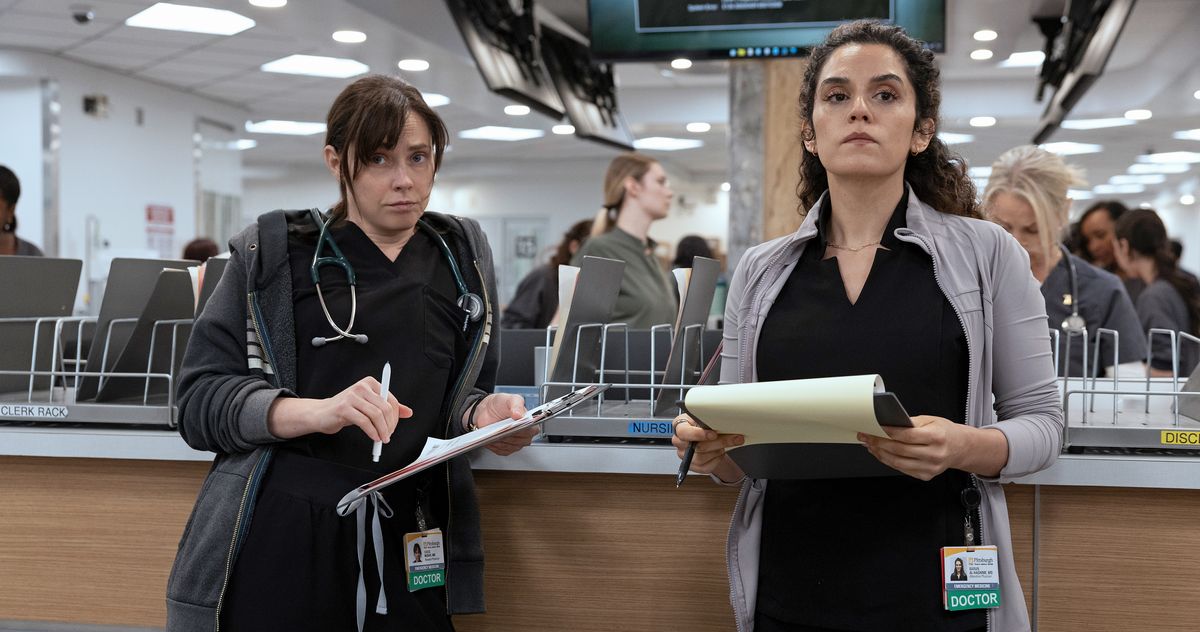
“She does have a lot of strong opinions about Robby that she keeps to herself.”
Photo: Warrick Page/HBO Max
Spoilers follow for the second season of The Pitt through 12th episode “6:00 P.M.”
Whatever is going on with The Pitt newcomer Dr. Baran Al-Hashimi (Sepideh Moafi) when she seems to freeze and zone out while caring for patients is a mystery. How Dr. Michael “Robby” Rabinovitch (Noah Wyle) is treating her is not. This entire shift, Robby has been dismissive and disrespectful to Al-Hashimi, the attending who will take over for him when he’s on his three-month sabbatical, and in “6:00 P.M.,” he graduates to cursing in her face and implying she’s not cut out for the job. When Baran calmly suggests that there should be two daytime attendings working in such a thinly spread department, Robby shouts, “It’s going to be yours to fuck up, so don’t fuck it up!” and storms out of their conversation, signaling how little he cares about her opinion. It’s an awful way to treat a colleague, and it’s another moment when Dr. Al-Hashimi has to put up with Robby acting like an infant throwing a tantrum. Baby Jane Doe would never.
The Iranian American Moafi has spent over ten years appearing in all kinds of procedurals — including The Good Wife, Nurse Jackie, The Blacklist, and Black Bird — and as Dr. Al-Hashimi, she’s the most major new addition to The Pitt’s season-two ensemble. Like Dr. Trinity Santos last year, Al-Hashimi is somewhat divisive both inside the PTMC and with viewers, with some co-workers (again, Santos) chafing against her preference for rules and procedure and some fans immediately disliking her for championing a data-collection app that uses AI to help doctors with charting. But as the season has progressed, Moafi (who was originally invited to audition for the Samira Mohan character in the first season) has kept Baran cool, collected, and mission focused, whether she’s advocating for a prisoner with malnutrition to be admitted in “12:00 P.M.,” pulling off a tricky slash tracheostomy in “4:00 P.M.,” or dealing with Robby’s antagonism. “She’s never overstepping because she wants to get in the way,” Moafi says. “She’s trying to get herself fully in there, absorb herself in who she’s speaking to and what she’s doing and the patients she’s with, as much as possible, because she’s almost painfully, dangerously overachieving.”
Tell me about your chemistry read with Noah to join season two.
Sometimes they won’t give you the exact scenes, but they’ll give mock sides that capture the sort of tone they’re trying to see. I had one scene that was purely expositional, but in the words of my mentor, exposition is always POV. It was all about the AI and this new technology that she was trying to implement. Another was a scene in which I lost a patient and was beating myself up about it, and it was clearly a stark contrast to the first scene, where I was very put together, organized, and articulate. In this scene, I barely say anything, and I’m really punishing myself. And the third scene was more of a flirty scene with Noah, teasing him and calling him out. You see all these colors in the Pitt.
Flirting with Robby?
It starts off where I’m confronting him, a similar dynamic that you see when I say, “Why are you treating me like one of your residents?” She’s calling him out that way, but then it turns and she calls him “Dr. Daddy” at one point. She makes jokes about how he’s so smooth, and he’s got this rizz and charm, and makes him really uncomfortable, basically.
I love it. “Dr. Daddy” is a phrase that will haunt me for the rest of my days.
Me too. Me too.
The Pitt sometimes tricks us about a character by giving us one perspective on them for a long time before revealing something totally different. This is what happened with Santos and Langdon in the first season. Along those lines, I think Dr. Al-Hashmi is treated very unfairly in terms of what we hear about her at first. Robby says she has “giant balls of disrespect” for coming in early to the shift. She’s labeled a strict rule follower like that’s a bad thing. I’m curious if you felt that the cards were stacked against her as a character in the beginning, and if that affected your performance.
Oh my God, I didn’t expect this. This makes me so emotional. Of course it affects how you live inside of this character, because you’re so misunderstood. And as somebody who felt very misunderstood throughout my life, and still do in so many ways — like, in this moment that we’re living through, with how fractured the Iranian diaspora is — it’s so hard, especially in these two-dimensional mediums like social media and technology, to be able to fully communicate the complexity and nuance of your life, of your views, of the whys and the hows of who you are and why. With her, I didn’t feel emotional doing it, necessarily; I just felt like she knows she’s misunderstood and she has to put all of that away. She has to compartmentalize all of that and trust that and know that she’s coming from a good place in her heart.
Part of her backstory that I fleshed out for myself is that Dr. Al-Hashimi is half-Iranian, half-Iraqi, and she was deployed in Iraq. Getting to reconnect with part of her identity that she has disconnected from for a number of ways, because of a slightly fractured relationship with her father — this is all stuff that wasn’t in the script; it’s for myself that I filled out. Long story short, it hasn’t been easy, and there are qualities about her that can seem a little socially out of tune. You’ll see her stand too close, but that’s really how myopic she is with wanting to improve the system, wanting to collaborate, wanting to connect, wanting to help. Some people could easily, in the beginning, project onto her that she’s there and she wants to dominate. She doesn’t want to dominate the room, but the room sharpens around her. With any woman who’s deeply rigorous and skilled and brilliant and high-achieving, you’re going to get a lot of backlash, and you’re going to have to push up against a system that’s not built for you.
The complexity of who she is was so relatable. The way that we present ourselves is different from the way that we think and feel sometimes, because we don’t think that we can reveal how we think and feel fully. We’re afraid of being judged; we’re afraid of being ostracized. There’s a lot of that within her. She knows she’s being misunderstood, but she can’t allow her feelings — her pain even — to get in the way of this sort of Promethean charge to fix and advance a broken system.
We get a sense of this in “6:00 P.M.” when Robby yells at her for suggesting that the PTMC could benefit from two daytime attendings rather than one, and Baran can’t really let herself react. How did you and Noah approach that scene?
Scenes that are emotionally charged are always — even when they’re uncomfortable on some level — fun to play. Dr. Al-Hashimi doesn’t reveal much, so when she does deliver a piece of her mind or reveal her emotional life, it felt really good, because she spends 98 percent of her day covering it up. She does have a lot of strong opinions about Robby that she keeps to herself, but when it gets to the point where it is sacrificing the level of care, that’s when the mama bear comes out a little bit.
To be honest, I haven’t seen episode 12, and I don’t know which take they used. Regardless, in the writing, it does show that she’s like, Why can’t we have a heated argument, like a dialectic? Why does it have to slip into this personal jab? You don’t have to agree with me, but why do you have to disrespect me? In the beginning, especially when he would undercut her, she’s used to it to a certain degree. But the more she’s grown to like, know, and admire Dr. Robby, the more it does affect her emotionally. Because it’s like, You’ve seen the work that I’m bringing — the level of care, the level of attention to detail. Why do we have to get dirty in our fights or disagreements?
The fact that Dr. Al-Hashimi suggests two attendings, even that is offensive to him. It reveals the level of sensitivity that he has personally and professionally, and a bit of a scarcity mind-set too. The last thing he literally says is, “It’s yours; don’t fuck it up.” I don’t want it to be “mine.” I want it to be ours. The only way that hospitals work is through teamwork, right? And that’s what’s beautiful about The Pitt. It’s not about this one savior. Yes, Noah Wyle, Dr. Robby, is the main protagonist, but the reason why this hospital works is because of this entire ecosystem, this entire team that needs each other, this community of people who devote themselves and their lives to helping people.
I’m going to lay out my idea of what is going on with Dr. Al-Hashimi. We know that she was at Dasht-e-Barchi Hospital in Afghanistan when it was suicide-bombed and dozens of mothers and babies were killed. We know she has a son she wants to spend more time with. We know she’s the patient of a neuroscientist. We know she feels a bond with the mother who blames herself for her son getting locked in the car. My guess is she lost a child and is traumatized by that guilt. What’s your reaction to that theory?
I’m obsessed with this question. I can’t say anything. [Laughs.] But I love that this has stirred up so much mystery and speculation. That is what art does. From the callback, I’ve known what’s going on with my character, and nobody else in the show did. At the end of episode one, where Dr. Al-Hashimi is looking at the baby, people were asking me, “Do you know what’s happening? What’s going on here?” I would always ask them, “What’s your theory? What do you think?” and everybody had a different answer. At a time where we are so divided and so isolated behind our screens, it’s so cool that this is a moment where screens are actually stirring conversation. But I can’t tell you what it is.
We’re both Iranian American. We’re speaking after the U.S. and Israel have started bombing Iran. You mentioned the diaspora earlier. I’m seeing so many wild takes on social media from so many different corners of the diaspora. I’m wondering if there’s anything you’d like to say about all this right now, and how it’s affecting you.
The social-media world is so inundated with really disturbing takes and a lot of cyberbullying and attacking. It’s been hard. I’ve felt helpless. There are still family members that we haven’t been able to reach in Iran. And it’s also really difficult, because there’s a lot of wishful thinking right now, and thinking that is divorced from a sort of political reality and political patterns.
There are many, many problems and conflicts in the world: Sudan, DRC, Gaza, the list is endless. In this moment, eyes are on Iran because of the long-standing suffering of the Iranian people, but mainly because, yet again, our U.S. dollars are being used to bomb and decimate another country. It’s complicated. Iran is not a monolith. The political spectrum runs far and wide, and every voice matters. Even my answer is kind of all over the place, because I honor and I respect people who are inside of Iran who are so desperate that they think a bomb at least changes something or gives hope when they are trapped, when they’ve been held hostage for 47 years by this regime. And if you see the patterns of history throughout the region, we’ve never been able to bomb our way to democracy. So I’m praying, and I’m trying to amplify in the best way that I can, and I’m trying to work and organize with these groups that I know are leading the charge. The priority is making Iranian people feel seen, feel heard, and not feel alone.
To tie this back to the show, The Pitt has, in its first season and throughout the second season, tied in societal issues we’re living through and brought them to the forefront. What feels poignant about Dr. Al-Hashimi, and bringing her diverse medical background into the world of The Pitt, is that we’re living through these proliferating crises all over the world — all over South America, all over the Africas, all over the Middle East or SWANA region — because of climate disaster, war and displacement, collapsing health systems, and rising authoritarianism. All of these things are simultaneously happening to bring us to an unprecedented moment of humanitarian need and crisis. To introduce a character who’s practiced medicine in these environments, who’s treated patients in places where the entire country is turned into an ER, where resources are scarce and the need is unbelievably, overwhelmingly high, adds a different gravity to the hospital. It helps us zoom out a little bit more from the microcosm of our lives to see that we are interconnected.
Bringing that global awareness to The Pitt felt really important and beautiful. I’m an ambassador with the International Rescue Committee, and doctors in the field love the show. My friends in Jordan or Beirut are saying how amazing it is to bring a doctor that reflects their experience to arguably one of the biggest shows in the world, definitely the biggest show in the States. It gives me hope that we’re making people feel seen and appreciated for their work — not just health-care workers that we see in our hospitals, but our health-care workers that travel abroad and do impossibly courageous work and come back and live with that trauma for the rest of their lives.
Sign up for the Vulture Daily
An entertainment newsletter for the pop-culture obsessed.
Vox Media, LLC Terms and Privacy Notice
Related