
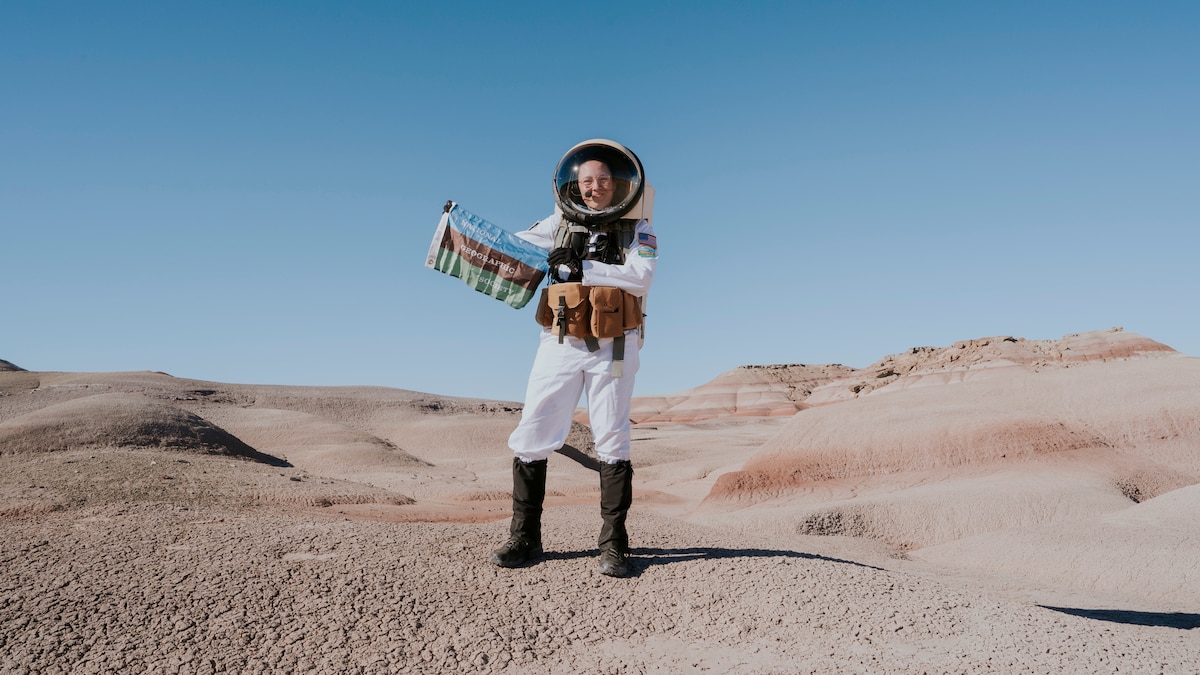
At least she wasn’t on the The Hydronaut, the underwater mission designed to imitate long-duration spaceflight, Calle describes. “Ninety square feet. Three people. No windows,” she winces. “No, no, no.”
At least at MDRS, Calle could move about the two-story cylinder that served as the crew’s living space. She could roam the habitat’s tunnels and find herself in its greenhouse (GreenHab), the solar observatory or the engineering bay — the Repair and Assembly Module (RAM). She could exit the environment via the mock airlocks for an extravehicular activity (EVA), or tend to the microgreens she was growing, or retreat for some solace in the tiny citadel above the living quarters. Still, “It was harder than I thought it was going to be,” she admits.
Why would anyone, especially a non-astronaut, do this?
“I want to photograph space so space feels possible.”
From observer to participant
Calle’s storytelling endeavor, supported by the National Geographic Society, is a manifestation of years of her space interest and inspiration by space exploration icon Sally Ride.
“We are at a new and incredibly exciting era in space exploration,” Calle observes, pointing to missions like NASA’s Artemis II, set for launch in March, which will have astronauts orbit the Moon. It will be the closest humans have been to the lunar surface since Apollo, until NASA’s Artemis III which aims to put humans back on the Moon in 203027. “How can we make people feel connected to it?” she wonders, acknowledging that space is a paradox — a universal human experience, and yet, “hostile and alien.” Bridging the gap is at the core of her photographic work.
“I always come back to the quote by Dr. Sally Ride. She said, ‘You can’t be what you can’t see.’ So how can we make a space that’s alien personal, and who’s actually going to go?”