
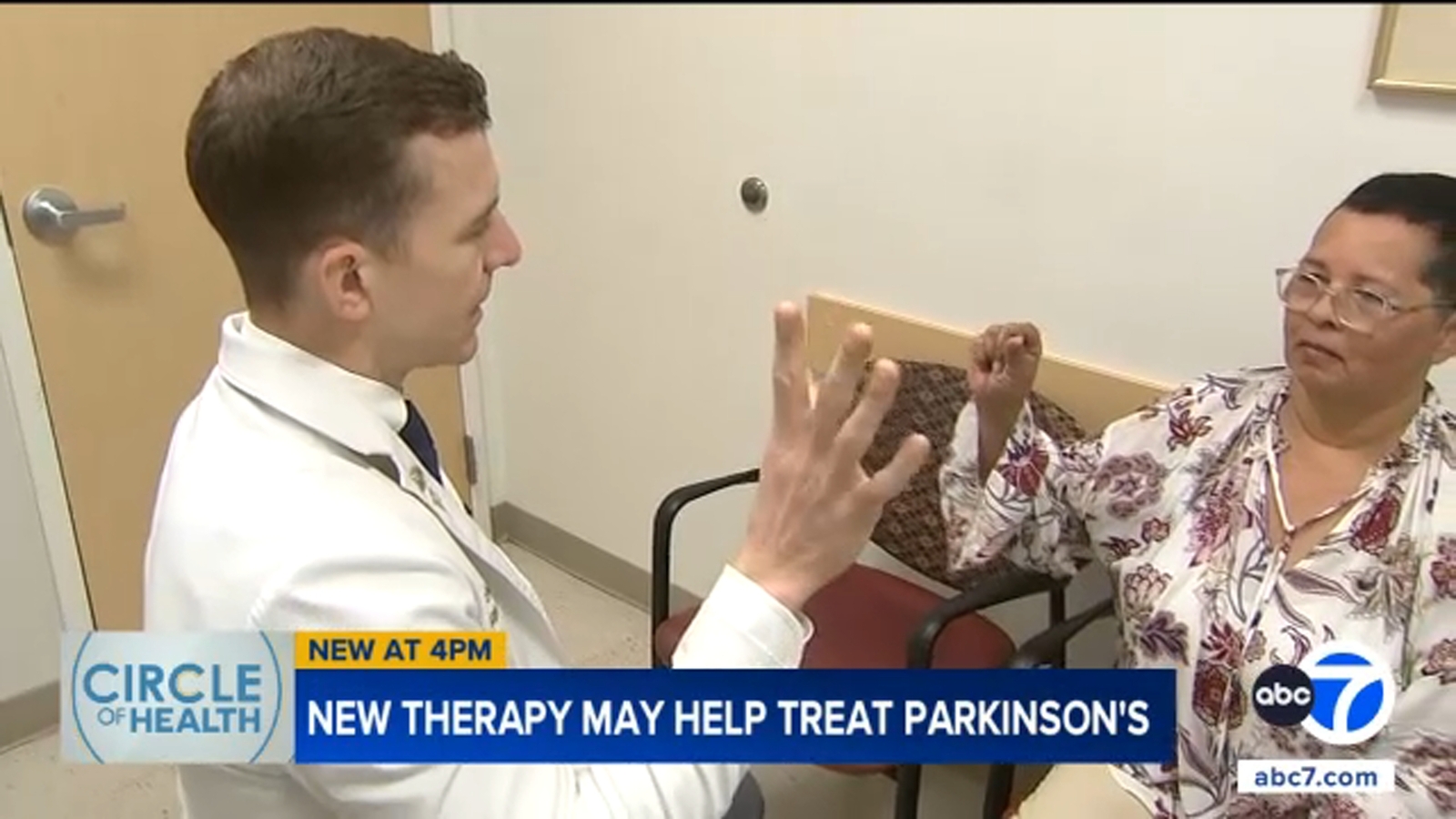
LOS ANGELES (KABC) — A new stem cell treatment may offer hope for Parkinson’s disease. Keck Medicine of USC is investigating a unique therapy that aims to repair damaged brain cells
Four months after neurosurgeons implanted specialized stem cells into Elizabeth Mendoza’s brain, she noticed a positive change in her Parkinson’s disease symptoms.
“I feel good. I feel better than I have in a while,” she said.
Parkinson’s disease is a progressive neurodegenerative disorder that impacts more than a million Americans.
It can also cause muscle stiffness and affect balance and walking. Mendoza’s tremors started in 2019.
“The tremors occur when the limb is at rest,” said Keck Medicine of USC neurologist and co-principal investigator, Dr. Xenos Mason.
He said the risk for Parkinson’s increases in those 60 or older, but doctors are finding it in younger people. Some studies suggest pesticides and pollution may play a role.
“There is an increase in Parkinson’s that we don’t understand that is probably related to something in the environment over the last 30 or 40 years,” he said.
The condition occurs when the brain doesn’t produce enough of the neurochemical dopamine.
“In Parkinson’s disease when that dopamine is lost, movements are inhibited,” said Mason.
While medications help Mendoza make more dopamine, it doesn’t slow the progression and can cause side effects.
“I was totally nauseated, really bad,” said Mendoza.
Now, she’s one of the first patients nationwide to participate in an early-phase clinical trial investigating whether implanting specially-programmed stem cells can help the brain produce more dopamine naturally.
“Introducing something that has more consistency or may even be more of a biologic behavior than a single dose of dopamine that you take through a pill can be more advantageous,” said Mason.
In the procedure, surgeons drilled a small hole in Elizabeth’s skull to access the brain. Then, they implant the stem cells into the area that controls movement.
“We’re understanding how stem cells work in the brain. How they release dopamine, how they grow, how they integrate as we’re doing these trials and studies,” he said.
The first phase of the trial is looking into safety.
But patients will be monitored for any changes in their Parkinson’s disease symptoms and for possible side effects for up to five years.
While she is still using medication to control her tremors, she’s seen slight improvement.
“My tremors are a little less,” she said.
Mendoza hopes her involvement in this study will give other people with Parkinson’s hope.
“I would have never thought I would have stem cells injected into my brain, and here I am and I feel pretty good,” she said.
Copyright © 2026 KABC Television, LLC. All rights reserved.