
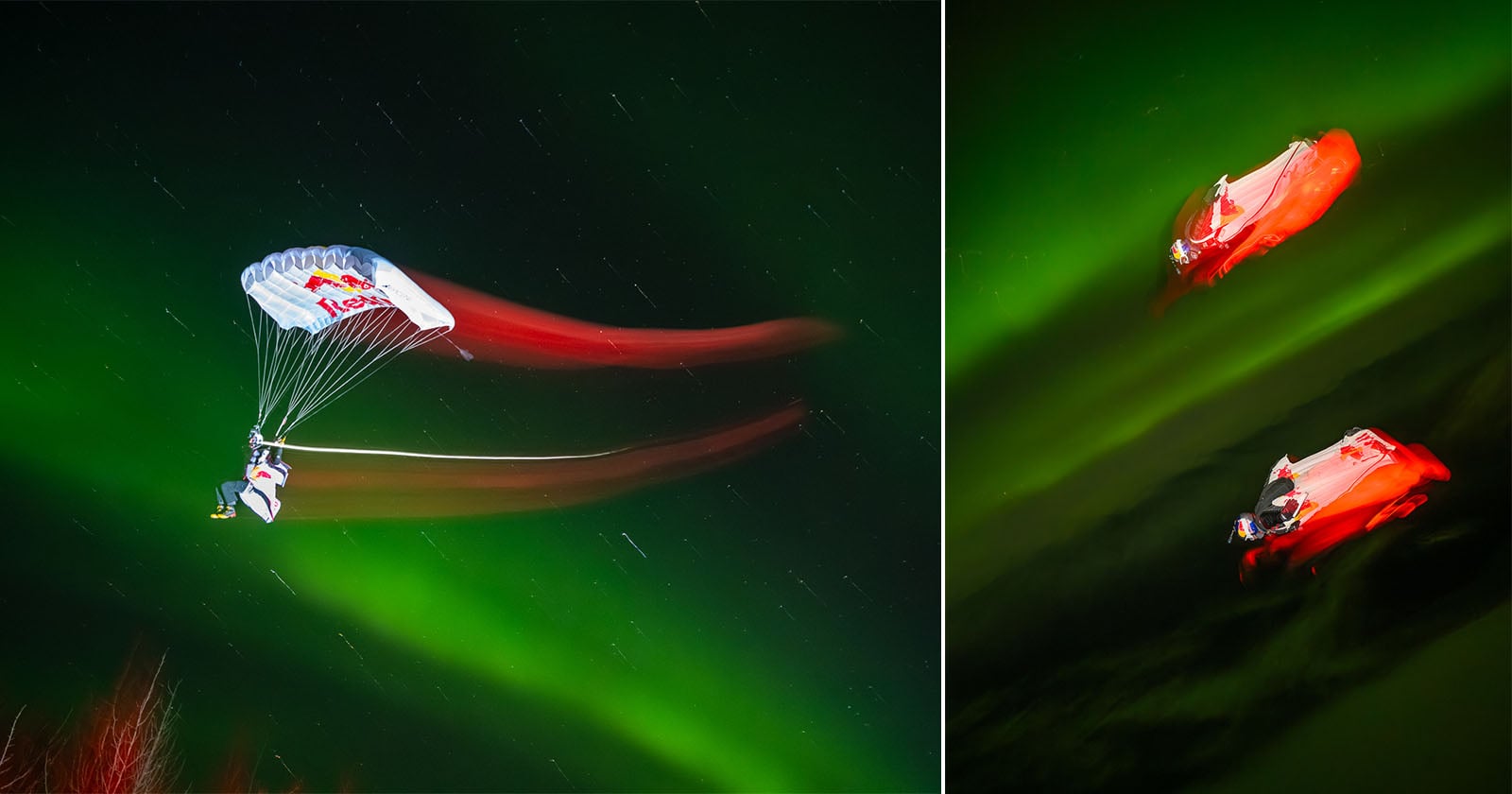
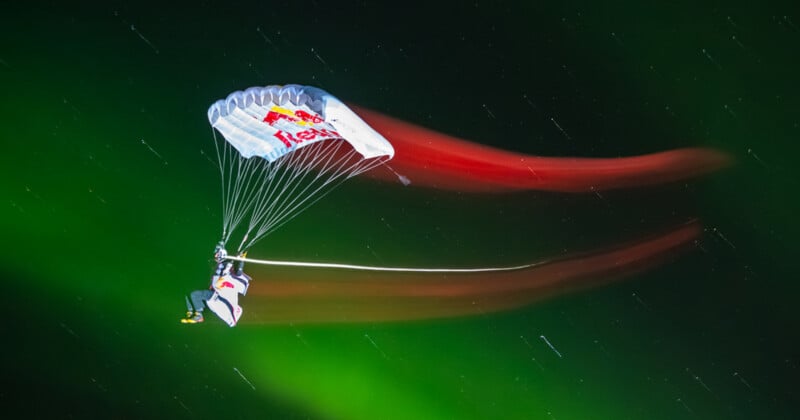
Capturing the impossible, photographer Michael Clark documented Red Bull Air Force wingsuit skydivers as they soared beneath the shimmering Aurora Borealis. He shares how months of planning, technical innovation, and high-stakes collaboration culminated in images that make the sky itself look alive.
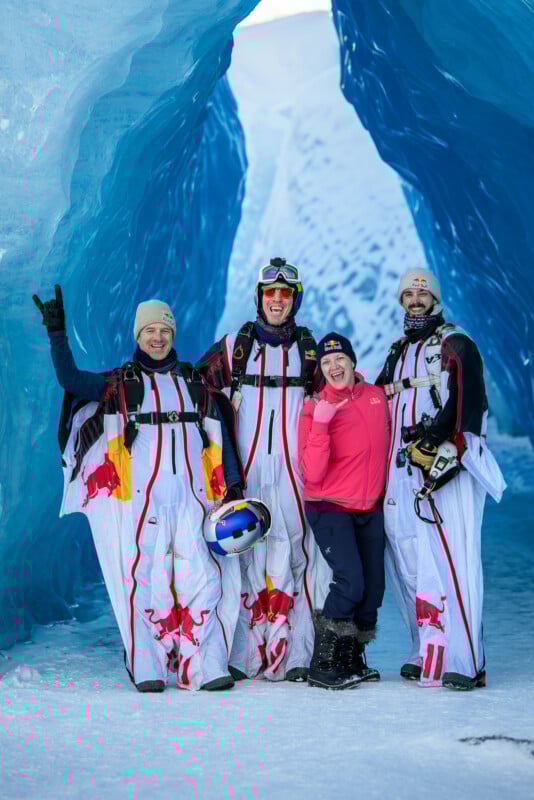 Jeff Provenzano, Jon DeVore, Amy Chmelecki and Mike Brewer hanging out on the Knik Glacier Lake just before a test wingsuit skydive near Palmer, Alaska on March 23, 2026. Photo by Michael Clark.
 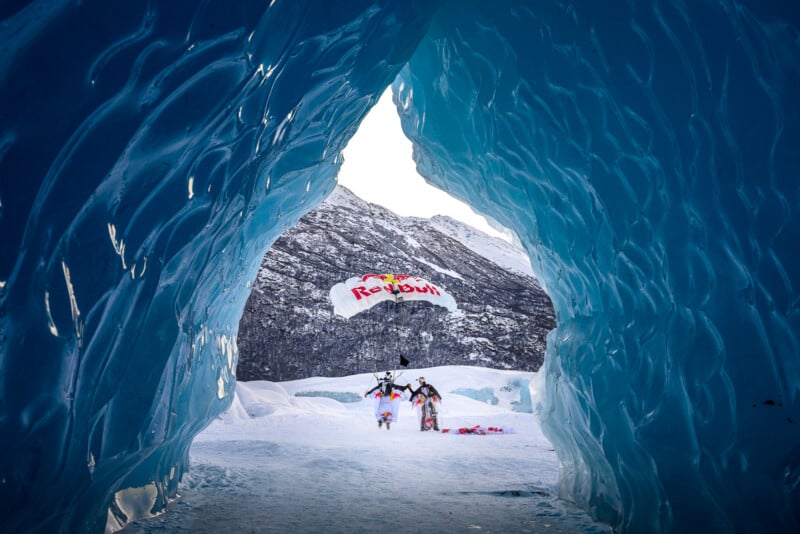 Jeff Provenzano and Mike Brewer landing on the Knik Glacier Lake after a test wingsuit skydive near Palmer, Alaska on March 23, 2026. Photo by Michael Clark. The Dream Team’s Dream
For photographer Michael Clark, the dream of photographing wingsuit skydivers beneath the Aurora Borealis was years in the making. Clark, an award-winning freelancer with more than three decades behind the lens, brings a rare combination of artistic vision, athleticism, and technical expertise to his work. In pursuit of a childhood dream to become an astronaut, he earned a B.S. in Physics from the University of Texas at Austin, and that analytical rigor informs every project he tackles.
The idea for this stunt originated with Red Bull Air Force team member Jeff Provenzano, who wanted to cap off his last state, Alaska, with a spectacular skydive under the Northern Lights. He approached Clark roughly four years ago to explore whether such a feat could be captured on camera. Provenzano also enlisted Jon DeVore, captain of the Red Bull Air Force and a native Alaskan, to help organize the logistics of the jump. Drawing on his previous aurora photography experience and his problem-solving skills honed through physics, Clark devised a plan to document the unprecedented stunt.
“It was originally the idea of Jeff Provenzano. He called me about this project maybe four years ago to see if it was even possible to capture images at night under the aurora. He then called Jon DeVore to check in with him, and after a few days of doing research and drawing from previous experience photographing Auroras elsewhere, I devised a plan for how we could document this project and then we set out to make it happen,” Clark says.
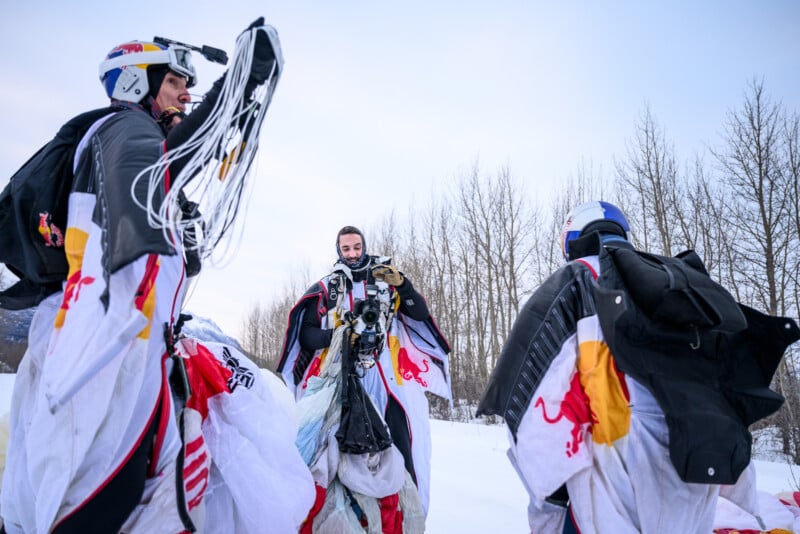 Jeff Provenzano, Jon DeVore and Mike Brewer wingsuit skydiving near Palmer, Alaska on March 23, 2026. Photo by Michael Clark.
 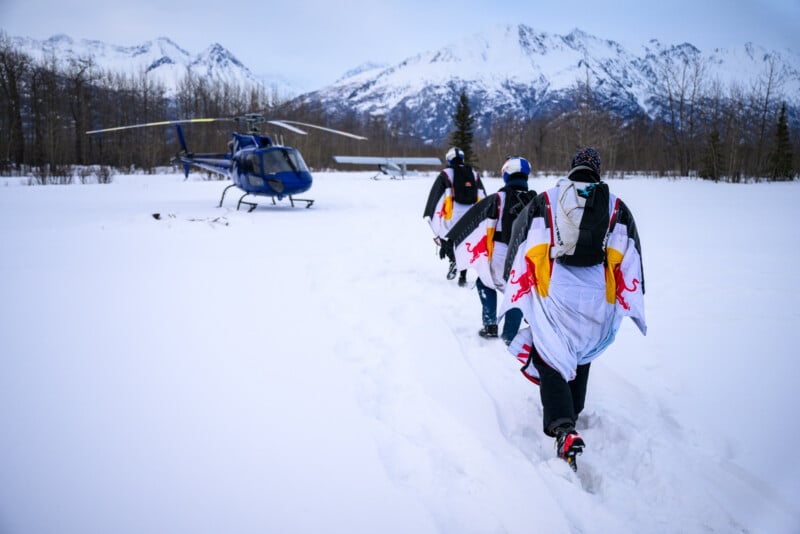 Jeff Provenzano, Jon DeVore and Mike Brewer walking to the helicopter before doing a test wingsuit skydive near Palmer, Alaska on March 23, 2026. Photo by Michael Clark.
 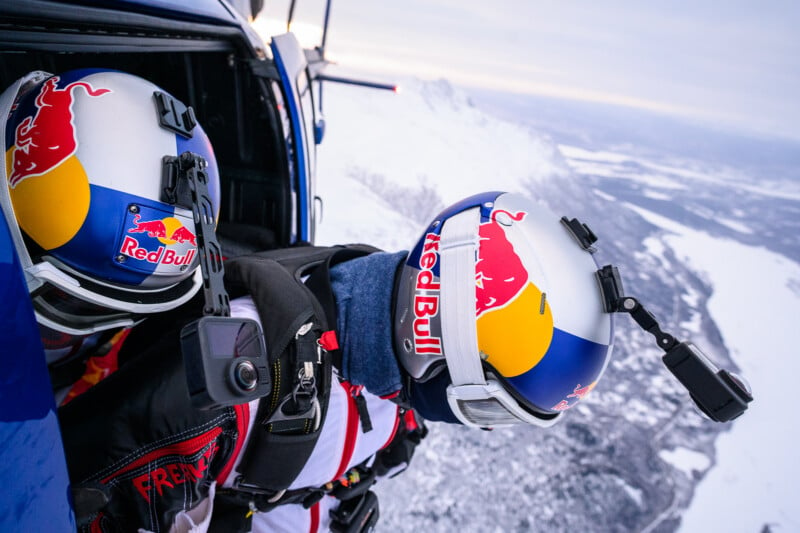 Jeff Provenzano and Jon DeVore wingsuit skydiving under the Aurora Borealis near Palmer, Alaska on March 23, 2026. Image by Mike Brewer (in collaboration with Michael Clark).
The project faced numerous stops and starts over the years. Weather, wind, and the fickle aurora repeatedly forced last-minute cancellations. Yet the team’s persistence and Clark’s passion for problem-solving kept the project alive. Having worked with Red Bull as a freelance photographer for sixteen years, Clark is used to high-risk, technically challenging assignments. He thrives on the intersection of athletic skill and photographic innovation, and this project demanded that in spades.
“The reason this assignment and this collaboration is so exciting is that to create these images from the start was a group of individuals who have come together to solve all the logistics to make it happen. And on top of that, the collaboration created a set of images that have never been created before, and we managed to even exceed my own concept and expectations,” Clark explains.
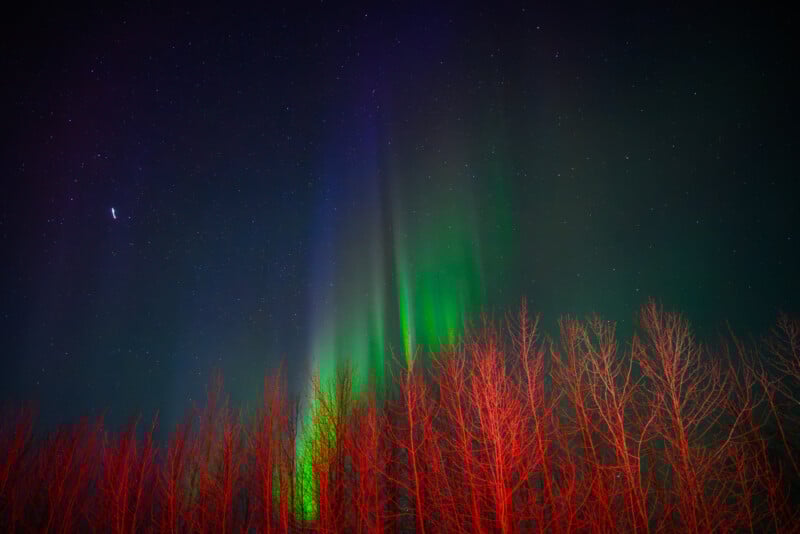 Aurora Borealis near Palmer, Alaska on March 23, 2026. Photo by Michael Clark.
 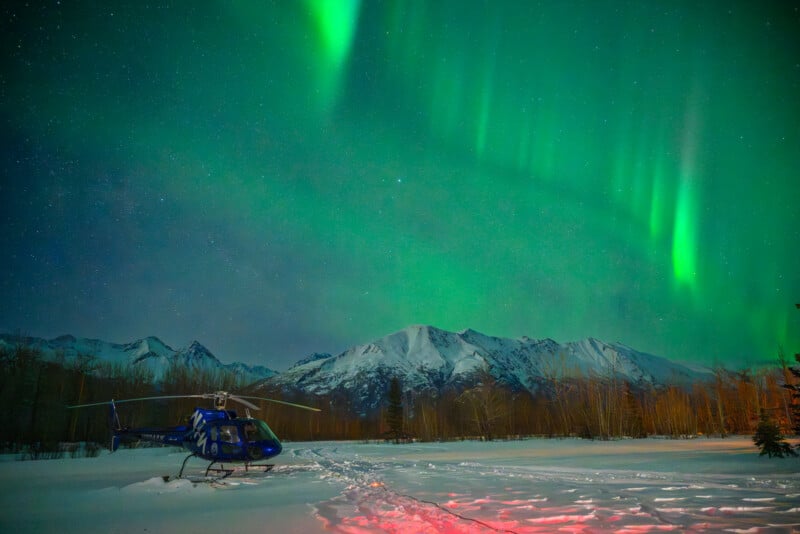 The Aurora Borealis near Palmer, Alaska on March 23, 2026. Photo by Michael Clark.
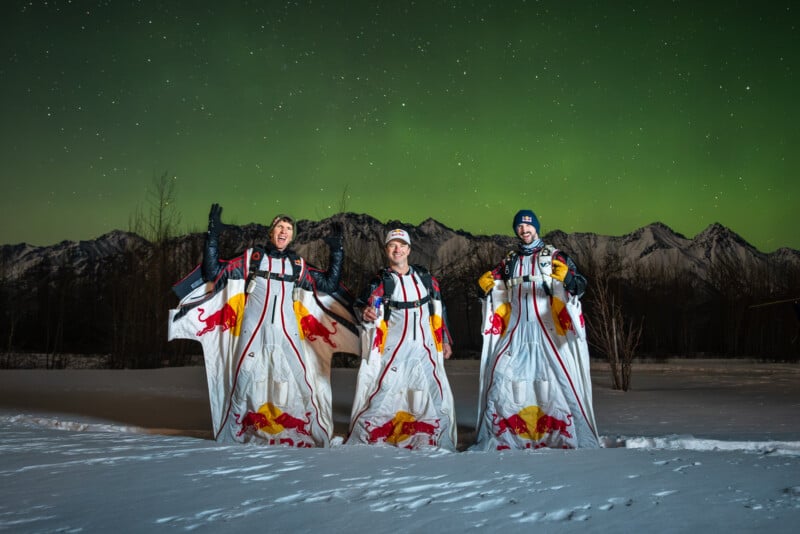 A portrait of Jeff Provenzano, Jon DeVore and Mike Brewer created after they succesfully wingsuit skydived under the Aurora Borealis near Palmer, Alaska on March 23, 2026. Photo by Michael Clark. A Symphony of Technical Challenges
Capturing wingsuit skydivers against a night sky posed enormous technical challenges. The aurora requires long exposures, typically from one to twenty seconds, but the skydivers were moving at roughly 120 mph. Clark had to freeze their motion while still allowing the aurora’s colors to emerge in the frame.
Air-to-air shots were captured by Mike Brewer, who flew with a Nikon Z6 mounted with a Nikkor 20mm f/1.8 lens and a small SB-400 speedlight attached to his helmet. The short-duration flash froze the skydivers’ motion, while long exposures captured the aurora above them. On the ground, Clark and fellow photographer Kien Quan used a Nikon Z8 with battery-powered strobes to photograph swooping landings, carefully timing flashes with 1.3-second exposures to capture motion blur while illuminating the athletes.
“The red LEDs ended up being the dimmest color, but that is what made the wingsuit skydivers look like they were flying on fire beneath the aurora. We did not know it would look like that until we saw the images. It exceeded anything we had imagined,” Clark says.
The extreme cold added another layer of complexity. At jump altitude, temperatures reached –21°F, with wind chills surpassing –100°F as the athletes reached terminal velocity. They needed LED lighting in their suits to see each other and maintain safety, which created additional challenges for the long-exposure photographs. Through experimentation and collaboration, the team turned these constraints into a creative advantage, producing images that Clark describes as “well beyond what we could have ever hoped.”
“It is a true collaboration between photographer and skydivers,” stated Clark, “To mix my photography input with their skydiving skills and their own photographic intuition. Together, as a team, we create something wild and unique.”
Collaboration in Extreme Conditions
The success of the project hinged on trust and teamwork. Brewer, Provenzano, and DeVore brought skydiving skill, composure under pressure, and an intuitive understanding of composition. Clark provided the photographic strategy and technical expertise, guiding Brewer in positioning and camera operation. Ground-based photographers added complementary angles, capturing landing shots with motion blur and precise lighting.
“Everyone was learning from everyone, and that only enhanced the project. It was truly a team effort,” Clark says.
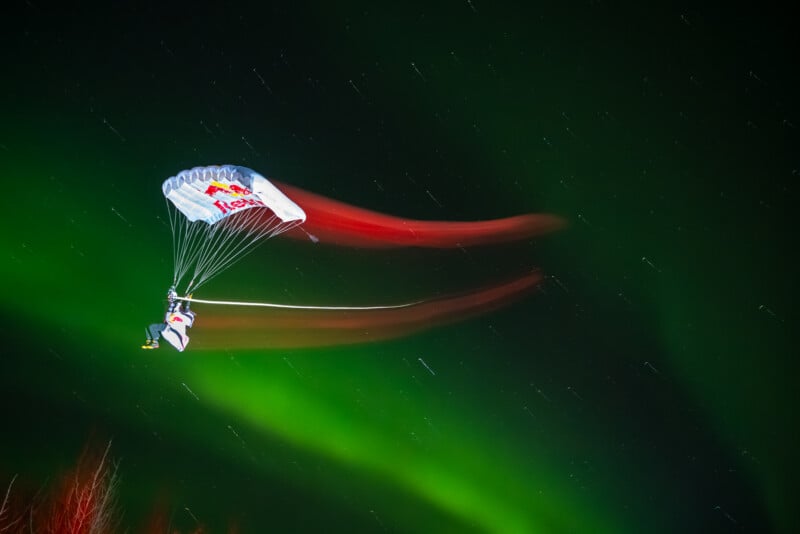 Mike Brewer wingsuit skydiving under the Aurora Borealis near Palmer, Alaska on March 23, 2026. Photo by Michael Clark.
 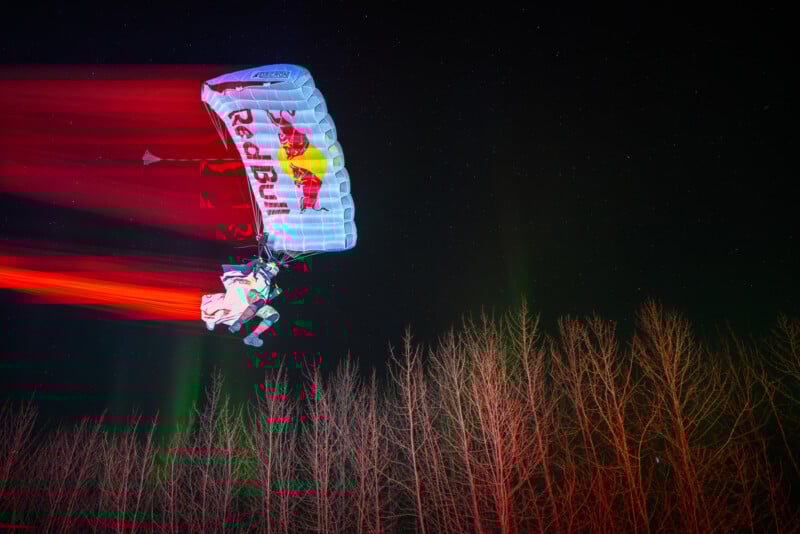 Jeff Provenzano wingsuit skydiving under the Aurora Borealis near Palmer, Alaska on March 23, 2026. Photo by Michael Clark.
 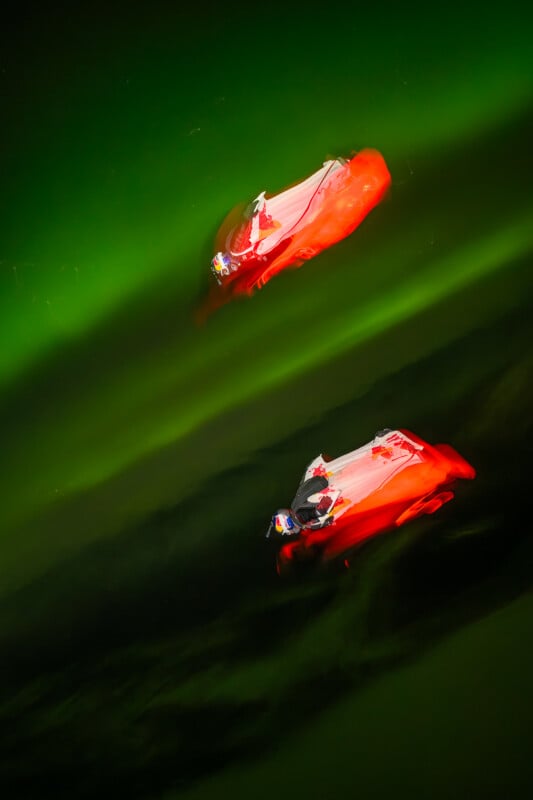 Jeff Provenzano and Jon DeVore wingsuit skydiving under the Aurora Borealis near Palmer, Alaska on March 23, 2026. Image by Mike Brewer (in collaboration with Michael Clark). The Moment of Magic
After years of planning and countless variables to manage, the culmination was brief but extraordinary. One skydive produced nearly all the images the team had envisioned. The combination of aurora light, wingsuit motion, LED glow, and careful timing resulted in visuals that exceeded even Clark’s long-held expectations.
“With this one skydive where everything aligned perfectly—the aurora, the wingsuits, the motion blur from the LEDs—it was everything we wanted and more. Seeing that after years of planning was magical. Everyone left buzzing with excitement, and I am still feeling that even days later,” Clark reflects.
For Michael Clark, projects like this are not just technical exercises. They are opportunities to push boundaries and explore uncharted territory in photography. He emphasizes that seeing the final images surpass the original concept is exceptionally rare, even in a thirty-year career. This project, however, is one of those moments.
“Creating images that are nearly impossible to pull off is what really gets me excited. Working with a team to create something completely new in the photographic space, this is why I do what I do,” Clark says.
Image credits: Red Bull, Michael Clark, Mike Brewer