
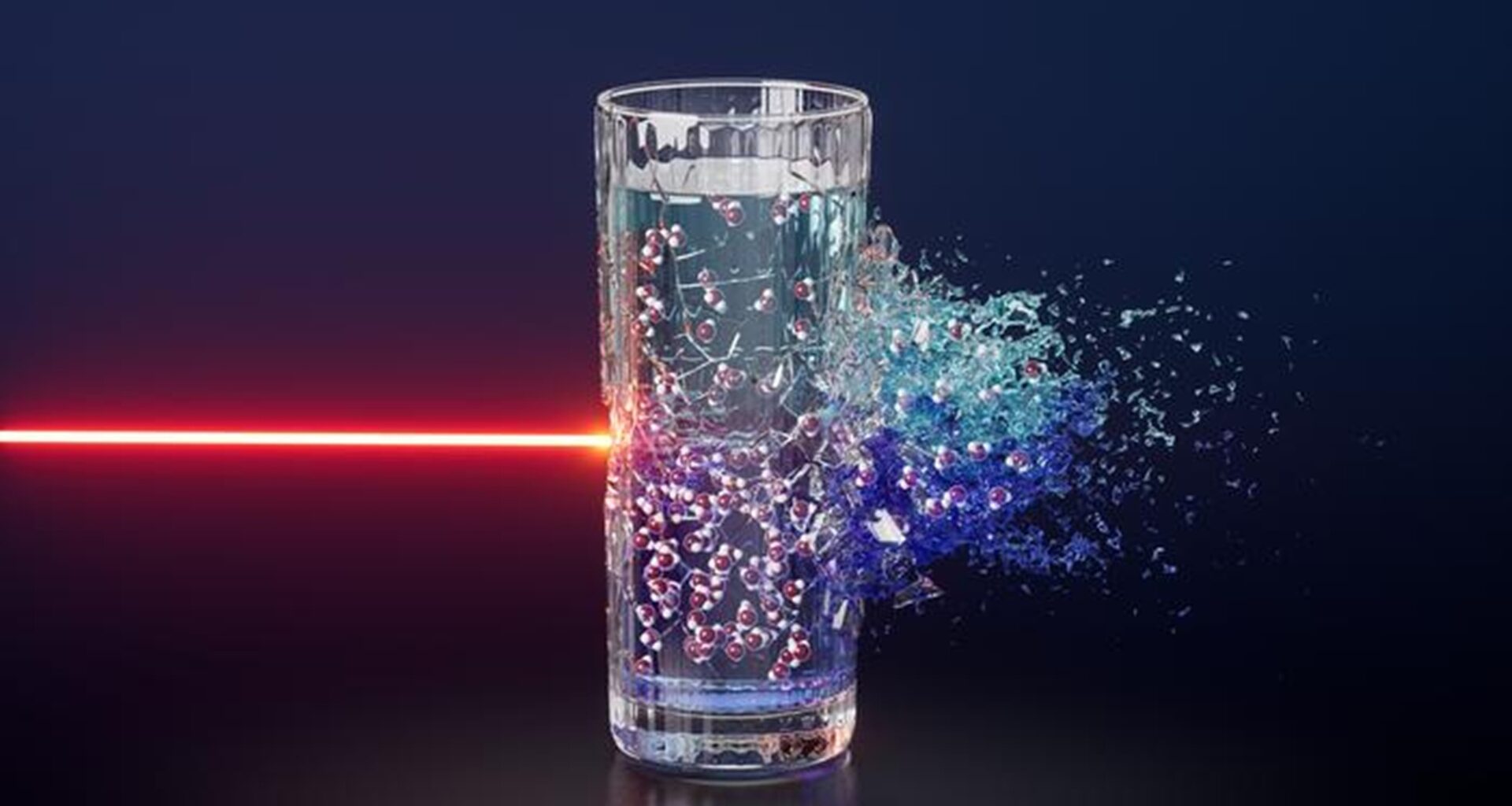
Scientists may have solved the long-standing mystery of why ice floats and why liquid water expands as it cools below 39 degrees Fahrenheit, after discovering evidence of a hidden liquid-liquid critical point in supercooled water.
Researchers at Sweden’s Stockholm University used x-ray lasers to determine the existence of the critical point at -81 degrees Fahrenheit (63 degrees Celsius) and roughly 14,500 pounds per square inch (1,000 atmospheres).
The find helps explain water’s odd behavior and its unusual properties, including the reason ice cubes float and how liquid water expands as its temperature drops below 39 degrees Fahrenheit (four degrees Celsius).
“What was special was that we were able to X-ray unimaginably fast before the ice froze and could observe how the liquid-liquid transition vanishes and a new critical state emerges,” Anders Nilsson, PhD, a professor of chemical physics at the department of physics at Stockholm University, revealed.
Water’s strange physics
Despite being essential for life, water has long puzzled scientists as it’s unlike any other substance. Its density, heat capacity, compressibility, and viscosity respond to changes in temperature and pressure in ways that defy typical liquid behavior.
Most materials shrink as they cool, and therefore become denser. Water, however, doesn’t follow this patter. Ice floats, and liquid water reaches its highest density at about 39 degrees Fahrenheit, causing colder, denser water to sink.
Moreover, if water is cooled below that temperature, it begins to expand. In pure water cooled below 32 degrees Fahrenheit, this expansion not only continues, but also speeds up.
“For decades there has been speculations and different theories to explain these remarkable properties and one theory has been the existence of a critical point,” Nilsson said. “Now we have found that such a point exists.”
To uncover this elusive state, the researchers turned to turned to ultra-fast X-ray laser pulses at facilities in South Korea. These pulses made it possible to observe water at incredibly short timescales for the first time ever, and fast enough to capture its structure before it crystallized into ice.
Iason Andronis, a chemical physics PhD student at Stockholm University praised the team’s achievement. “Many have dreamt about finding this critical point but the means have not been available before the development of the x-ray lasers.”
New state detected
The experiments revealed that water can exist at two distinct liquid phases at low temperatures and high pressures. These differ in how its molecules organize and bond. Under certain conditions, the distinction between them disappears entirely. The point where the two phases merge is the newly confirmed critical point.
According to the researcher team, this critical point could explain water’s distinct properties. The scientists believe they emerge from fluctuations between the two liquid states, even at ambient temperatures.
Simply put, ordinary water is constantly shifting on a microscopic level. The closer conditions are to the critical point, the stronger these fluctuations become.
The study also found that water’s molecular dynamics slow significantly as it nears the critical point. “It looks almost that you cannot escape the critical point if you entered it, almost like a Black Hole,” Robin Tyburski, PhD, a chemical physics researcher at the university, said in a press release.
According to Nilsson, the findings settle a long-standing scientific question and also open new avenues for research. “The next stage is to find the implications of these findings on waters importance in physical, chemical, biological, geological and climate related processes,” he added. “A big challenge in the next few years.”
The paper has been published in the journal Science.