
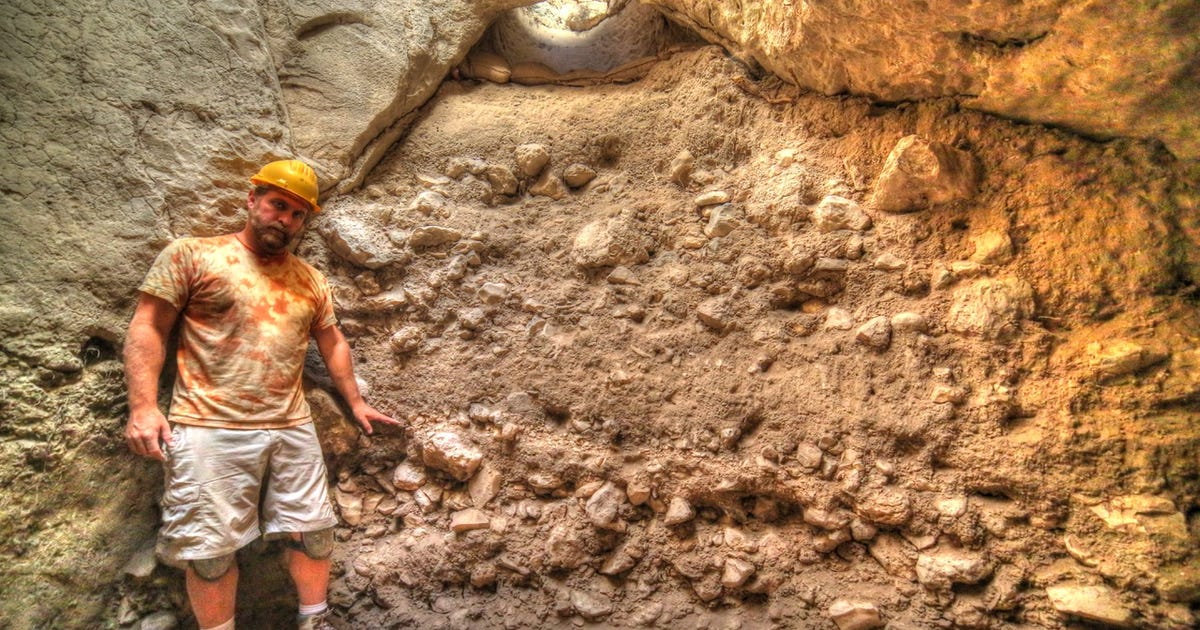
More than a decade ago, archaeologists investigating a cistern among the ruins of Azekah, an ancient town southwest of Jerusalem, made a gruesome discovery. The millennia-old water reservoir was not only filled with broken pottery and sediment washed in during centuries of abandonment, as one would expect. It also contained dozens of skeletons of children.
This mass grave for infants, most of them less than two years old, was likely in use during the Persian Period, some 2,500 years ago. It housed the fragile, jumbled remains of up to 89 individuals, the researchers say.
The unique and unsettling find helps explain an enduring archaeological mystery about the absence of young children in burials from this period and also sheds light on the beliefs and social norms of the ancient Israelites, they say. While analysis is still ongoing, the remains don’t appear to belong to victims of a massacre or a plague, a team of Israeli and German researchers reported Friday in the journal Palestine Exploration Quarterly. They suspect the cistern was used over decades to bury children who died of natural causes, in an era when infant mortality rates were very high.
Azekah is an ancient hilltop settlement overlooking the Elah Valley, probably best known as the setting for the biblical story of the duel between David and Goliath. It was first settled in the Early Bronze Age, more than 4,000 years ago, and was a prosperous Canaanite town until the end of the Bronze Age, in the 12th century B.C.E. After a period of abandonment in the Early Iron Age, it was rebuilt and incorporated into the Kingdom of Judah.
During its existence Azekah was destroyed and rebuilt multiple times and this tell, an accumulation of superimposed layers of habitation over millennia, has been intensely investigated by researchers of the ancient Levant.
 Close
Close
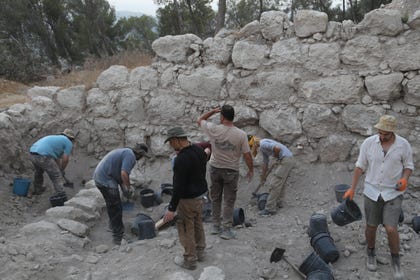
Excavating biblical Azekah, 2025 Credit: Oded Lipschits
Excavating biblical Azekah, 2025 Credit: Oded LipschitsRelated ArticlesCan’t touch this
Between 2012 and 2014, archaeologists excavated a cistern in the outer reaches of the town and discovered this unexpected mass burial, containing dozens of tiny skeletons, apparently accompanied by paltry grave offerings: mainly pottery and some jewelry, including beads, earrings and rings.
Part of the reason why the find has gone unreported for more than a decade was the difficulty researchers faced in dealing with such a gut-wrenching discovery of dead infants, says Oded Lipschits, a professor of archaeology at Tel Aviv University who leads the Azekah expedition.
“For several years, I didn’t touch it. It was a scary topic,” Lipschits tells Haaretz in a phone interview. “My own children were young at the time, so it was not easy.”
Eventually, the bones made their way to the anthropology lab at Tel Aviv University, and the researchers began to try to make sense of the shocking find.
 Close
Close
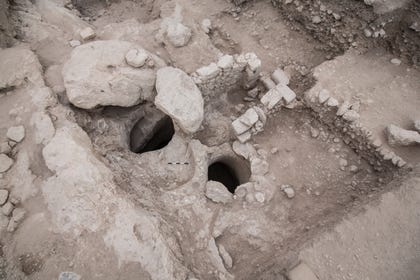
The two opening shafts and the staircase leading to the cistern Credit: The Lautenschläger Azekah Expedition
The two opening shafts and the staircase leading to the cistern Credit: The Lautenschläger Azekah Expedition
The cistern was originally used for its intended purpose, to store water, in Canaanite times, throughout the Middle and Late Bronze ages, and then again by the Israelites through the Iron Age (or the First Temple Period – if one prefers a reference to the biblical chronology).
At the bottom of the pit, the archaeologists found a layer of jars from the end of the Iron Age, suggesting the cistern went out of use at the time of the Babylonian conquest of Judah in 586 B.C.E., which resulted in the destruction of Jerusalem, Azekah and other major towns in the kingdom.
Following a few decades of abandonment during the Babylonian Exile, the city was repopulated once Judah and the rest of the Levant fell under Persian rule.
It was then that the cistern was repurposed as a mass grave, Lipschits and colleagues report.
Based on radiocarbon dating, as well as the types of ceramics and jewelry found in the pit, the grave was in use over the course of the 5th century B.C.E., when Azekah was part of the Persian province of Yehud, as Judah was called then.
Of the up to 89 people buried in the cistern, around 90 percent were under 5 years old, with more than 70 percent under 2, says Prof. Hila May, a physical anthropologist at Tel Aviv University. Only a handful of individuals – between two to eight – could be identified as older children or young adults, and we’ll talk about these few outliers later on.
 Close
Close
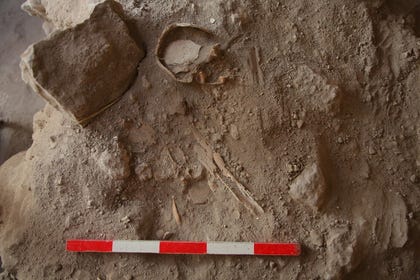
The upper body of one the buried children Credit: The Lautenschläger Azekah Expedition
The upper body of one the buried children Credit: The Lautenschläger Azekah Expedition
The fact that the grave was used over a relatively long time seems to rule out that the deceased were killed by a single event, like a plague or a massacre, May says. Also, no signs of violence or disease were found on the remains, which is not entirely conclusive, because not all pathologies and killing methods leave marks on bones, she cautions.
It is also possible that the grave housed unwanted babies, specifically girls, who in antiquity were sometimes abandoned and left to die. The fact that they were not all newborns would seem to make this unlikely. However, to fully check this hypothesis, the researchers are extracting DNA from the remains, because sexual dimorphism emerges only in puberty, so it is not possible to evince sex from children’s bones, May says.
In the meantime, the most likely explanation is that the burial was meant to house mainly children who died of natural causes before weaning, Lipschits says.
This is the way
In the Bronze Age Levant, as well as in earlier periods, children were often buried in jars under the floors of their family’s home. This custom disappeared in the Iron Age and the Persian Period, but infants are generally not found in the family cave burials that were typically used as graves in these eras. This despite the fact that in antiquity, and pretty much until the 18th century, around four out of seven infants did not survive, Lipschits notes.
“In every period they dealt with the loss of babies in a different way. I think that this was the way in the Persian and Iron Age,” Lipschits says. “I haven’t found a better explanation.”
 Close
Close
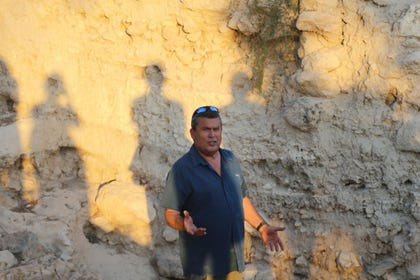
Prof. Oded Lipschits at Tell Azekah, July 2025 Credit: Oded Lipschits
Prof. Oded Lipschits at Tell Azekah, July 2025 Credit: Oded Lipschits
The separate burial of infants may have been a custom derived from the high mortality rate, which may have pushed society to avoid considering a breastfeeding child as an independent person, deserving of their own grave.
While weaning in modern societies often occurs around age one, in ancient societies it is believed to have been delayed until two or three, which would have improved the child’s survival chances – and also served as a natural form of birth control. This implies that the vast majority of the children found in the mass grave were un-weaned babies.
The Bible, large parts of which – most scholars agree – were first written in the Late Iron Age and the Persian Period, contains echoes of this attitude toward young infants, Lipschits and colleagues note. The end of breastfeeding is depicted as a major rite of passage, for example in Genesis 21:8, where Abraham holds a great feast for Isaac’s weaning. Then there is the story of the Prophet Samuel, conceived after his mother Hannah had vowed to give her son in service to God if she were granted a child. As 1 Samuel 1:21-23 narrates, Hannah gains a reprieve from fulfilling her vow until Samuel is weaned, indicating that, to some degree, children were not considered fully separate individuals by the ancient Israelites as long as they depended on their mother’s milk, Lipschits says.
 Close
Close
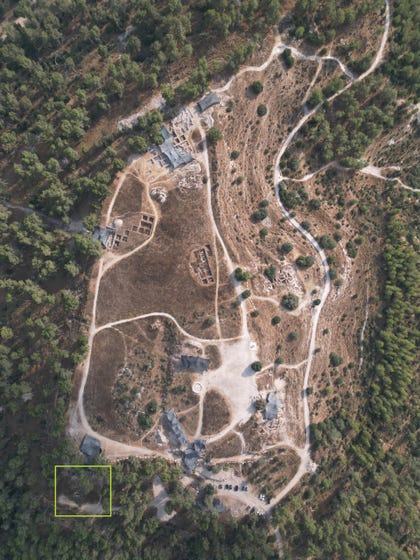
Aerial view of Tel Azekah and the location of the mass grave in the square at the lower left Credit: The Lautenschläger Azekah Expedition
Aerial view of Tel Azekah and the location of the mass grave in the square at the lower left Credit: The Lautenschläger Azekah ExpeditionGreek babies
Although the Azekah cistern is the first case unearthed in Israel, the idea of a separate, mass burial for infants is not confined to the ancient Levant, the archaeologists note in their study. A cemetery housing more than 2,400 infants, with no adults, was found on the Dodecanese island of Astypalaia,. Most of the burials there date to the 6th-5th centuries B.C.E., roughly the same time as the Azekah grave, the study says.
Hundreds of infants and fetuses dated to the 2nd century B.C.E. were also found buried in wells just outside the agora (the main square) of Athens and of Messene, in the Peloponnese.
All these discoveries are different from cases of clearly intentional disposal of newborns in antiquity, such as the infants found in a sewer under a Roman-era brothel in Ashkelon, on Israel’s Mediterranean coast, or the cremated bones of sacrificed children in the “tophets” of the Carthaginian cultural sphere, the Azekah team believe. Instead, these discoveries point to a cross-cultural phenomenon of separate mass burial for un-weaned children, victims of the high mortality rate in societies that didn’t consider them sufficiently formed individuals to warrant their own grave, the researchers say.
This doesn’t mean that parents in antiquity were not emotionally attached to their children or didn’t mourn when they died, May qualifies.
“We know people cared for their children in ancient times. Maybe parents were aware that their children had a higher chance of not surviving; that was their reality. But I don’t think this prevented them from connecting to them,” she says. “I think this burial custom is more a social question, it’s about their role in society and at what age someone was considered a full member of society.”
Assuming the interpretation of the mass grave is correct, we are left with the further enigma of the handful of older children or young adults who were also found there. Possibly they may have been individuals of very low social status, or people who died at a great distance from their family tomb and could not be transported, Lipschits says. Alternatively, they may have been young mothers who died in childbirth and were buried with their stillborn progeny, May suggests. Hopefully, the ongoing genetic analysis will give us more answers.