
DEVELOPMENT PLANS:
Efforts are under way to promote the nation’s self-sufficiency in semiconductor materials and equipment, assisting companies, government officials said
By Chung Li-hua / Staff reporter
The Executive Yuan has determined 13 strategic industries as the focus of Taiwan’s development this year, including key minerals, essential public infrastructure and urban renewal projects, government officials said.
The 13 strategic industries are: the semiconductor industry, artificial intelligence (AI), silicon photonics and quantum technologies, AI robotics, defense manufacturing, security and control, next-generation communications, critical minerals, biotech and healthcare, an Asian asset management hub, essential public infrastructure and urban renewal, cultural and creative industries, and the tourism industry, they said.
In the semiconductor sector, the nation’s overall output reached NT$6.5 trillion (US$203.9 billion) last year, the Executive Yuan said, adding that it ranked second in the world.
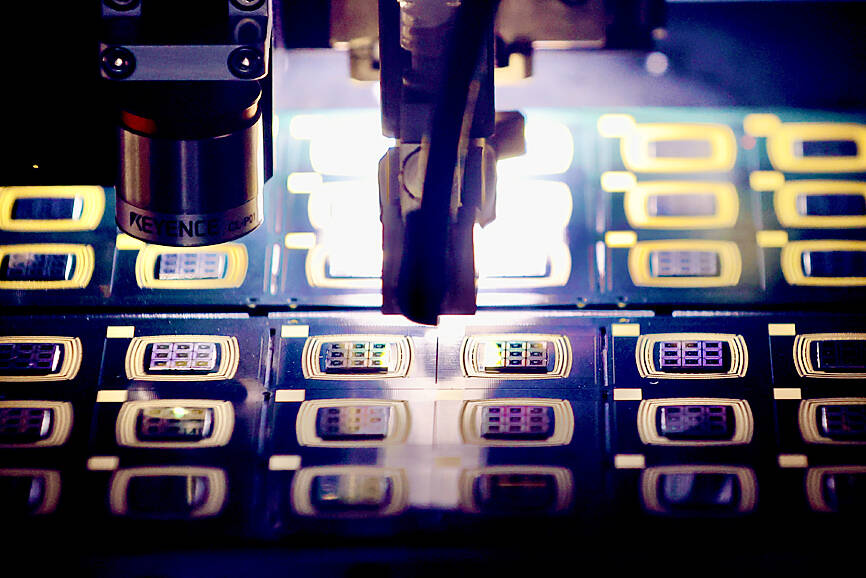
Photo: Ritchie B. Tongo, EPA-EFE
Building on the new top 10 AI initiatives and the five major “trusted industries” policies, Taiwan’s global AI ranking improved from 26th in 2023 to 16th last year, with the digital economy — including AI — now generating about NT$2 trillion in value, Cabinet data showed.
Construction of an advanced semiconductor research and development base in Hsinchu began last month to support production lines for advanced processes, officials said.
Efforts are also under way to promote self-sufficiency in materials and equipment, assisting companies in completing verification of semiconductor material and equipment production lines, they added, estimating that it would generate an additional output of about NT$20 billion.
Last month, the Executive Yuan also approved a quantum computing mainframe construction project that is aimed at establishing Taiwan’s first shared quantum computing core infrastructure by 2030, they said.
Meanwhile, referring to January’s Taiwan-US Economic Prosperity Partnership Dialogue, during which the two sides signed the Silicon Prosperity Declaration and the Joint Statement on Taiwan-US Economic Security Cooperation, the officials said that Taipei and Washington agreed to bolster cooperation in areas such as the mining, refining and exploration of critical minerals.
The Ministry of Economic Affairs would this year launch a critical minerals value-added application promotion project and establish a pilot production line within three years to meet 50 percent of domestic demand, laying an important foundation for enhancing the nation’s self-sufficiency in critical materials, they added.
As for essential public infrastructure and urban renewal, public construction spendings last year were estimated to be about NT$813.7 billion, the highest level in 18 years, they said.
With the amendment to Article 65 of the Urban Renewal Act (都市更新條例), the scope of the “original building floor area” eligibility has been expanded, with an estimated 270,000 aging buildings nationwide expected to be included, they added.